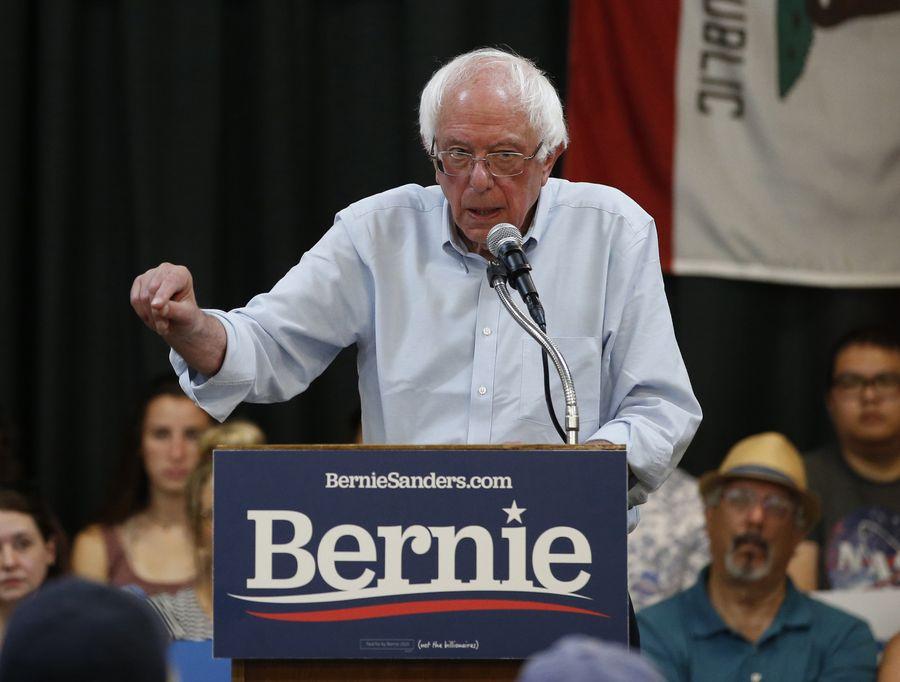
Democratic presidential candidate Sen. Bernie Sanders, I-Vermont, speaks at a climate focus town hall meeting in Chico, Calif., Thursday, Aug. 22, 2019. Sanders on Thursday released a $16.3 trillion plan to combat changed. (AP Photo/Rich Pedroncelli)
How Sanders' Climate Plan Could Divide Progressives
COMMENTARY
Published Aug. 26, 2019 • Read time: 6m
Elizabeth Warren has been the buzziest of the two most left-wing candidates in the Democratic presidential primary. Her steady production of ambitious plans has kept her campaign fresh, and fueled her rise in the polls. Bernie Sanders’ most loyal supporters often praise his consistency — as his rhetoric and positions are largely unchanged from the 1980s. But consistency and freshness don’t always go hand-in-hand, and his level of support in the RealClearPolitics national poll average has been essentially flat since May.
Sanders’ new climate proposal is different. It’s not what he has supported in the past. It is more ambitious, and more socialist, than his 2016 climate plan of a carbon tax. More than a climate plan, it is a vision of a restructured society. And in all likelihood, no other Democratic candidate will be willing or able to match its ideological reach, most especially Warren.
The plan hinges on public investment to create 20 million jobs (and “ending unemployment”) in support of producing clean energy, with a goal of using only renewable energy for all of our electricity and transportation needs by 2030. Sanders also envisions an enormous expansion of government’s role in the economy, with a mix of outright socialism and government support for small enterprise. The renewable energy would be “publicly owned,” as would new broadband infrastructure. Billions in public investment would be made in small family farms, local food processing and grocery co-ops.
The government’s posture towards the energy and farming industries would abruptly shift. Sanders would “massively” raise taxes on “corporate polluters’ and investors’ fossil fuel income and wealth” to help fund the program (though he does not get specific on tax rates, and is silent on whether the plan would include a carbon tax). He would direct the Justice Department to ferret out and prosecute any climate-related crimes committed by the fossil fuel industry. And he would “break up big agribusinesses,” ban natural gas fracking, and refuse to renew nuclear power licenses.
Sanders Seeks Caucus Trifecta Win to Close Delegate Gap
Sanders Fighting Perception He Can't Overcome Clinton Edge
Clinton Targets Trump as Sanders Circles
Sanders, Clinton Differ Sharply at Flint Debate
Sanders doesn’t duck the price tag: $16.3 trillion over 15 years. But for his short-term political purposes, that number is a feature, not a bug. No other candidate comes close to the amount of public funding Sanders is pledging to address the climate crisis.
Kirsten Gillibrand’s far less detailed plan proposes “$10 trillion in public and private funding” over 10 years, but didn’t break down how much would be public and how much private. Joe Biden and Beto O’Rourke offer similar amounts of public money ($1.7 trillion and $1.5 trillion, respectively, over 10 years) in hopes of attracting additional private monies to boost the overall investment to $5 trillion. Warren ponies up slightly more than Biden and O’Rourke, $2 trillion, for “researching, developing, and manufacturing clean energy technology.” (Other candidates such as Kamala Harris, Pete Buttigieg and Cory Booker have yet to offer specific climate plans.)
By pushing — or more accurately, shoving — the parameters of the climate policy debate, Sanders is squeezing Warren. Underneath the friendliness the two exhibit for each other, they are fiercely competing for left-wing voters who want an uncompromising president with an uncompromised agenda. Warren is now stuck with two unappealing choices. She could belatedly copy Sanders. Or she could quietly cede the climate issue to him and try to keep the focus on her own set of signatures issues.
Neither choice is appealing. Warren has already copied Sanders once, on health care, and it remains one of her weak spots. “I’m with Bernie on Medicare for All,” she said at the first presidential debate. But saying you’re with someone else on an issue forces you to defend whatever that person says about that issue. Case in point: Warren has been clearly uncomfortable, and refuses to answer directly, when asked if she agrees with Sanders’ candid assertion that a single-payer health insurance system would require higher taxes on the middle class.
And since she doesn’t talk as much about Sanders’ health insurance plan and her own plans on certain other issues, some voters detect a difference in commitment. One Sanders supporter recently told HuffPost, “I’m not saying Warren won’t support people to have health care, but it might just mean it’s not her priority when she’s in office.” As it stands, Warren doesn’t talk about climate as much as her proposals to address economic inequality (while she does have a set of fragmentary climate proposals, she has refrained, so far, from issuing a comprehensive climate strategy). Simply saying “I’m with Bernie on climate” might also draw attention to a difference in prioritization.
Warren may not want to copy Sanders’ climate plan if she doesn’t fully agree with it. For example, while Sanders wants to solve the crisis with the full force of the federal government, Warren, who has referred to herself as a “capitalist,” has said she believes in “using the power of public markets to accelerate the adoption of clean energy,” which she would facilitate by forcing publicly traded companies to disclose their “climate-related risks” and, in turn, “push more investors to move their money out of the fossil fuel industry.” Therefore, she may conclude that matching Sanders isn’t desirable on the policy merits, and will cede the issue to him.
Climate, however, isn’t just any issue. To environmentalists, any climate solution short of perfect will result in planetary calamity. To some democratic socialists who have championed the Green New Deal, the climate crisis is a unique opportunity to transform the economy and vanquish capitalism. Those voters may not be enough to win the Democratic presidential nomination. But they are likely to stay loyal to the candidate who has the most aggressive climate strategy.
Not only does Sanders’ bold climate plan further complicate Warren’s ability to consolidate the left-wing vote, it may also expose rifts within the progressive movement, between advocates of socialism and regulated capitalism, and between those who prioritize environmentalism and those who prioritize reducing economic inequality. And anything that creates disunity among progressives weakens their ability to exert influence over the Democratic Party.
Of course, Sanders’ ambition and detail have their upsides for progressives. As he did to the health care debate, he has moved the “Overton Window” of the climate debate, broadening the spectrum of ideas that are part of our discourse and making other progressive plans look more moderate and feasible. But at some point, progressives need to unify around a candidate and a platform, if they want to maximize their power. So long as there is a clear divide between Sanders and Warren, unity will be elusive.

A RealClear Thanksgiving: Investing in a Better Future
David DesRosiers • RealClearPolitics
Trump’s Newsom Problem: Antagonist-in-Chief
Carolina Lumetta • RealClearPolitics
America’s Free Spirit
John Maxwell Hamilton • RealClearPolitics
The GOP Majority Should Go Out in Glory
Daniel McCarthy • RealClearPolitics
Republican Majorities Could Return Sooner Than Expected
J.T. Young • RealClearPolitics
The Danger Before the Attack
Leslie J. Sullivan • RealClearPolitics
RCP Today
Top stories on RealClearPolitics
The Takeaway
Polling intelligence and analysis delivered to your inbox
World News
Featuring the latest world news
Policy
Featuring the latest policy news
Support Our Mission
As part of RealClearPolitics, authors aim to provide balanced, non-partisan analysis by presenting top reporting and commentary from all sides of the political spectrum.
Trusted by policymakers and citizens alike since 2000