Pretenders or Contenders: Why Do Long Shots Run?
Published June 26, 2019 • Read time: 18m
Twenty-five men and women are running for the presidential nomination that Democrats will bestow next summer in Milwaukee. Just a handful of these candidates are household names. Some are accomplished, if little-known, party back-benchers. Others are utterly unknown. Only seven of the 25 are polling over 2%. The latest to join the field was former Pennsylvania Rep. Joe Sestak. Never heard of him? Don’t feel bad; even political junkies were pulling out their dusty old Almanac of American Politics as a refresher.
With the first candidate debate taking place this week in Miami – the field is so large, it’s taking place over the next two nights – the question arises: Why are so many long shots and no shots mounting bids for the White House?
Looking at the field closely, these candidates seem to fit into four, or maybe five, categories. All of these archetypes have predecessors in previous U.S. presidential elections, and when you break it down this way, there is a method to their madness. The categories range from candidates who have reason to believe they could balance out a national ticket nicely to those expecting a miracle. A handful have a message they believe their political party — and the rest of their fellow Americans — need to hear. A few are hoping to sell books, or themselves. Some are simply marching to a beat that only they can hear.
“It’s important for people to follow their own star and own convictions in an election as opposed to succumbing to the self-fulfilling prophecy of pundits,” says Dennis Kucinich, who ran similar long-shot presidential bids in 2004 and 2008. “If people want to run, let them. That’s fundamental.”
Lies, Assault and Cover-ups Don't Stop Donald Trump
Trump Stands by His Man; Obama on a Health Scourge; Hayden Interview; Reagan's Courage
Analysis: For Trump, Few Limits to Win-At-Any-Cost Approach
What If Clinton Isn't Indicted?
Lightning-in-a-Bottle Democrats
If history is our guide, Bill de Blasio, Pete Buttigieg, and Wayne Messam will not be nominated. The reason is simple: Neither major political party has ever conferred its presidential nomination on a mayor. Now it’s true that not all cities are created equal: De Blasio is mayor of New York, a town with a population about equal to that of the three states where front-runners Joe Biden, Bernie Sanders and Elizabeth Warren come from -- combined. Yet, according to bookmakers, de Blasio’s odds are 100-1, while Mayor Pete is 20-1. (Messam, mayor of an obscure Florida city, isn’t even listed.) Julián Castro probably belongs on this list, too. Although he served in President Obama’s cabinet, his claim to fame is his time as mayor of San Antonio, Texas.
Gabbard hopes to make the rare leap from the House to the Oval Office.
AP Photo/John Locher
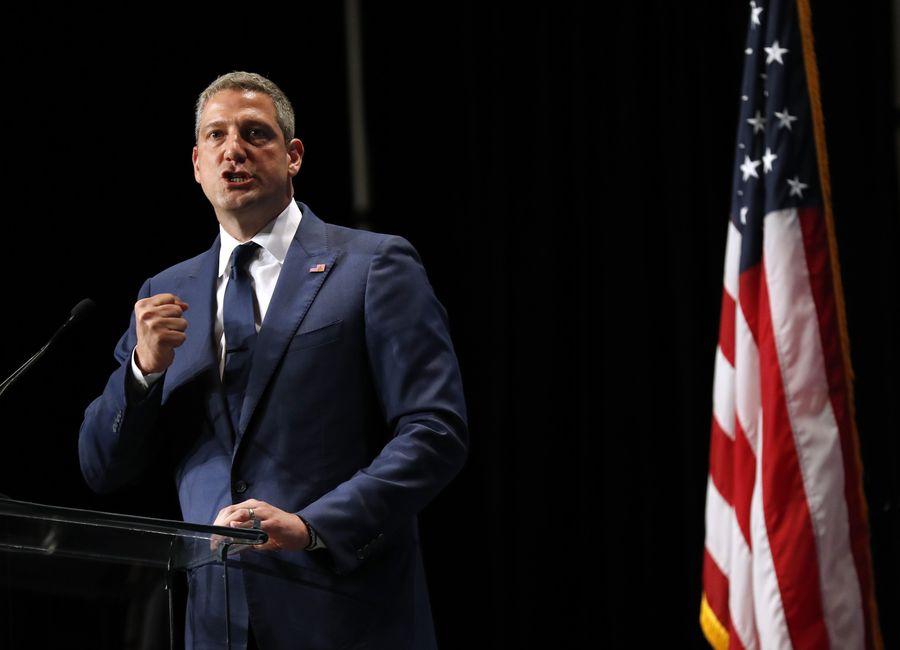
And if the past is truly prologue, the following candidates have no business running, either: John Delaney, Tulsi Gabbard, Seth Moulton, Beto O’Rourke, Tim Ryan (pictured above), Eric Swalwell, and Sestak. This group, let’s call them the Magnificent Seven, are members of the House of Representatives, or in the case of Delaney, O’Rourke, and Sestak, former members. The last time a House member ascended to the presidency was 1880 when James A. Garfield did it. But Garfield was a decorated Civil War general who was a newly elected senator at the time he became president.
Speaking of senators, it’s not that Michael Bennet, Cory Booker and Kirsten Gillibrand are necessarily unqualified to run for president, it’s that their path to the nomination is a mystery and none of them have even reached 3% in the RealClearPolitics polling average. The same is true of governors or former governors John Hickenlooper (Colorado), Jay Inslee (Washington state), and Steve Bullock (Montana). Ditto for former Alaska Sen. Mike Gravel, self-help guru Marianne Williamson, and Silicon Valley entrepreneur Andrew Yang.
But the 2020 Democratic long shots have some history on their side as well. It starts with the improbable surge in Iowa seven years ago by underfunded but highly motivated Rick Santorum. On Dec. 1, 2011, the former Pennsylvania senator was under 4% in a Des Moines Register poll despite visiting all 99 counties in the state. Yet only one month later he surged into a dead heat with Mitt Romney, and was the last man standing other than front-runner Romney the rest of the way.
The patron saint of long-shot presidential candidates also made his mark in Iowa. Jimmy Carter, then the former one-term Georgia governor, practically lived in the Hawkeye State in 1975. His victory there propelled him to the Democratic nomination, and the White House. “It seems apparent that the more the public has gotten to know Jimmy Carter, the more they have gotten to like him,” reported the Christian Science Monitor in 1975.
Against all odds, a few quixotic 2020 candidates are hoping for their own Santorum surge or Carter conquest. Augmented by the television audience that the Miami debate stage presents, they foresee themselves rising in the polls.
Andrew Yang speaks during the Iowa Democratic Party's Hall of Fame celebration.
AP Photo/Charlie Neibergall
“There’s an interesting thing going on in our campaign where our poll numbers have continued to rise, but our name recognition is still relatively low,” Randy Jones, the press secretary and director of political affairs for Andrew Yang, told RCP. “And what that means –– more so than any other candidate in this race –– is that when people hear Andrew Yang’s message, they support him. There’s a direct correlation there.”
Patricia Ewing, Williamson’s communications director, said the successful author is looking to attract independent voters. Although Williamson is polling under 1%, Ewing said voters in early states are still waiting to decide on a candidate.
“When you go to a Democratic event in Iowa, people don’t wear [campaign] gear,” Ewing told RCP. “The voters know in these states that they have the power, and they’re holding out. For people like Williamson, that’s very good. The more we talk to them, the more we convince them that she’s the right choice.”
Moulton’s campaign press secretary, Matt Corridoni, agreed. “It’s a pretty wide-open field,” he said. “Polling at this stage in the game is super unpredictable –– with 25 people in the race, it’s hard to get an accurate, scientific count of whose support is where, especially when people’s support is so soft, especially when everyone has multiple candidates that they are looking at.”
Gillibrand and her campaign are holding out for a boost in the polls come fall. Though she has yet to break 2%, the New York senator has convinced herself she can win the Democratic nomination.
“I just know that I will prove myself over time, and I know that I can win and I will win,” Gillibrand told The Atlantic. “I just have to do what I do, which is campaign directly.”
Williamson herself could admire such positive thinking. And in fairness to them all, a more current success story than Jimmy Carter’s is right in front of them. Only three years ago this month, Donald Trump was polling under 6%, behind a slew of Republican candidates. Months later, Trump was on top. And though they rarely cite him as their inspiration, some two dozen Democrats are trying to take President Trump’s job by emulating him.
Vice Presidential Hopefuls
Although none of the candidates RealClearPolitics reached out to would confirm that their more realistic hope is being selected as a nominee for vice president, the basic exigencies of ticket-balancing suggest this is the case.
With a politically moderate, elderly, white, male Washington insider as the front-runner, it’s practically an article of faith among party activists that if Joe Biden is the nominee, he’ll be obliged to recruit a running mate who reflects the changing identity and message of the Democratic Party. His short list, then, might include the cadre of candidates polling directly behind him such as Sens. Warren, Harris, Booker (although Booker is on the record as saying the VP choice has to be a woman).
On the other hand, if Warren, Harris, Sanders, Booker, or Buttigieg were to win the top spot, Democrats might decide they need to counter-balance the nominee’s progressive tilt.
John Hickenlooper brings gubernatorial experience and appeal to Western voters to the race.
AP Photo/Meg Kinnard
Hickenlooper, a self-proclaimed “extreme moderate” and “pragmatic progressive,” could fit the bill. The former governor of Colorado cites ending the nation’s “crisis of division” as the reason he’s running for president.
Similarly, Delaney seems to be positioning himself for just such a possibility. The former Maryland congressman identifies himself as a “pragmatic idealist.” In an op-ed he wrote for the Washington Post, Delaney cites his love of country for behaving differently in politics. His willingness to compromise for the sake of a solution reflects the optimistic attitude needed for serving as VP. Bennet and Bullock both boast strong bipartisan track records in Western states.
Ohio Rep. Ryan touts an ability to speak to disaffected Midwestern voters, whom Democrats failed to win over in 2016 despite their famous “blue wall” that had stood since 1992. After nearly 17 years in Congress, Ryan will be aiming to gain support from voters in early states. His communications director, Mike Zetts, told RCP that Iowa and New Hampshire are akin to the Buckeye State.
“They have the same problems. They have factories, businesses, warehouses and neighborhoods that lay vacant,” Zetts said. “They have jobs that don’t pay enough to make ends meet. When Rep. Ryan goes to these places, his message resonates with people.”
Could Ryan deliver Ohio to the Democrats? That’s the kind of question raised about VP choices every four years, and it applies to others in the field, including Sen. Amy Klobuchar, who has gained name recognition as a pragmatic Midwestern moderate, particularly during her cross-examinations of now-Justice Brett Kavanaugh during his contentious confirmation hearings last fall.
In modern politics, VP decisions are made by the nominee, not his party, although activists exert pressure. In 1984, Klobuchar’s fellow Minnesotan, Walter Mondale, was persuaded to put the first woman on a national ticket. He carried only one state against President Reagan that year, but the electorate’s expectations may have evolved since then.
Four years earlier, Reagan resisted the temptation of choosing a “Dream Ticket” with former President Gerald Ford as his running mate. Instead, Reagan chose the man who finished second to him in the 1980 GOP primaries, George H.W. Bush. That’s another calculation for 2020 also-rans: Maybe finishing second is good enough, at least to get on the ticket. Or, perhaps, just behave during the debates in a way that endears you to the eventual nominee. A certain 2020 front-runner certainly knows about that precedent. Barack Obama didn’t pick the Democrat who ran second to him in 2008. He picked Joe Biden.
‘John the Baptist’ Democrats
Although this year’s field is unprecedentedly packed, the phenomenon of long-shot primary candidates running on a particular message is nothing new.
In 1944, the austere governor of Minnesota, Harold Stassen, sought the Republican nomination for the first time. He would do so eight more times before his death, and even offered to run alongside Sen. Bob Dole as an 89-year-old.
Despite eventually becoming a punch line, in Stassen’s mind he was doing this for the best of reasons: out of true conviction. “I sometimes wish people would ask not how times I’ve run a campaign, but how many times I’ve been right on the big issues,” he once told the Washington Post. As a liberal, antiwar Republican, he opposed Vietnam, and ran serious campaigns, offering a different vision for a party that he saw as drifting rightward.
Who fits that paradigm this time?
Sen. Gravel rose to fame by reading the previously verboten Pentagon Papers into the congressional record, spurring the opening of a Supreme Court case in his name. Under the slogan “End All Wars,” Gravel has roundly criticized front-runner Biden’s policies, advocating for a non-interventionist and environmentalist America. Gravel told Fox News that while he planned to make the debate stage (which he did not qualify for), he plans “to drop out after that and endorse the most progressive candidate,” committing himself firmly to his prescribed agenda.
Seth Moulton's resume includes combat experience as a U.S. Marine.
AP Photo/Charlie Neibergall
Rep. Moulton and former Rep. Sestak have also made foreign policy and national security their signature issues. Sestak told RCP his experience as a U.S. Navy admiral for 31 years gave him a broader and deeper understanding into global leadership. “I’m back for a national purpose, to restore our leadership in the world under a united America. That’s our epic challenge,” he said. “I want to restore that sense of trust in the presidency of the United States.”
Moulton’s press secretary, Corridoni, told RCP that Trump is going to be harder to beat than most Democrats are willing to admit, but Moulton’s experience in combat as a Marine gives him an edge.
“Going for him personally just doesn’t work,” Corridoni said. “We need to attack his ability to lead or lack thereof. One of the places we think he’s weakest, that other candidates in the field don’t have the same credibility to take him on, is as commander-in-chief. We know the other candidates don’t have the same background or biography to do that.”
Other issue-based candidates have emerged in the field. Jay Inslee is emphasizing climate change as the concern he thinks is paramount. Steve Bullock wants to rid U.S. politics of “dark money.” Sporting an eye-catching pink website, Gillibrand has made women’s rights and LGBT rights hallmarks of her campaign.
“I believe that reproductive rights are human rights, they are civil rights, and they are non-negotiable,” she told The Atlantic. “The attacks we’ve seen from Republicans in states like Alabama and Georgia represent the greatest threat to women’s reproductive rights since Roe ... which is why I’ve made this a major platform for my presidential campaign.”
Political outsiders Williamson and Yang have tried to make a mark with their own signature policy positions. Williamson proposes a cabinet “Department of Peace,” whereas Yang is pushing a unique idea – a “Freedom Dividend” of $1,000 per month paid to every adult over the age of 18.
Does a guaranteed government check like that sound crazy? To many people it does -- and maybe it is. But a Department of Peace was proposed by Benjamin Banneker and Founding Father Benjamin Rush in the 18th century. And other ideas have similarly been proffered before their time. Just ask the patron saint of idea-based presidential candidacy.
“I’m the voice for getting out of Iraq,” Dennis Kucinich told moderator Larry King during a 2004 presidential debate. “For universal single-payer health care. For getting out of NAFTA and the WTO. For having our children go to college tuition-free.”
“You’re here to make statements then?” King asked. Yes, he was, and Kucinich wasn’t finished. He was for same-sex marriage as well as universal health care coverage. Fringe issues then, they are part of the Democrats’ catechism today. His party wasn’t ready him 15 years ago – Kucinich didn’t even carry his own congressional district in the Ohio primary – but he looks like an oracle today.
Dennis Kucinich made quixotic runs for president in 2004 and 2008.
AP Photo/Tony Dejak
“I feel like Johnny Appleseed,” he told the New York Times at the time. “I’m planting seeds all over this country: seeds of peace, seeds of hope. At some point, maybe years from now, there will be orchards.”
Resume Builders
In June 2007, Gov. Mike Huckabee of Arkansas polled at roughly 2.5% nationally, lagging behind four other established candidates. Although Huckabee would win the 2008 Iowa caucuses, he was out of the race by March 4. In the process, however, he went from being a regional Republican to a national figure in conservative circles. His reward was a prime-time Fox News slot, which he abandoned in 2016 to once again try for the GOP nomination.
Not every losing candidate will get his or her own television show, but there are other goodies. In the 2012 presidential cycle, two Republican candidates – Newt Gingrich and Herman Cain – raised eyebrows for how unabashedly they promoted their own books on the campaign trail. Early in the campaign, Drake University political scientist Dennis Goldford wondered aloud, “Is the book there to sell a presidential candidacy [or is] the candidacy there to sell the book?” Drummed out of the race by sexual harassment allegations, Cain’s memoir got a little ahead of itself: The title was “This Is Herman Cain: My Journey to the White House.”
When asked directly if he was running in hopes of landing a TV show, a la Mike Huckabee, he gave a priceless answer: “If you know Herman Cain, nothing is further from the truth. If you don’t believe me, I invite you to get a copy of new book … because they are selling like hotcakes.”
Self-interest is not always financially remunerative. There are other perks of peddling a presidential campaign. Among this year’s Democratic Party long shots, Reps. Ryan, Moulton, Gabbard and Swalwell have consistently called for changes in leadership of the House Democrats, while openly putting themselves forward as younger voices within the party. All but Ryan belong to the Future Forum, a caucus of millennial Democrats that Swalwell chairs and Moulton vice-chairs.
Gabbard and Swalwell also hail from states with aging Democratic senators who will someday need replacing. Do presidential bids burnish high-profile Senate campaigns in the future?
Although Julián Castro served as the secretary for Housing and Urban Development under Obama, the 2020 election sets up a platform for him to build his name recognition and possibly join his brother, Rep. Joaquin Castro, during the next election cycle in a statewide race in Texas. Castro, like Pete Buttigieg, certainly cannot be faulted for wanting to demolish glass ceilings. No Latino has ever been president of the United States. Nor has an openly gay man. Buttigieg is carrying a generational banner as well: He’d be the first millennial president.
Another mayor, de Blasio, cites a parochial rationale for running, but it’s not pure self-interest. According to a Quinnipiac Poll from April, de Blasio’s approval rating as mayor shifts between 42% and 44%. With such underwhelming numbers, de Blasio has centered his campaign on making living conditions better for residents in New York City. While a ticket to the White House seems unlikely, the 2020 election could bolster support for his next run as mayor.
Bill de Blasio speaks here to Iowa Democrats, but are New Yorkers his true target audience?
AP Photo/Charlie Neibergall
“I am concerned that … right now our federal government is not helping New York City in a whole host of ways and we’re being hurt all the time by bad policies in Washington,” de Blasio said at a news conference in April. “Real changes are needed in our country. If they don’t happen, New York City continues to suffer.”
With no experience in political office, tech entrepreneur Yang brings non-traditional campaign tactics to promote his own interests and message. He has appeared on a score of podcasts, late night shows, and news segments, which range in their political affiliation from conservative media like “The Ben Shapiro Show” and Fox’s “Tucker Carlson Tonight” to Bill Maher’s and Trevor Noah’s left-leaning late-night shows.
Beyond the explicitly political benefits, Yang hopes to make himself a scion of pop culture, as self-dubbed “Yang Gang” supporters have taken to corners of the internet to trumpet their candidate. Yang also has appeared on the wildly popular Joe Rogan podcast, distinguishing himself as a candidate who thrives in cyberspace.
“The top podcast audiences now are significantly larger than cable news viewership,” Yang told Brian Stelter on CNN's “Reliable Sources.” “And so certainly the Joe Rogan podcast has been seen on YouTube 3 million times alone, just on YouTube, and was seen millions of more times in audio format and others.”
Similarly, self-help author Williamson brings a creative approach to promoting her brand. In her campaign biography, she explicitly references her canon of books. Her debut title, “Healing the Soul of America,” particularly speaks to “a lot of the policy plans she’s talking about,” her communications director Patricia Ewing told RCP. Williamson has another book called “A Politics of Love: Handbook for a New American Revolution” set to hit the shelves in spring 2020.
If you’re a professional author, selling books is not a bad side benefit of running for president. Recent history suggests, however, that maybe, just maybe, anyone can grow up to be president. Four years ago, as he began his seemingly quixotic quest for the Oval Office, speculation abounded as to why Donald J. Trump was running. He was a fading reality-TV host whose real estate model had largely devolved into licensing his name to people who actually constructed the buildings. Some thought it was just ego, others thought he wanted to go Mike Huckabee one better — create an entire television network, not just a show. There’s also some evidence he was trying to jump-start a massive Moscow real estate deal.
The real reason, according to an author from Marianne Williamson’s world, acclaimed psychologist Guy Winch, is quite basic -- and it applies to Donald Trump and most of the 25 Democrats running for president: They are running because they think they’d be great at the job.

A RealClear Thanksgiving: Investing in a Better Future
David DesRosiers • RealClearPolitics
Trump’s Newsom Problem: Antagonist-in-Chief
Carolina Lumetta • RealClearPolitics
America’s Free Spirit
John Maxwell Hamilton • RealClearPolitics
The GOP Majority Should Go Out in Glory
Daniel McCarthy • RealClearPolitics
Republican Majorities Could Return Sooner Than Expected
J.T. Young • RealClearPolitics
The Danger Before the Attack
Leslie J. Sullivan • RealClearPolitics
RCP Today
Top stories on RealClearPolitics
The Takeaway
Polling intelligence and analysis delivered to your inbox
World News
Featuring the latest world news
Policy
Featuring the latest policy news
Support Our Mission
As part of RealClearPolitics, authors aim to provide balanced, non-partisan analysis by presenting top reporting and commentary from all sides of the political spectrum.
Trusted by policymakers and citizens alike since 2000