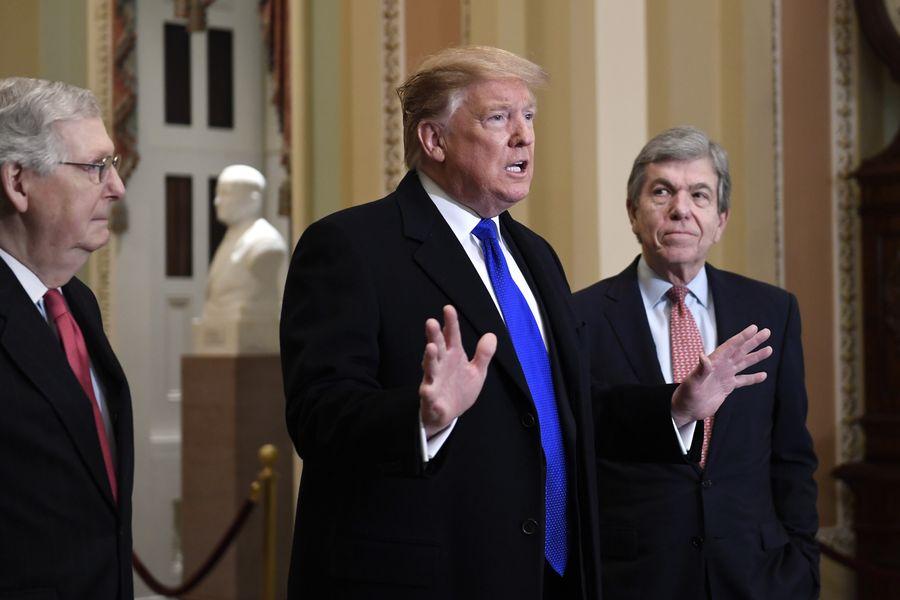
President Donald Trump accompanied by Senate Majority Leader Mitch McConnell of Ky., left, and Sen. Roy Blunt, R-Mo., right, speaks to members of the media as he arrives for a Senate Republican policy lunch on Capitol Hill in Washington, Tuesday, March 26, 2019. (AP Photo/Susan Walsh)
Mr. President, a Nuclear EMP Attack Is Mostly Science Fiction
COMMENTARY
Published March 28, 2019 • Read time: 4m
A nuclear device detonating at the precise point in our atmosphere to cause an electromagnetic pulse capable of destroying our nation’s electrical grid is the stuff of science fiction. Literally, it’s the plot of “One Second After,” a novel by William Forstchen. In the book, a hostile government attacks the U.S. by detonating a guided nuclear missile over North Carolina, causing a massive EMP. Chaos then ensues, including nuclear power plant meltdowns, starvation, disease, and mass hysteria. As doomsday scenarios go, it’s pretty compelling.
In 2009, Forstchen’s book reached No. 11 on The New York Times Best Seller List for fiction. Since then, there have been numerous news articles, media reports and op-eds in prominent publications – including by serious authors -- about the dangers of an EMP. On Tuesday, President Trump signed an executive order directing several federal agencies to study the risks of an EMP damaging the nation’s technology and energy infrastructure, and to improve our resilience to such an occurrence. That being said, should the American people and our electric utilities panic about a nuclear EMP?
Absolutely not.
An EMP is a real threat, but one with a very low probability. It is similar to worrying about the potential for a meteor strike that would lead humans to meet the same fate as the dinosaurs.
In Ted Koppel’s book “Lights Out,” about cybersecurity threats to our power grid, the famed journalist quotes former Homeland Security Secretary Janet Napolitano about her concerns of an EMP strike. Napolitano says, “You know if I had to rack and stack the most likely risks that we are dealing with, I would not put that in the top, certainly not in the top 10 threats to our infrastructure.” She’s right -- there are other, more pressing threats to our electric grid that need our attention.
BART Is Not a Homeless Shelter
Thank Gridlock for Economic Turnaround
Infrastructure Is Not the Problem
Take the Public-Private Road to Efficiency
After all, what causes more downed power lines -- nuclear EMPs or storms? The answer is obvious: In 2018, there were more than 58,000 wildfires, four nor’easters, and two category 4 hurricanes in the continental U.S. The associated power outages from these extreme weather events required thousands of boots on the ground to get the power back on. Storm hardening and wildfire response are vital to the security of our electric grid today.
Further, EMP-proofing the entire grid is not realistic. Sure, there are EMP protection technologies for power plants and transmission lines, but they are unproven and securing these assets alone will not prevent a blackout in the case of an EMP.
This is because there are countless points of contact between the power plant, transmission lines, substations, transformers, and home electrical boxes. If power plants are protected but everything else is knocked out, then the lights will still be off and hospitals and military bases won’t have power. Additionally, if a foreign power successfully detonates a nuclear EMP that destroys our water infrastructure, telecommunications, and financial systems, as happens in Forstchen’s book, then electricity transmission failure will be the least of our problems.
Ultimately, to cover all points of exposure is an expensive proposition -- think many billions of dollars. The cost just to replace every American home’s electric meter would be around $12.76 billion (estimate based on $100 per meter per U.S. home, plus installation cost).
Additionally, as someone who has spent a career working for smarter energy practices, diverting limited resources to protect the electrical grid from nuclear EMPs, rather than modernizing and diversifying our energy mix, would be tragic. The technology exists to transform our grid, making it more resilient and more reliable today, and safer for future generations. As severe weather becomes more frequent, doesn’t it make better sense -- and better cents -- to invest in solutions to current problems?
Ultimately, protecting the electrical grid is about ranking priorities and risks. If you look at the facts, and not science fiction, it’s more prudent to spend grid-hardening dollars on clear and present threats to our electrical infrastructure – like strong winds and wildfires. Electricity must be grounded to prevent injury; the same is true for the dialogue on grid priorities.

A RealClear Thanksgiving: Investing in a Better Future
David DesRosiers • RealClearPolitics
Trump’s Newsom Problem: Antagonist-in-Chief
Carolina Lumetta • RealClearPolitics
America’s Free Spirit
John Maxwell Hamilton • RealClearPolitics
The GOP Majority Should Go Out in Glory
Daniel McCarthy • RealClearPolitics
Republican Majorities Could Return Sooner Than Expected
J.T. Young • RealClearPolitics
The Danger Before the Attack
Leslie J. Sullivan • RealClearPolitics
RCP Today
Top stories on RealClearPolitics
The Takeaway
Polling intelligence and analysis delivered to your inbox
World News
Featuring the latest world news
Policy
Featuring the latest policy news
Support Our Mission
As part of RealClearPolitics, authors aim to provide balanced, non-partisan analysis by presenting top reporting and commentary from all sides of the political spectrum.
Trusted by policymakers and citizens alike since 2000