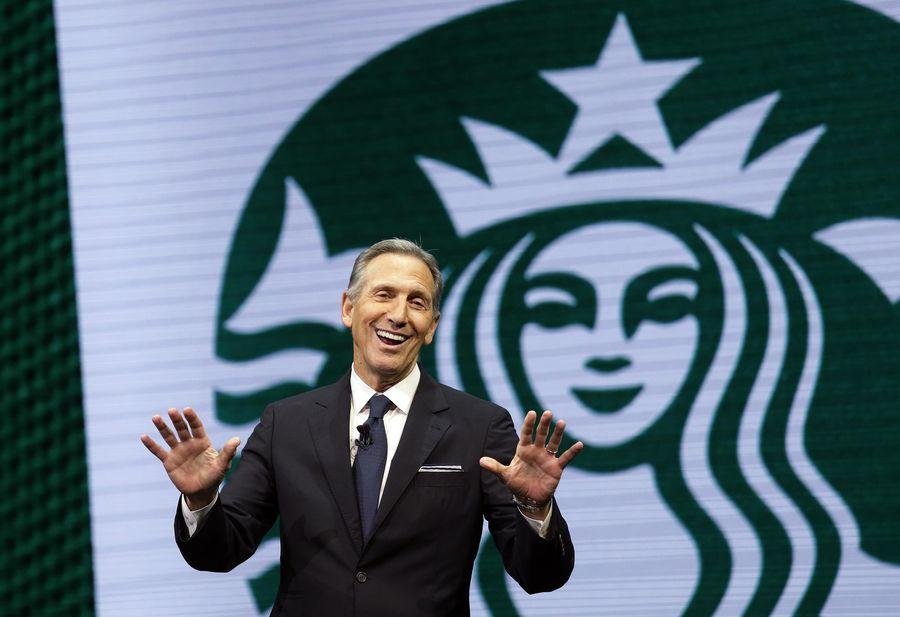
FILE - In this March 22, 2017 file photo, Starbucks CEO Howard Schultz speaks at the Starbucks annual shareholders meeting in Seattle. Schultz says the company will now allow people to use bathrooms at its coffee shops even if they donât buy anything, as it continues to take a closer look at its operations following the arrest of two black men at a Philadelphia shop. Schulz discussed the new policy while he spoke at the Atlantic Council in Washington, Thursday, May 10, 2018. Schultz said the company previously had a âloose policyâ that only paying customers be allowed to use bathrooms, but that it was up to each store manager to decide. (AP Photo/Elaine Thompson, File)
Democrats: Less Is More in 2020
COMMENTARY
Published Jan. 6, 2019 • Read time: 6m
Join the Conversation
0Forty-five years ago, while running for governor of California the first time, Jerry Brown embraced a new book with a memorable title: “Small Is Beautiful.” It was written by E.F. Schumacher, an Oxford economist who’d left his native Germany after Hitler came to power. Schumacher was an atheist as a young man, and a Marxist. He was a seeker throughout his life, however, who kept an open mind and heart. He helped the British government during World War II, and went to Asia after the war to contemplate the positive effect Buddhism might have on capitalism.
Schumacher also delved deeply into Catholic social thought, finding answers there and converting to Catholicism. The subtitle to his book, which became an unlikely international bestseller, was “A Study of Economics as If People Mattered.”
In the U.S., Schumacher was embraced by prominent Democrats. Jimmy Carter brought him to the White House two months after being inaugurated. The author was also befriended by Jerry Brown, Carter’s 1976 primary season rival. A former Jesuit seminarian who later went to Japan to study Buddhism, Brown spoke at Schumacher’s 1977 funeral. As governor, Brown tried to implement the “small is beautiful” ethos into state programs, touting a similar mantra: “Less is more.”
Four decades later, with Democrats stacking up like planes over O’Hare to run against President Trump, it’s a good time for them to recall their New Age roots. Large fields of candidates are not beautiful. Fewer is better. Democrats need not hark back to the 1970s to see the wisdom of this idea. They only need to recall the last presidential election. How do they think an unqualified reality-TV star with a string of bankruptcies and broken marriages made off with the Republican Party nomination?
Sanders Seeks Caucus Trifecta Win to Close Delegate Gap
Sanders Fighting Perception He Can't Overcome Clinton Edge
Clinton Targets Trump as Sanders Circles
Sanders, Clinton Differ Sharply at Flint Debate
When I say “unqualified,” I mean for the presidency. Donald Trump had never held or sought elective office. He’d not served in government or the military, and bragged about not reading books about past presidents -- or any topic. But he turned out to be well-qualified candidate at a time when grassroots voters had soured on political elites. Simply put, in a field with 17 mostly credible candidates, the bombastic demagogue with charisma and finely honed television skills is not easy to beat.
Democrats don’t believe this can happen to them. They attribute Trump’s victory to white racism among Republicans, or sexism, or the “ism” du jour. They expect their voters to choose sagely no matter how many Democrats decide to run. I’m skeptical. I see little evidence that the Democrats’ base is any more temperate than their Republican counterparts. I think a large field is perilous for the Democratic Party, and the country. We could easily get another Trump; or, at the least, a Democrat who will secure the nomination by being the most Trump-like candidate. That might bring us another four years of Trump himself.
It’s worth recalling how that happened. Remember in August 2015 when Fox News scheduled two presidential debates to kick off the campaign, instead of one? This started a precedent, and a meme, about the “kids’ table” debate featuring the second-tier candidates. But why should GOP luminaries such as Rick Santorum, Rick Perry, and Lindsey Graham be relegated to the undercard – a non-prime-time debate seen by far fewer voters and mostly ignored by the media – when Ben Carson, Mike Huckabee, and Rand Paul were in the main event? The answer was the same reason Donald Trump was at the big-kids’ table: polling numbers. But why not put them all on stage at once? The answer was simple math: A 90-miniute debate, divided by 17 candidates, would have come out to 5 minutes and 18 seconds apiece. “Scarcely enough time,” noted Michael Barone, “for the oral equivalent of a few tweets.”
The large field warped the campaign in other ways. Each election cycle, an attractive young face emerges. Florida Sen. Marco Rubio fit that description last time, but if you count Mar-a-Lago he was only one of three GOP candidates who resided in Florida. Moreover, his rivals came at Rubio in waves: Jeb Bush dropped a cool $100 million in advertising, much of it negative attacks, on his onetime protege. Chris Christie launched a kamikaze attack on Rubio in New Hampshire. Trump finished the job with his primary win in Florida.
Why were so many GOPers running for president anyway? The answer was that they all made the calculation that the Democrats were stuck with Hillary Clinton and that almost any Republican could beat her. The same dynamic is true now, which is why so many Democrats are lining up to run against Trump. They think they can whip him. Many also believe another lesson of 2016 is that experience is no longer valued by voters. If Trump can be president, anyone can. Nearly a dozen Senate Democrats are considering a run, with one them, Elizabeth Warren, already on the campaign trail. A passel of governors or former governors are making noises about running. House members, too!
So even if the last House member to win the White House was James A. Garfield in 1880, nine House Democrats are eyeing the starting blocks. Mayors, too! City Hall is a launching pad that has never produced a president. But then again, neither had “The Apprentice.” We haven’t even started talking about potential candidates with Trump-like resumes -- private sector characters such as Tom Steyer, Howard Schultz, Oprah Winfrey, and Dwayne “The Rock” Johnson.
Looking at the vast field taking shape and remembering 2016, you might think that this is unlikely to end well. Jerry Brown might have saved his party from Trump had he heeded my advice and run in 2016, but he’ll be 82 years old on Election Day 2020, so he’s off the hook this time. As for Brown’s political party, they’ve moved so far to the left during the Trump regime that “Small Is Beautiful” isn’t nearly radical enough anymore. Today’s Democrats are more inclined to heed the advice of a truly revolutionary thinker, one who proclaimed: “Let a hundred flowers bloom.”
If they stay true to Mao, the Democrats are going to need three or four debate stages, not just two. The 2016 circus will seem tame by comparison, raising the obvious question: Is there any way this could work out for them? Perhaps, if they do one thing. Again, California’s politics of an earlier generation provides the inspiration. In 1966, as Ronald Reagan prepared to unseat Jerry Brown’s father, Gov. Pat Brown, he glided to the Republican gubernatorial nomination without ever criticizing his primary opponents. Not only that, but he forestalled the attacks of rivals on him by quoting then-state party Chairman Gaylord Parkinson, who coined the so-called 11th Commandment: “Thou shalt not speak ill of any fellow Republican.”
Notwithstanding their ritual genuflections to Ronald Reagan, the 2016 Republicans did not remain true to these roots, violating the Parkinson-Reagan “commandment” at every turn. The 2020 Democrats could reprise this code of behavior, though they’d probably modify it. Their “12th Commandment” might go something like this: “Thou shalt not speak ill of any presidential contender other than Donald J. Trump.” Who knows, it just might work.

A RealClear Thanksgiving: Investing in a Better Future
David DesRosiers • RealClearPolitics
Trump’s Newsom Problem: Antagonist-in-Chief
Carolina Lumetta • RealClearPolitics
America’s Free Spirit
John Maxwell Hamilton • RealClearPolitics
The GOP Majority Should Go Out in Glory
Daniel McCarthy • RealClearPolitics
Republican Majorities Could Return Sooner Than Expected
J.T. Young • RealClearPolitics
The Danger Before the Attack
Leslie J. Sullivan • RealClearPolitics
RCP Today
Top stories on RealClearPolitics
The Takeaway
Polling intelligence and analysis delivered to your inbox
World News
Featuring the latest world news
Policy
Featuring the latest policy news
Support Our Mission
As part of RealClearPolitics, authors aim to provide balanced, non-partisan analysis by presenting top reporting and commentary from all sides of the political spectrum.
Trusted by policymakers and citizens alike since 2000