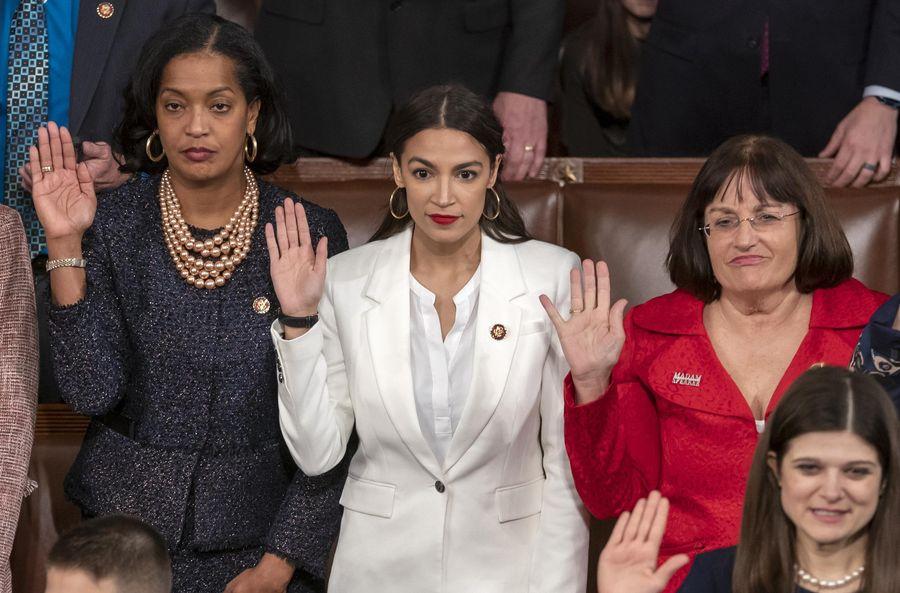
Media's 'Blue Wave' Morphs Into a 'Diverse' Congress
ANALYSIS
Published Jan. 4, 2019 • Read time: 3m
As the new Congress was sworn in Thursday, it was remarkable that the phrase “blue wave,” so ubiquitous just two months ago, received nary a mention. It appears even the media have finally accepted that the election results did not amount to the sweeping power transition they predicted. What is the media’s new term du jour and how much are they framing the new Congress as a battle against Trump?
The timeline below shows the average percentage of airtime (as measured in 15-second intervals) on CNN, MSNBC and Fox News, from November 1, 2017 to present that mentioned “blue wave” (using data from the GDELT Project’s processing of the Internet Archive’s Television News Archive).
The phrase “blue wave” appears to have come into being with the November 2017 off-year election as media outlets breathlessly described Democratic wins as signaling an approaching wave that would sweep Republicans out of office in the 2018 midterms. Coverage built steadily over the past year in the lead-up to an election that many outlets were predicting would result in an utter wipeout for the president’s party. Yet, when Democrats managed to achieve only modest gains, the term appears to have quickly faded away. Only MSNBC tried to keep the idea alive, with year-end pieces describing “a blue wave that crashed over the capital as Democrats took over.”
Interestingly, Fox News used the term the most overall, 22 percent more than MSNBC and more than twice as often as CNN.
The trend is even clearer in online news coverage. The timeline below shows the percentage of coverage in the 65 languages monitored by the GDELT Project since November 1, 2017 that mentioned “blue wave.” Two weeks after last year’s elections the phrase had largely faded from use globally.
If the vaunted “blue wave” is dead, what is the new term that the media are using to describe the Democratic transition in the House? The two words that appeared everywhere in Thursday’s coverage of the incoming congressional class were “diverse” and “diversity.” The timeline below plots global online news mentions of “blue wave” against “Congress AND (diverse OR diversity).” It seems “diversity” is the new “blue wave” but even this new term, which received so much attention on Thursday, began fading within 24 hours.
McCain to Code Pink Protestors: Get Out of Here You Low Life Scum
AG Nominee Lynch Deflects Cruz Missile
Senate to Begin Hearings on Obama Attorney General Nominee
Democrats, Republicans Spar Over Benghazi Investigation
Looking specifically at the House, how much coverage of it has mentioned President Trump? Over the same November 1, 2017-to-present time period (and caveating that 2018 covers two months and 2019 represents just 3 ½ days of coverage), there has been a steady year-over-year increase in the percentage of House coverage that also mentioned Trump. The 2019 House in particular is being positioned as the House Against Trump.
Putting this all together, the media seems to have accepted that the anticipated “blue wave” didn’t crash across the country. In its place, “diversity” has become the new favored term, but even it is already fading. When it comes to Trump, the House is no longer an independent body in the eyes of many in the media -- it is merely a foil for an ever-present president.

A RealClear Thanksgiving: Investing in a Better Future
David DesRosiers • RealClearPolitics
Trump’s Newsom Problem: Antagonist-in-Chief
Carolina Lumetta • RealClearPolitics
America’s Free Spirit
John Maxwell Hamilton • RealClearPolitics
The GOP Majority Should Go Out in Glory
Daniel McCarthy • RealClearPolitics
Republican Majorities Could Return Sooner Than Expected
J.T. Young • RealClearPolitics
The Danger Before the Attack
Leslie J. Sullivan • RealClearPolitics
RCP Today
Top stories on RealClearPolitics
The Takeaway
Polling intelligence and analysis delivered to your inbox
World News
Featuring the latest world news
Policy
Featuring the latest policy news
Support Our Mission
As part of RealClearPolitics, authors aim to provide balanced, non-partisan analysis by presenting top reporting and commentary from all sides of the political spectrum.
Trusted by policymakers and citizens alike since 2000