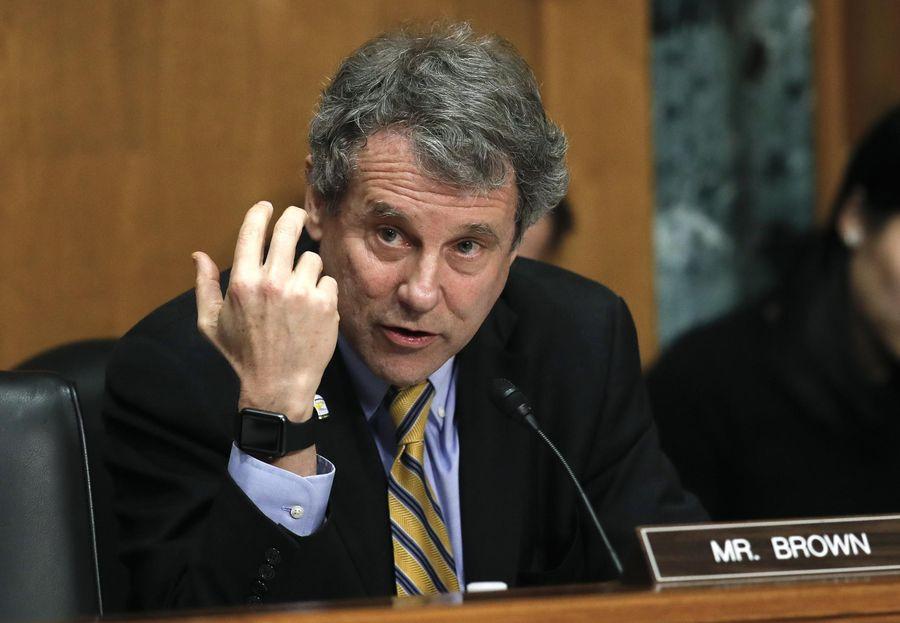
FILE - In a Jan. 9, 2018 file photo, Senate Finance Committee member Sen. Sherrod Brown, D-Ohio, questions Alex Azar during a Senate Finance Committee hearing on Capitol Hill in Washington. Brown, Ohioâs Democratic U.S. senator says Senate Majority Leader Mitch McConnell is rushing the Supreme Court confirmation process for Brett Kavanaugh because he fears more negative publicity will surface for the nominee. (AP Photo/Carolyn Kaster, File)
Here's Where Democrats Are Really Picking Up Trump Voters
Published Oct. 11, 2018 • Read time: 4m
COLUMBUS, Ohio -- "I think it's all about the dignity of work," says Democratic Sen. Sherrod Brown in an interview in the backseat of his Chevy Suburban. "I talk about how we value work. People who get up every day and work hard and do what we expect of them should be able to get ahead. I don't think they hear that enough from Republicans or national Democrats."
It is an old-fashioned theme much favored by Brown, who proudly sees himself as a labor Democrat. But it is also a direct response to the 2016 political catastrophe for Brown's party across the Midwest -- and especially in Ohio.
One bottom-line truth of American politics is that given the way the Electoral College operates Democrats need to reverse the flight of the white working class to Donald Trump's GOP. Ohio is ground zero this year in testing the durability of Trump's coalition.
In Brown's quest for re-election, the appeal to workers is working. While Ohio swung from a 3-point victory for Barack Obama in 2012 to an 8-point Trump win, Brown has enjoyed leads from 13 to 18 points over Republican Rep. Jim Renacci in three polls over the last month.
Democrats are not counting on that sort of margin for Brown, but even coming in at half that range would underscore the fragility of Trump's hold on his own electorate.
One key indicator will be the outcome in Mahoning County, home to the ailing blue-collar stronghold of Youngstown. Few places in the country offered a more dramatic example of Trump's success in turning economic discontent into an electoral windfall. In 2012, Obama carried the county by nearly 28 points; Hillary Clinton managed to win it in 2016 by just 3.
Sanders Seeks Caucus Trifecta Win to Close Delegate Gap
Sanders Fighting Perception He Can't Overcome Clinton Edge
Clinton Targets Trump as Sanders Circles
Sanders, Clinton Differ Sharply at Flint Debate
Brown has a political advantage in the state's once thriving manufacturing regions because he has been a consistent critic of free-trade pacts such as NAFTA, an area of common ground with Trump. "If people ask, I say I agree with him on trade," Brown said. "I will agree with Trump when he's right. I don't think he's right very often."
Indeed, when Brown spoke Sunday at the state's Democratic convention here, he drew his most explosive applause for touting his vote against the confirmation of Brett Kavanaugh to the Supreme Court. If Republicans are counting on pro-Kavanaugh sentiment to mobilize their base, Democrats here showed that the GOP's dismissal of Christine Blasey Ford's allegations against Kavanaugh generated at least as much outrage.
Brown excoriated Republicans for their treatment of Ford, but he turned his argument toward the economic, stressing that he opposed Kavanaugh early on because the nominee had "a history and record of putting his thumb on the justice scales" in favor of "Wall Street over consumers" and "health insurance companies over patients."
His mention of health insurance companies was no accident. In this year's other big contest in Ohio, Democratic gubernatorial candidate Richard Cordray faces Republican Attorney General Michael DeWine. And in a variation on a strategy being pursued by Democrats around the country, Cordray is making a major issue of DeWine's participation in a 2011 lawsuit against the Affordable Care Act.
Overturning the act would have killed its insurance protections for those with pre-existing conditions. DeWine is now trying to suggest that he favors such safeguards, but Cordray noted in an interview that "people have begun to recognize how much is at stake, and what it means to have your coverage stripped away when you get sick." Republicans, he added, "are scrambling around trying to find different positions."
One of Cordray's most interesting ads stresses the importance of job training to move workers to better-paying jobs, but he argues for his plan in terms that speak directly to Trump's base. "You shouldn't need a college degree," Cordray says, "to be part of the middle class." Count on this to become a new national Democratic theme.
The polls find the governor's race to be on a knife-edge. Cordray could be helped by recent corruption scandals in the GOP-controlled legislature and splits between Trump supporters and Gov. John Kasich, his arch-critic, who is leaving office because of term limits. DeWine is keeping it close since he's one of the best-known political figures in a state where Republicans have traditionally maintained residual strength even in relatively good Democratic years.
But if both Brown and Cordray prevail, it will be in significant part because their pro-worker evangelism resonated with many who supported Trump and still haven't found the prosperity and security he promised them.
(c) 2018, Washington Post Writers Group

A RealClear Thanksgiving: Investing in a Better Future
David DesRosiers • RealClearPolitics
Trump’s Newsom Problem: Antagonist-in-Chief
Carolina Lumetta • RealClearPolitics
America’s Free Spirit
John Maxwell Hamilton • RealClearPolitics
The GOP Majority Should Go Out in Glory
Daniel McCarthy • RealClearPolitics
Republican Majorities Could Return Sooner Than Expected
J.T. Young • RealClearPolitics
The Danger Before the Attack
Leslie J. Sullivan • RealClearPolitics
RCP Today
Top stories on RealClearPolitics
The Takeaway
Polling intelligence and analysis delivered to your inbox
World News
Featuring the latest world news
Policy
Featuring the latest policy news
Support Our Mission
As part of RealClearPolitics, authors aim to provide balanced, non-partisan analysis by presenting top reporting and commentary from all sides of the political spectrum.
Trusted by policymakers and citizens alike since 2000