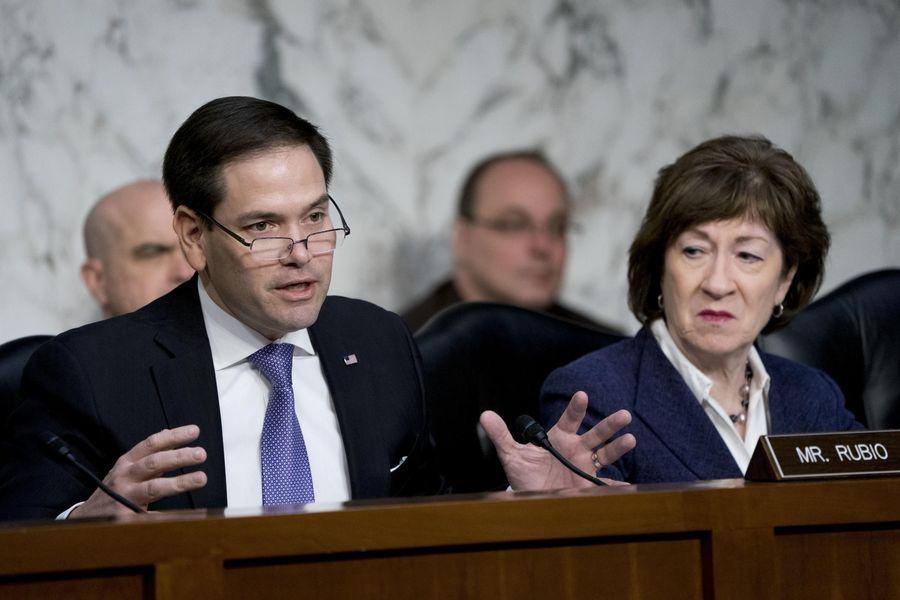
FILE - In this March 21, 2018, file photo, Sen. Marco Rubio, R-Fla., left, accompanied by Sen. Susan Collins, R-Maine, right, speaks as Homeland Security Secretary Kirstjen Nielsen and former Homeland Security Secretary Jeh Johnson appear before a Senate Intelligence Committee hearing on election security on Capitol Hill in Washington. After flaming out in the GOP presidential primary _ and enduring rival Donald Trumpâs taunts along the way _ Rubio is entering his next act in politics. But one thing Rubio isnât doing, he says, is gearing up for a White House run in 2020. And, he says no other Republicans should primary Trump either, because it could cost the GOP the presidency. (AP Photo/Andrew Harnik, File)
'Deep Fakes' and the Fight for Truth Online
Published Sept. 6, 2018 • Read time: 5m
Despite the ominous topic, it was reassuring to hear Sen. Marco Rubio speak last month at the Heritage Foundation’s event on “deep fakes,” demonstrating that someone in Congress not only understands the threat posed by the evolving technology landscape but also recognizes that addressing the threat requires a radical rethinking of how we consume information.
While fact checkers have become a central element in the war against “fake news,” Rubio mused that when it comes to a tight election, the right fake news could be enough to change the outcome no matter how much contrary evidence there is or how many fact checkers confirm it is false. He offered the hypothetical of a video appearing a few days before voters go the polls, allegedly showing one of the candidates making extremely disparaging remarks about a large bloc of voters. In our 24/7 news cycle and hyperpartisan politics, it is all but assured that the video would rocket to viral status as news outlets run the unverified clip while politicians and pundits condemn it.
No matter how much the candidate protests that the video is false and that he or she can document being on the other side of the country from where it was allegedly filmed, and no matter how many fact checkers confirm that it is a forgery, the damage will be done and before the news cycle corrects itself, the candidate will likely lose the election.
This is the world in which we live today, where dispassionate truth comes second to the emotional falsehoods that fire us up.
The FBI Gained Access; We'd Already Lost Our Privacy
Terrorists and Their Privacy
The Internet of Every Damn Thing
Owning Ideas
Of course, ever since there have been photographs there have been attempts to manipulate them for political means, perhaps none more famous than the Soviet Union’s “airbrushing” of history. The rise of Photoshop and computer graphics placed such editing capability into the hands of the general public, though thankfully most edits were fairly clumsy and easy to spot.
Fast-forward to the past few years, when the rapid ascent of deep learning algorithms has made it possible for machines themselves to make such edits, skillfully taking a video of a politician speaking and altering it to say or do anything one can imagine. Today’s “deep fake” videos are still relatively crude, but as technology advances and the bar to using it lowers, it may not be long until you will be able to live-broadcast an event from your phone while editing it to make the participants say and do whatever you like.
As Rubio so aptly noted, in a world in which truth and fiction are so inextricably intertwined, it becomes impossible to trust anything. A fake video becomes truth and a true video can be easily dismissed as fake.
While the Heritage event’s panelists saw hope in the idea of technologies that would allow public figures to authenticate through a third party their every waking moment to prove that they were not at a particular event or did not utter the word attributed to them, Rubio’s introduction was far more pragmatic in its take on the impact of these new technologies. As the Florida senator understands, in today’s hyperpartisan world it really no longer matters if some third-party organization formally attests that a politician didn’t speak at a particular rally – a portion of the electorate will have their minds made up and all the fact-checking and evidence in the world will make no difference. The mere presence of the fake video is enough for it to create the necessary reasonable doubt and change the topic just long enough to change reality.
When MSNBC host Joy Reid was confronted earlier this year with a series of homophobic remarks she made a decade ago on her personal blog, one might assume she would have faced discipline or even termination. Instead, by attacking the third-party archives of her blog that had preserved the now-deleted posts and claiming that either the archives or her blog had somehow been hacked and that the statements were falsely attributed to her, she was able to change the narrative just long enough that by the time the entries were confirmed to be hers, the outcry had died down and the network took no action. As Rubio recognized, no matter how trusted a third-party verifier is, a public figure under fire can simply attack its credibility long enough to change the narrative and survive what in previous times would likely have been a fatal public relations catastrophe.
Deep fakes are just beginning and the astonishing pace of the underlying technologies raises concerns over whether the corresponding detection tools for identifying forged videos will be able to keep up.
At the same time, the near-ubiquity of smartphones now means that political blunders are captured not only by accredited news organizations, but by any audience member who posts the video anonymously online. Such videos don’t need to be nefariously edited to cause damage – all it takes is for a statement to be presented out of context to cause immense damage. Indeed, many of the “fake news” images and videos that go viral have not been edited, but rather have been shared out of context, spawning new stories about what they supposedly depict.
In the end, the rising wave of “deep fakes” threatens to remove the last traces of our ability to trust what we see and hear, creating a “Matrix”-like world in which true reality and virtual reality, truth and fiction are blended together in a wilderness of mirrors that can both destroy honest politicians and save corrupt ones. Welcome to our Orwellian new world.

A RealClear Thanksgiving: Investing in a Better Future
David DesRosiers • RealClearPolitics
Trump’s Newsom Problem: Antagonist-in-Chief
Carolina Lumetta • RealClearPolitics
America’s Free Spirit
John Maxwell Hamilton • RealClearPolitics
The GOP Majority Should Go Out in Glory
Daniel McCarthy • RealClearPolitics
Republican Majorities Could Return Sooner Than Expected
J.T. Young • RealClearPolitics
The Danger Before the Attack
Leslie J. Sullivan • RealClearPolitics
RCP Today
Top stories on RealClearPolitics
The Takeaway
Polling intelligence and analysis delivered to your inbox
World News
Featuring the latest world news
Policy
Featuring the latest policy news
Support Our Mission
As part of RealClearPolitics, authors aim to provide balanced, non-partisan analysis by presenting top reporting and commentary from all sides of the political spectrum.
Trusted by policymakers and citizens alike since 2000