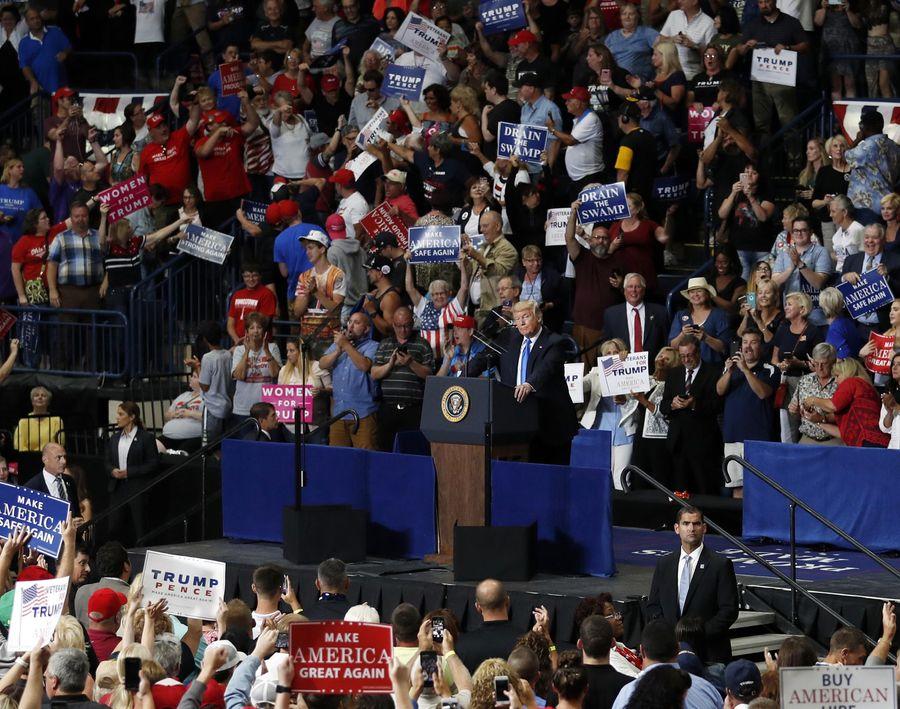
President Donald Trump pauses as he speaks during a Make America Great Again rally, Tuesday, July 25, 2017, at the Covelli Centre in Youngstown, Ohio (AP Photo/Carolyn Kaster)
Donald Trump and the Clash of Communities
COMMENTARY
Published May 25, 2018 • Read time: 6m
As a political scientist, I’ve always preferred maps to polling data. Don’t get me wrong, I think that well-conducted polls, when properly interpreted, provide valuable information about voter preferences. Maps, however, can provide clues to the more important question of why voters arrive at their choice. That’s why I was so intrigued when I opened up “The Great Revolt,” the much talked about new book by Salena Zito and Brad Todd, and saw that almost every chapter began with a picture of a map.
I like maps because geography offers important clues about the social and economic history of a community. Understanding communities is crucial to understanding politics. For example, southwest Ohio has historically been more Republican because of the influence of Southern abolitionists who migrated there in the 1800s. Northeast Ohio has a different history, and very different politics.
When it comes to non-political habits, we easily recognize that everything from the words we use to describe certain things (soda or pop?) to the sports teams we follow are influenced by where we are from. We like to think of ourselves as independent political actors, and are therefore reluctant to admit that our views of the political world are also shaped by our communities.
A lot of ink has been spilled (or should I say pixels generated) speculating about why a critical mass of the U.S. electorate, strategically located, decided to stun the planet in November 2016 and put Donald Trump in the Oval Office. Zito and Todd took an unconventional approach: They talked to voters from places like Ashtabula, Ohio and Freeland, Pennsylvania who voted for Donald Trump in 2016. They took what they learned, and categorized these voters into seven “archetypes,” from “Red-Blooded and Blue-Collared” to “Silent Suburban Moms.”
Lies, Assault and Cover-ups Don't Stop Donald Trump
Trump Stands by His Man; Obama on a Health Scourge; Hayden Interview; Reagan's Courage
Analysis: For Trump, Few Limits to Win-At-Any-Cost Approach
What If Clinton Isn't Indicted?
Yet the factor that weaves these disparate archetypes together is the idea of community. Put simply, the voters interviewed explained – albeit in different ways -- that they cast their 2016 ballots in the way they thought would best sustain their communities.
How did these voters define their communities? Clearly their idea of community included the local town or city in which they lived. But these voters also saw themselves as part of the American community. They often expressed pride in the vote for Trump in terms of feeling that they had done something special for their country.
What they didn’t identify with was what elites sometimes call the “international community.” It would not be a stretch to infer that the term itself would seem an oxymoron to these Middle America voters. Because community is more than just location, it is also about a shared sense of belonging, of being part of something unique and special.
This suggests that communities are also exclusionary: They define themselves as much by what they are not, as what they are. This doesn’t just hold true for those who live in the Rust Belt. Residents who identify with a cosmopolitan communities such New York City or Los Angeles regard themselves as different – better, if they are being honest – than those who live in smaller, less urban communities. The very things that are often valued in these less cosmopolitan places -- stability over transience, physical work over mental work, shared (as opposed to diverse) cultural norms -- are seen as backward-looking by coastal urbanites.
Since our sense of self tends to be bound up with our communities, we want to see our communities preserved. Getting back to politics, voters are likely to support candidates who they believe will fight for their communities. That’s what Hillary Clinton’s voters were doing in 2016, and its why they just don’t just dislike Trump, but fear him. Since communities that supported Clinton overlap with major media hubs, their residents’ perspective is well-known. Zito and Todd give a voice to the other side, Trump voters, who explain that they were doing exactly same thing. They were as afraid of Clinton as her voters are of Trump.
Another point revealed by Zito and Todd is the importance of the Trump rallies. If the rallies were mentioned at all by political commentators, it was usually in the context of the free media that Trump gained by luring networks like CNN to cover them live during prime time. The voters interviewed in “The Great Revolt,” however, mention the important effect of the Trump rallies on those who attended. For example, Zito and Todd quote Renee Dibbles, a former school bus driver in Ashtabula, Ohio who had changed her registration from Democrat to Republican in order to vote for Trump in the primary. She talked about attending a local Trump rally with her husband, and explained that “a lot of the portrayal was these rallies were negative. ... Then you go there, and now trying to explain what the atmosphere was like is difficult, it was so positive. ... It gives me goose bumps just thinking about it.”
What Trump was able to do through these rallies was to play up the idea of community. Unlike most presidential candidates, he didn’t drone on with a pre-scripted laundry list of programs that he would institute if elected president. Instead, he attacked, not just Clinton (“Lock her up!”) but elites in general -- and of both parties. These rallies rarely took place in major urban areas. What Trump was doing was defining a rival community, one that was out to destroy the community he himself had lived in all his life. The media saw anger, but the attendees saw a more positive message: I’m with you. Understanding this, it is easier to see why Trump was so successful, drawing an Electoral College straight that almost no one saw coming.
One can’t help but to come away from reading “The Great Revolt” without feeling that the clash of communities reflected in the narratives did not end on Election Night 2016. What Trump did was to recognize and choose sides in a rift that had been growing for years. How American politics plays out in the next decade or more will be determined by how candidates and parties react to the underlying tension Trump exposed.

A RealClear Thanksgiving: Investing in a Better Future
David DesRosiers • RealClearPolitics
Trump’s Newsom Problem: Antagonist-in-Chief
Carolina Lumetta • RealClearPolitics
America’s Free Spirit
John Maxwell Hamilton • RealClearPolitics
The GOP Majority Should Go Out in Glory
Daniel McCarthy • RealClearPolitics
Republican Majorities Could Return Sooner Than Expected
J.T. Young • RealClearPolitics
The Danger Before the Attack
Leslie J. Sullivan • RealClearPolitics
RCP Today
Top stories on RealClearPolitics
The Takeaway
Polling intelligence and analysis delivered to your inbox
World News
Featuring the latest world news
Policy
Featuring the latest policy news
Support Our Mission
As part of RealClearPolitics, authors aim to provide balanced, non-partisan analysis by presenting top reporting and commentary from all sides of the political spectrum.
Trusted by policymakers and citizens alike since 2000