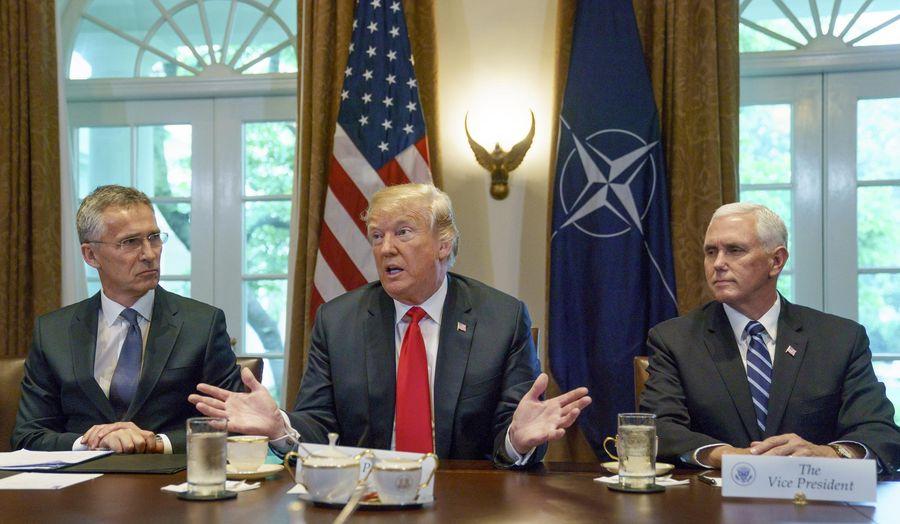
President Donald Trump, joined by NATO Secretary General Jens Stoltenberg, left, and Vice President Mike Pence, right, speaks during an expanded bilateral meeting in the Cabinet Room of the White House, in Washington, Thursday, May 17, 2018. (AP Photo/Carolyn Kaster)
Trump's Unilateralism Risks Further Alienating Millennials
COMMENTARY
Published May 18, 2018 • Read time: 4m
For almost 70 years, the United States has maintained its position atop the global pecking order by building military and diplomatic strength through a multilateral foreign policy. Today, it is surprisingly not baby boomers who gravitate toward multilateralism as a voting bloc; it’s their sons and daughters — the millennials -- who have grown up reaping its benefits. Indeed, the Harvard Kennedy School Institute of Politics’ Bi-Annual Survey of Youth Attitudes shows that an overwhelming percentage of young Americans under the age of 30 — regardless of party affiliation — believe in a highly collaborative approach to foreign policy.
The Trump administration’s practice of a foreign policy dictated by transactions, not collaboration, could have a profound and lasting impact on the largest cohort of voters within the American electorate. And if the baby boomer/millennial pattern holds for future generations, then President Trump’s “America first” -- and often “America alone” -- policy could beget a post-millennial generation of steadfast globalists. In this way, Trump’s legacy will be reminiscent of President George W. Bush’s unintentional inspiration of globalism and progressivism among the oldest millennials who came of age in the wake of 9/11. His push into Iraq, part of the seemingly boundless Global War on Terror, helped create a wave of progressive, globalist voters that propelled Barack Obama to the White House in 2008 and remains one of the most reliable blocs of the Democratic Party.
Is Trump Right About NATO?
Over Here: Competence Amid Repulsive Politics
We're Not a Poor Country, Donald
U.S. Officials Say 2 Americans Died in Brussels Attack
A telling statistic about how young voters see the world is their view of the United Nations; in nearly 20 years of polling, young Americans have strongly preferred cooperation with the U.N. and other countries when addressing international crises, over unilateral American action. Among young Americans, cooperating with the U.N. is a sentiment shared across the political spectrum:
- 60 percent of Democrats, 59 percent of Republicans and 64 percent of Independents believe the United States should allow the U.N. to take the lead in solving the world’s conflicts. Even among those who approve of Trump’s job performance, some 62 percent still support U.N.-led, multilateral action.
- More surprising still may be that not only do more young Americans trust the U.N. than Congress, but young Republicans express greater confidence in the U.N. than the Congress controlled by their own party. Among Republicans ages 18 to 29, 15 percent trust Congress to do the right thing all or most of the time, while more than twice that number, 36 percent, express the same faith in the U.N.
The U.N.’s faith in America, though, is likely to have been tested by Trump’s solo acts in recent weeks, whether it be his decision to withdraw from the Iran nuclear deal, the moving of the American embassy from Tel Aviv to Jerusalem, or, most recently, his administration’s rebuff of a U.N. request to increase food aid to North Korea.
Despite this, Trump still has the power to transform both his presidency and the world’s view of America in the critical weeks ahead. As he prepares for the planned summit with Kim Jong-un, he would be wise to demonstrate the power of global cooperation. While this approach may be markedly un-Trumpian, it would be decidedly American and position the president as a more vital political force at home and abroad at a critical juncture for his administration. His appeal to America’s most significant voting bloc and the short- and long-term relationship between tens of millions of young American voters and the Republican Party depends on it.
Correction: An earlier version of this article mistakenly reported that 69 percent of young American Democrats believe the United States should allow the U.N. to take the lead in solving the world’s conflicts. The correct number is 60 percent.

A RealClear Thanksgiving: Investing in a Better Future
David DesRosiers • RealClearPolitics
Trump’s Newsom Problem: Antagonist-in-Chief
Carolina Lumetta • RealClearPolitics
America’s Free Spirit
John Maxwell Hamilton • RealClearPolitics
The GOP Majority Should Go Out in Glory
Daniel McCarthy • RealClearPolitics
Republican Majorities Could Return Sooner Than Expected
J.T. Young • RealClearPolitics
The Danger Before the Attack
Leslie J. Sullivan • RealClearPolitics
RCP Today
Top stories on RealClearPolitics
The Takeaway
Polling intelligence and analysis delivered to your inbox
World News
Featuring the latest world news
Policy
Featuring the latest policy news
Support Our Mission
As part of RealClearPolitics, authors aim to provide balanced, non-partisan analysis by presenting top reporting and commentary from all sides of the political spectrum.
Trusted by policymakers and citizens alike since 2000