
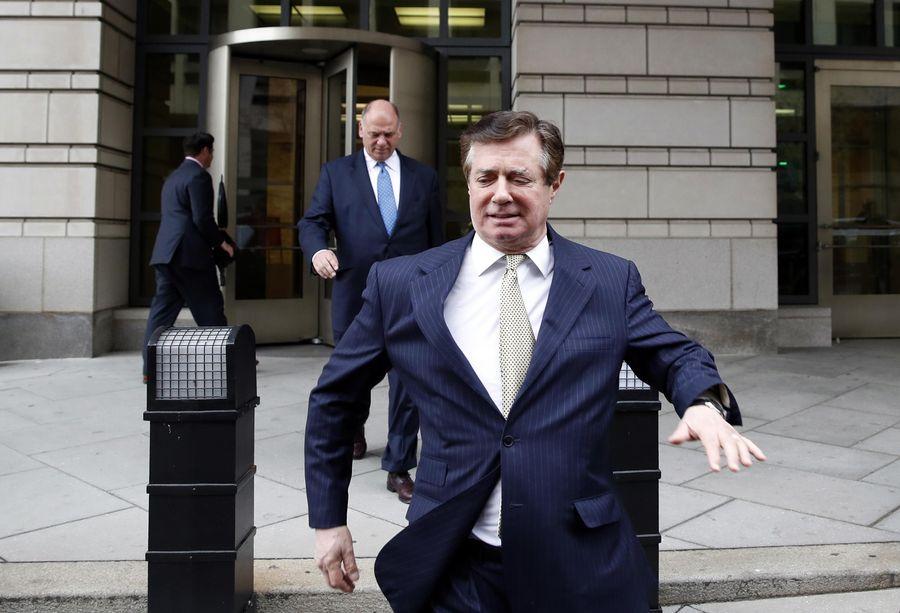
Paul Manafort departs Federal District Court after a hearing, Thursday, April 19, 2018, in Washington. (AP Photo/Alex Brandon)
Trump Cannot Make the Manafort Case Disappear
Published April 26, 2018 • Read time: 4m
WASHINGTON -- When August 2016 began, Paul Manafort was about 11 weeks into his job as chairman of Donald Trump's campaign. But despite the political tumult, Manafort found time that month to meet at a swank Manhattan cigar bar with someone the FBI has suggested has ties to Russian intelligence.
By the time August ended, Manafort was gone -- having resigned after allegations that he had received millions of dollars "off the books" to support pro-Russia figures in Ukraine. On the very day he was forced out, the financially strapped Manafort created a shell company that received $13 million in loans over the next few months from people or financial institutions with links to Trump.
The machinations of that August illustrate why Manafort is a central figure in special counsel Robert Mueller's investigation. And they show why the probe has deep roots -- in evidence already made public, cases filed and plea deals won -- that will persist even if Trump moves to fire Mueller.
Manafort has pleaded not guilty to tax and bank-fraud charges and making false statements, and his attorneys have argued that Mueller's allegations are outside his jurisdiction in the Russian election-meddling probe.
Mueller's team fired back in a court hearing last Thursday. "He [Manafort] had long-standing ties to Russia-backed politicians," said Justice Department attorney Michael Dreeben. "Did they provide back channels to Russia? Investigators will naturally look at those things."
The story begins with Thomas J. Barrack Jr., a billionaire real estate financier close to both Manafort and Trump. After hearing Manafort's ideas for boosting the campaign in February 2016, Barrack forwarded Manafort's suggestions to Ivanka Trump and Jared Kushner.
Charge Against Trump Campaign Manager Eclipses Wisconsin Race
Judge Garland and the Left's Disdain for Truth
Military Has Wide Discretion on Bergdahl Charges
Was Sierra Pacific Victim of Government Shakedown?
What's astonishing, in hindsight, is that after Barrack's initial introduction, nobody from the Trump campaign attempted any serious vetting of Manafort's background. This lack of review is surprising, given that the FBI had investigated Manafort's Ukraine activities back in 2014, according to a source familiar with the bureau's probe who wasn't authorized to discuss it publicly. For the Trump campaign, it was "plug and play," one campaign insider recalled, with "no process" for background checks.
Even as Manafort joined the campaign on March 29, he wanted some prominent Russians to know he was in the catbird seat. On April 11, he sent an email to his Ukrainian partner Konstantin Kilimnik to alert him to what Manafort called the "OVD operation," according to emails reported first by The Washington Post and later The Atlantic.
Mueller's court filings help decode these references. Kilimnik matches the "Person A" described in a startling passage in a Mueller sentencing memo in a separate case: FBI agents "assess that Person A has ties to a Russian intelligence service and had such ties in 2016." (Kilimnik has denied any intelligence ties.)
And who was the "OVD" whom Manafort was so eager to impress? According to The Post and The Atlantic, which cited people familiar with the emails, it was Oleg V. Deripaska, a billionaire Russian oligarch Manafort had been courting for more than a decade.
As Trump neared the nomination in July, Manafort emailed Kilimnik to propose "private briefings" for an unnamed person whom people familiar with the discussions told me was Deripaska. A Deripaska spokeswoman has denied that the Russian tycoon received any offer of a briefing from Manafort.
Manafort continued his contacts on the eve of his political demise. On Aug. 2, he met with Kilimnik at Manhattan's Grand Havana Room. Among the subjects they discussed were "the perception of the U.S. presidential campaign in Ukraine," Kilimnik told The Post last June.
Manafort had serious money problems, too, during his turbulent months running the campaign. They also came to a head in August, when a lender filed default notices on about $15 million in Manafort-family loans. Manafort created a shell company on Aug. 19 (with the ironically sunny name, Summerbreeze LLC), which received loans that eased the crunch. The loans included $13 million from two financial institutions whose senior executives had ties to Trump.
The final rupture came on Aug. 19, when Trump "accepted" Manafort's resignation as campaign chairman, five days after a New York Times story alleging he had received $12.7 million to help Ukraine's pro-Russia president, Viktor Yanukovych.
Manafort vanished after his firing. It turns out he went vacationing with his old friend Barrack, who was cruising off the Greek coast and invited a "depressed" Manafort to join him
The Manafort case illustrates how hard it will be for Trump to dispel the allegations that swirl around the Mueller investigation. The president might want to rid himself of the special counsel, but he can't make the evidence disappear.
(c) 2018, Washington Post Writers Group

The Danger Before the Attack
Leslie J. Sullivan • RealClearPolitics
Jon Finer’s Old and Dangerous ‘New Approach’ to Israel
Peter Berkowitz • RealClearPolitics
The President Deserves Better
John Ullyot • RealClearPolitics
Congress Doesn’t Need Another Blame Game. It Needs To Find What’s Broken
Jarrod Bernstein • RealClearPolitics
Democrats Won the Midterms. Common Sense Won, Too
Jordanne Kemper • RealClearPolitics
The 120th Congress Shapes Up
Carolina Lumetta • RealClearPolitics
RCP Today
Top stories on RealClearPolitics
The Takeaway
Polling intelligence and analysis delivered to your inbox
World News
Featuring the latest world news
Policy
Featuring the latest policy news
Support Our Mission
As part of RealClearPolitics, authors aim to provide balanced, non-partisan analysis by presenting top reporting and commentary from all sides of the political spectrum.
Trusted by policymakers and citizens alike since 2000