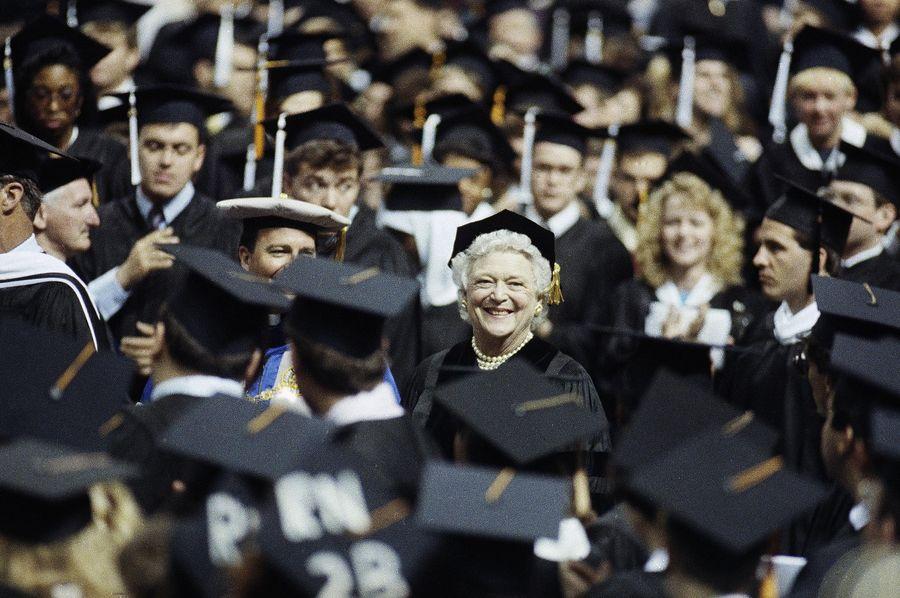
FILE - In this May 19, 1990, file photo, first lady Barbara Bush, center, smiles while being greeted by graduates at St. Louis University in St. Louis, Mo. A family spokesman said Tuesday, April 17, 2018, that former first lady Barbara Bush has died at the age of 92. (AP Photo/James A. Finley, File)
Will Smith College Finally Warm to Barbara Bush?
COMMENTARY
Published April 20, 2018 • Read time: 6m
While the nation mourns the passing of former first lady Barbara Bush, the question is: Will there be any mention of her at next month’s commencement ceremony at Smith College?
To recap: Mrs. Bush briefly attended the elite Northampton, Mass., women’s college before dropping out after her freshman year at age 19, to marry George H.W. Bush the following winter. (The two had met during their prep-school years; Bush, as a World War II naval aviator, named three of his planes after her.)
In March of this year, just weeks before she revealed she was in failing health, Mrs. Bush filed this update in the spring issue of the Smith Alumnae Quarterly:
“I have had great medical care and more operations than you would believe. I’m not sure God will recognize me; I have so many new body parts!”
She added: “I am still old and still in love with the man I married 72 years ago.”
It was a reminder of Barbara Bush’s knack for self-deprecation and the quintessential love story that was her marriage. It also hinted at the former first lady’s complicated relationship with the school she once attended.
Smith College, the proving grounds for such lights as Silvia Plath, Betty Friedan, Gloria Steinem and Julia Child, at times lauded the only woman, other than Abigail Adams, to have been both a wife to and mother of a U.S. president. In 1989, the college bestowed on her an honorary degree and asked her to give a 20-minute convocation talk.
Otherwise, her interaction with the school was brief and intermittent – at times shallow and, on one occasion, somewhat harsh and defensive.
As Many as 1 Million Kids Will Have School Choice This Year
Hypocrisy Behind the Campus Renaming Craze
Can Our Colleges Be Saved?
Hillary's Federal Education Jackboot Squad
In August 1953, Smith Alumnae Quarterly noted the birth of Jeb (it called him “John”). In 1968, the future 43rd president also was cited, though not by name -- “Barbara (Pierce) Bush’s son graduated from Yale and joins the AF Reserve in July.” In the 1970s, with feminism on the rise, Mrs. Bush offered this overhead smash: “I play tennis, do vol. work and admire George Bush!”
But from 1981 to 1992, when Barbara Bush was wife to the vice president and later first lady (only Eleanor Roosevelt exceeded that 12-year run in and around the White House), there’s a glaring omission: Not once was she invited to deliver a commencement address at her former school. (In 1989, the same year that Mrs. Bush delivered her convocation speech, the commencement address was handled by that noted women’s icon John Kenneth Galbraith.)
The oversight continued in the 25 years after the White House and her return to private life, even as Barbara Bush’s stock climbed as a symbol of dignity and good humor amid an increasingly bitter political arena – she was a woman who cared about the lives of others (literacy and cancer research were passions), with the ability to poke fun at her own appearance (the hair, the weight, the faux pearls) and her children’s foibles. Mrs. Bush didn’t make the three-hour drive from her family’s compound in Kennebunkport, Maine, to the Smith campus.
So, what to make of this?
First, Mrs. Bush isn’t alone. The same slight was felt by Nancy Reagan, Smith Class of 1943. She too never delivered a commencement address at her alma mater.
But lest you think this is a Republican phobia: Elizabeth Dole delivered the Smith commencement address in 1998, ahead of her presidential run (ironically, Liddy Dole’s husband finished second to Barbara Bush’s husband in the 1988 GOP presidential primaries; in the 2000 race, Liddy herself would lose out to Barbara Bush’s son).
Perhaps the concern with Mrs. Bush as a Smith commencement speaker wasn’t so much her body of work as it was, to some on the left, what she embodied as a woman who never held a job outside the home or drew a paycheck.
In the rarefied climes of academia, perhaps what disqualified Barbara Bush as a font of wisdom was that she didn’t meet the definition of a suitably “modern” woman – i.e., what enlightened woman would trade a chance at a B.A. for an “Mrs.”?
Ironically, that didn’t stop another elite women’s institution, Wellesley College, from asking her to speak at the school’s commencement in 1990, the second year of the Bush 41 presidency. (Also attending that day was Raisa Gorbachev.)
Indeed, the first lady’s appearance sparked a feminist backlash. As the New York Times reported at the time: “The conflict has centered on a protest by 150 Wellesley students who said they were 'outraged’ by the selection of Mrs. Bush as the graduation speaker. They said she did not represent the type of career woman the college seeks to educate.”
To the first lady’s credit, she didn’t back out. (In 2014, Christine Lagarde, the first female head of the International Monetary Fund, reneged on her invitation to speak at Smith’s commencement after campus protests over IMF policies.) Instead, Mrs. Bush turned into the skid — her address touched gently yet forcefully on a topic (women leading a balanced life) that many public figures continue to clumsily paw at.
“For several years,” the first lady observed, “you’ve had impressed upon you the importance to your career of dedication and hard work. And, of course, that’s true. But as important as your obligations as a doctor, a lawyer, a business leader will be, you are a human being first. And those human connections – with spouses, with children, with friends – are the most important investments you will ever make.
“At the end of your life, you will never regret not having passed one more test, winning one more verdict, or not closing one more deal. You will regret time not spent with a husband, a child, a friend, or a parent.”
Mrs. Bush added: “[M]aybe we should adjust faster, maybe we should adjust slower. But whatever the era ... one thing will never change: fathers and mothers, if you have children, they must come first. You must read to your children, and you must hug your children and you must love your children. Your success as a family, our success as a society, depends not on what happens in the White House but on what happens inside your house.”
Maybe that was too antiquated of a notion for her old school to hear back in 1990, much less in these current times when free speech and nonconformist thinking are suppressed. But the passage makes sense in this complicated age.
Hopefully, when the Smith Class of 2018 graduates on May 20, there will be a moment of silence in honor of a lost member of the Class of 1947.
It would be a good moment to reflect on the dignified example that Barbara Bush set – and the complete life she led.

A RealClear Thanksgiving: Investing in a Better Future
David DesRosiers • RealClearPolitics
Trump’s Newsom Problem: Antagonist-in-Chief
Carolina Lumetta • RealClearPolitics
America’s Free Spirit
John Maxwell Hamilton • RealClearPolitics
The GOP Majority Should Go Out in Glory
Daniel McCarthy • RealClearPolitics
Republican Majorities Could Return Sooner Than Expected
J.T. Young • RealClearPolitics
The Danger Before the Attack
Leslie J. Sullivan • RealClearPolitics
RCP Today
Top stories on RealClearPolitics
The Takeaway
Polling intelligence and analysis delivered to your inbox
World News
Featuring the latest world news
Policy
Featuring the latest policy news
Support Our Mission
As part of RealClearPolitics, authors aim to provide balanced, non-partisan analysis by presenting top reporting and commentary from all sides of the political spectrum.
Trusted by policymakers and citizens alike since 2000