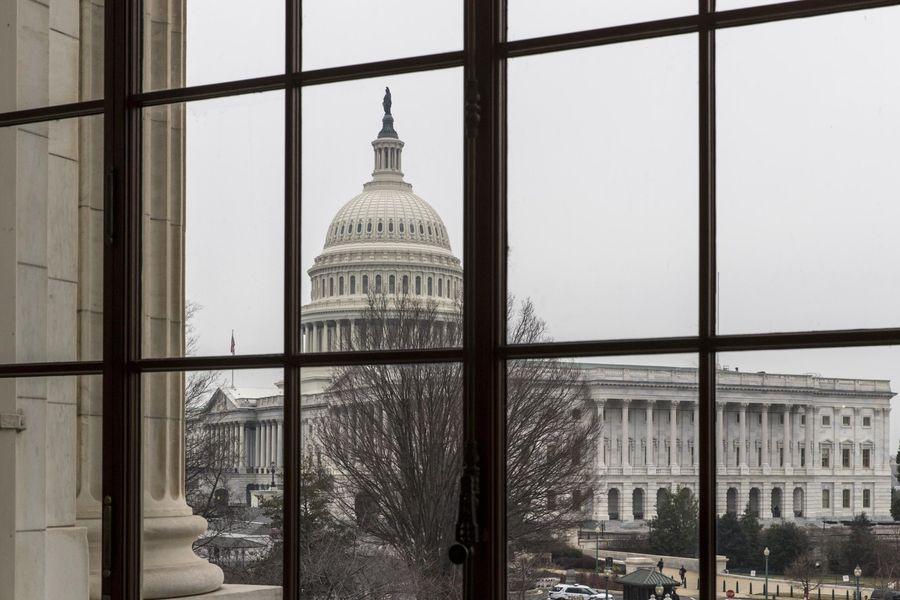
The Capitol is seen in Washington, Wednesday, Feb. 7, 2018. Democrats head into the midterm elections with an energized party base, an unpopular president and a growing wave of GOP retirements. But as they gather on Marylandâs Eastern Shore to discuss 2018 strategy, they must grapple with how to balance a positive economic agenda with nearly nonstop railing against President Donald Trump. (AP Photo/J. Scott Applewhite)
Spineless Congress Plays to Basest Part of Its Base
Published April 10, 2018 • Read time: 4m
It came over the city during the night, hovering eerily over the Capitol. Some people saw a spooky cloud, while others saw a haze of sorts, appropriately tinged yellow. But as it moved over the Capitol dome, everyone heard the same thing -- a terrifying crunching sound. One by one, congressional leaders were having their spines removed.
The first person to be filleted in this matter was Paul Ryan, the speaker of the House. He was averse to Donald Trump, but he has subordinated the larger agenda of opposing an antidemocratic president to a smaller agenda of tax cuts and regulatory reform. Ryan would make a splendid president of any chamber of commerce.
The other leaders have been similarly de-spined. They chortle among themselves as Trump says in the morning that he will veto this or that bill and in the afternoon signs it. They say nothing about the rhetorical mugging of Mexico or his long-held and mysterious adulation of Vladimir Putin. They stay silent while being soaked in a rain of lies, dignity running off them and splashing into the Washington gutter.
So maybe it's foolish to think they might speak up when the president uses his office to attack the free press. He calls stories he doesn't like "fake news," as he did with reports that he would fire national security adviser H.R. McMaster -- just before doing so. The incessant barrage of bogus criticism from the White House, the constant attack on the impartiality and professionalism of the press, has taken a toll. A recent Monmouth poll confirmed what we all know: The term "fake news" has been widely accepted. Republicans see fake news in stories that are critical of Trump; Democrats see it in those that aren't.
McCain to Code Pink Protestors: Get Out of Here You Low Life Scum
AG Nominee Lynch Deflects Cruz Missile
Senate to Begin Hearings on Obama Attorney General Nominee
Democrats, Republicans Spar Over Benghazi Investigation
This division is not entirely new. For years, major American cities had "Democratic" and "Republican" newspapers. In Chicago, the Tribune was unabashedly Republican. In New York, the Daily News was once Republican, and The Post once Democratic. Still, Democrats read Republican newspapers and the other way around. Now, though, a Fox News viewer is likely to watch only Fox. Too bad. "Fox & Friends" has the ratings, but it is to journalism what pornography is to sex.
Paul Ryan, Senate Majority Leader Mitch McConnell and other GOP congressional leaders surely do not for a minute believe that CNN, The New York Times or The Washington Post invent stories critical of Trump. They not only know better, they rely on these organizations to stay informed. Moreover, they appreciate why freedom of the press is embedded in the Constitution -- No. 1 among amendments.
These leaders can probably all cite John Adams on the subject and certainly Thomas Jefferson, who said that if he had to choose between "a government without newspapers, or newspapers without a government," he'd prefer "the latter." Hannah Arendt, the philosopher who fled Nazi Germany, put it this way: "The moment we no longer have a free press, anything can happen." And Sen. John McCain, R-Ariz., after being freed as a POW in North Vietnam, first asked for a decent meal and then for newspapers. It was a deprivation he keenly felt. "Of all the privations and injustices suffered in undemocratic nations, lack of a free press is among the worst," he later wrote in a preface to David Halberstam's "The Best and the Brightest," a journalist's account of government deception in Vietnam.
Of course, Trump's defenders would say that he doesn't want an unfree press, he just wants a fair one. Not so. What Trump actually wants is a servile press, one that offers praise, withholds criticism and refrains from reporting awkward truths. That's probably the reason he has criticized Amazon, founded by Jeff Bezos, who also owns The Washington Post. That might also be a reason the Justice Department is trying to block the merger of Time Warner and AT&T. Time Warner owns CNN, which Trump loathes.
Amazon can take its lumps. But the use of the bully pulpit to punish a corporation for a political reason would be yet another thing Trump has in common with Putin. It is, at its core, deeply un-American. This does not mean that the press is above criticism. It is not. But that criticism must be fair and fact-based -- not a lie.
If America emerges from the Trump years with a corrosive distrust of the press and a less vigorous democracy, then Republican congressional leaders will have to take some credit. Instead of protesting, they preferred to protect their political fortunes, play to the basest part of their base and remain meekly mute. They lack spine. Trump took them all.
(c) 2018, Washington Post Writers Group

A RealClear Thanksgiving: Investing in a Better Future
David DesRosiers • RealClearPolitics
Trump’s Newsom Problem: Antagonist-in-Chief
Carolina Lumetta • RealClearPolitics
America’s Free Spirit
John Maxwell Hamilton • RealClearPolitics
The GOP Majority Should Go Out in Glory
Daniel McCarthy • RealClearPolitics
Republican Majorities Could Return Sooner Than Expected
J.T. Young • RealClearPolitics
The Danger Before the Attack
Leslie J. Sullivan • RealClearPolitics
RCP Today
Top stories on RealClearPolitics
The Takeaway
Polling intelligence and analysis delivered to your inbox
World News
Featuring the latest world news
Policy
Featuring the latest policy news
Support Our Mission
As part of RealClearPolitics, authors aim to provide balanced, non-partisan analysis by presenting top reporting and commentary from all sides of the political spectrum.
Trusted by policymakers and citizens alike since 2000