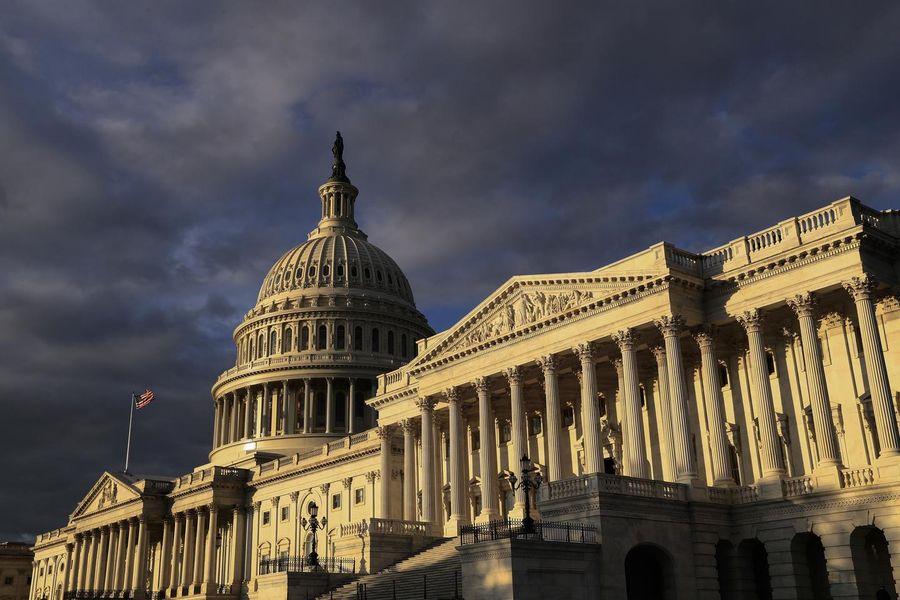
FILE - This Monday, Oct. 30, 2017, file photo shows the Capitol in Washington, at dawn. The House Republican tax plan would add $1.5 trillion to the federal debt at a time when the economy is doing pretty well on its own and the retirement of the Baby Boom generation is already putting a strain on Social Security and Medicare. All of which is why many analysts argue that big tax cuts arenât needed now, even if they would help stimulate the economy, which is far from certain. (AP Photo/J. Scott Applewhite, File)
America's Prudence Deficit
Published Feb. 12, 2018 • Read time: 4m
WASHINGTON -- Well, we just kicked the can down the road again -- to quote former President Barack Obama, who developed into an expert can-kicker during his eight years in the White House.
The bipartisan budget agreement reached last week by Congressional leaders is nothing if not a huge evasion of responsibility. Neither party will make the unpopular choices necessary to pay for an aging society and essential government. Ever-larger budget deficits have become their means of making policy and practicing politics.
Under the agreement, the federal debt will grow by $1.7 trillion or so over the next decade, estimates the nonpartisan Committee for a Responsible Federal Budget, or CRFB. (The spending figures announced by the Congressional leaders are smaller because they mostly cover only two years. But it strains credulity to think that Congress will soon reduce the spending it's just increased.)
Now, recall that Congress recently passed the Republican/Trump tax program, which may add another $1.5 trillion to annual deficits over the decade. All these deficits come atop the pre-existing deficits that the new president, whoever won, would have inherited. This figure is nearly $11 trillion, estimates the CRFB.
Altogether, we face cumulative deficits of about $14 trillion over the decade. These can't be blamed on an economy operating at less than full capacity. Just the opposite: The economy is close to "full employment" with a 4.1 percent unemployment rate.
Deficit-financing has become the mother's milk of politics. Compromise occurs by mutual forbearance. "Each party is giving the other its wish list [of spending] with all the bells and whistles included and asking future generations to pick up the tab," notes the CRFB's Maya MacGuineas.
McCain to Code Pink Protestors: Get Out of Here You Low Life Scum
AG Nominee Lynch Deflects Cruz Missile
Senate to Begin Hearings on Obama Attorney General Nominee
Democrats, Republicans Spar Over Benghazi Investigation
Of course, last week's agreement has some virtues. You can't spend so much money and get nothing in return. We may be spared another government shutdown over the budget, because the agreement sets spending levels for two years. Similarly, the agreement suspends the federal debt ceiling -- how much the government can borrow -- through early 2019. This presumably postpones another self-destructive debate over whether the government should default on its debt, damaging its credit rating and flirting with a financial crisis.
In truth, much of the spending authorized by the agreement is desirable. Future deficits have been wildly underestimated, because projections for defense and non-defense "discretionary" spending were unrealistically low. On defense, Obama's budgets reduced readiness, left the services too small and made it harder to counter new technological threats, most notably cyberwarfare. There was a similar squeeze on many vital domestic agencies, from the Internal Revenue Service to the National Parks.
To some extent, the new agreement represents a catch-up from this stringency. Meanwhile, so-called "entitlement" programs such as Social Security and Medicare -- for which people automatically qualify -- were largely untouched. They represent about 70 percent of federal spending. Together, costly entitlements and expanded discretionary spending produce enormous deficits, exceeding $1 trillion a year, as far as the eye can see.
That's a huge gap -- roughly 5 percent of our gross domestic product -- to close or shrink. Most politicians are can-kickers. They want nothing to do with the necessary tax increases or spending cuts, including possible reductions in Social Security, to curb the out-of-control deficits.
Ignoring them seems to involve few economic or political costs. The extra borrowing caused by deficits hasn't sent interest rates sky-high. Indeed, after the Great Recession, deficits helped the economy recover. Now, despite our political and social problems, foreigners still seem happy to hold U.S. Treasury securities as "safe" financial assets. In general, the public doesn't seem aggrieved by big deficits, especially when compared with the alternatives.
All this feeds a culture of nostalgia in both parties: They act as if nothing's changed. Republicans congratulate themselves on new tax cuts; Democrats are always eager to increase social spending -- witness the Affordable Care Act ("Obamacare").
So, why should we worry about escalating debt? The answer in a word: prudence.
We don't know how much federal debt is too much. It could be "a lot more" or "not much more." What we do know -- from previous financial crises in many countries and at many times -- is that once investors, traders and speculators lose confidence in a country's debt, the economic, social and political consequences can be devastating. Interest rates may soar; inflation may surge; governments may raise taxes sharply and cut spending deeply.
But once you cross that line, it's hard to get back to the other side. The prudent thing to do is never to get close to the line. We aren't being prudent.
(c) 2018, The Washington Post Writers Group

A RealClear Thanksgiving: Investing in a Better Future
David DesRosiers • RealClearPolitics
Trump’s Newsom Problem: Antagonist-in-Chief
Carolina Lumetta • RealClearPolitics
America’s Free Spirit
John Maxwell Hamilton • RealClearPolitics
The GOP Majority Should Go Out in Glory
Daniel McCarthy • RealClearPolitics
Republican Majorities Could Return Sooner Than Expected
J.T. Young • RealClearPolitics
The Danger Before the Attack
Leslie J. Sullivan • RealClearPolitics
RCP Today
Top stories on RealClearPolitics
The Takeaway
Polling intelligence and analysis delivered to your inbox
World News
Featuring the latest world news
Policy
Featuring the latest policy news
Support Our Mission
As part of RealClearPolitics, authors aim to provide balanced, non-partisan analysis by presenting top reporting and commentary from all sides of the political spectrum.
Trusted by policymakers and citizens alike since 2000