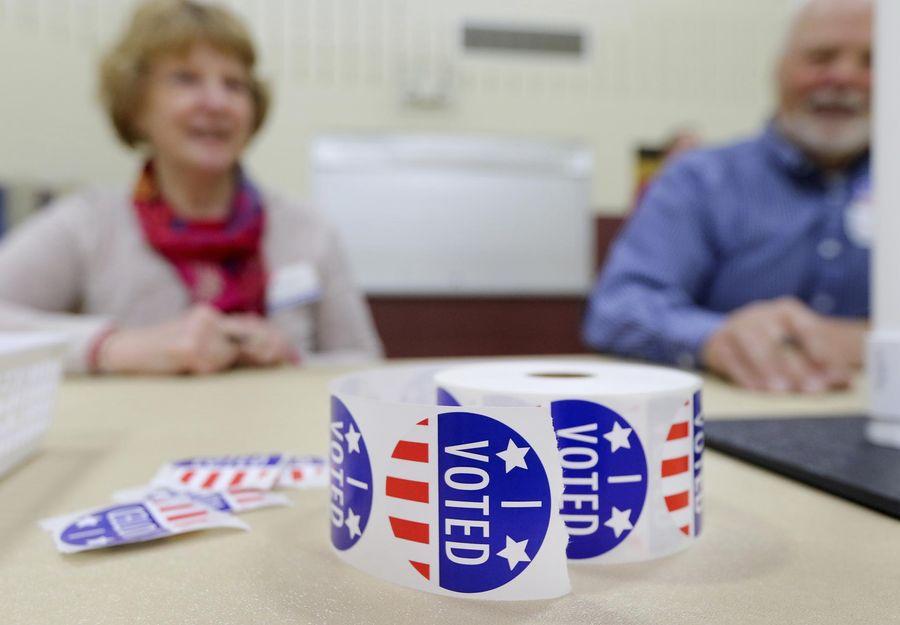
FILE - In this April 4, 2017 file photo, a roll of
The Takeaway: A Shrinking Feeling for Democrats?
Published Jan. 26, 2018 • Read time: 4m
Join the Conversation
0Intriguing tidbits from the week in election surveys and public opinion polls.
Putting the Blue Wave on Hold: One month ago Democrats held a whopping 13-point margin over Republicans in the generic ballot. Today, their lead in the RealClearPolitics Average has shrunk by nearly 40 percent, and now stands at 7.9 points. That’s still healthy, of course, and most analysts believe it keeps them within range of taking back the House of Representatives. However, it appears the Republican tax cut passed at the end of last year has blunted talk of a Democratic “blue wave” – at least for the time being. After all, the gap between now and November is practically an eon in political terms.
Tired of Winning Yet? Gallup’s year-end job approval rating for Donald Trump, 38.4 percent, puts him last on the list of first-year job approval ratings for the past 10 presidents elected since Harry Truman left office. JFK tops the list with a first-year job approval rating of 76.4 percent, followed by Eisenhower (68.8 percent), both Bushes (67.9 for W, 65.9 for HW), with Jimmy Carter (61.9) rounding out the top five.
Trump’s problem is not with Republicans, 83 percent of whom approved of the job he did during his first year, which is in line with support for George H.W. Bush, Ronald Reagan, and Richard Nixon. But Trump had historically low support from Democrats: Only 8 percent approved of him, far short of the average 44 percent approval presidents received from the opposition party in the previous 60-plus years. Among independents, 34 percent approved of the job Trump is doing.
Where "Obama Republicans" Split With Party
Curbelo Gives Spanish-Language Response to State of the Union
Rep. Bachmann Says She Won't Run For Re-Election
No, We Don't All Sin Like Mark Sanford
The Public’s Changing Mind: A new Pew Research survey demonstrates how the public’s policy priorities have shifted over time, with a particular de-emphasis on economic issues. In 2010, for example, 83 percent of voters said the economy was a “top priority,” with 81 percent citing jobs. Today, those numbers are 71 percent and 62 percent, respectively. The public has also taken a more laissez-faire attitude toward the budget deficit: 60 percent thought it was a top priority in 2010, but only 48 percent feel the same way today.
The public still views terrorism and education as top priorities, but the issues seeing the biggest gains over the past few years have been “climate change” and “protecting the environment” (+18 points for each vs. 2010), and “transportation” and “dealing with drug addiction” (+13 points for each vs. last year).
Trump as Charles Barkley: The Round Mound of Rebound once famously proclaimed that he was not a “role model” for kids. According to a new poll by Quinnipiac University, voters appear to feel the same way about Donald Trump. Ninety percent of those surveyed agreed that it is “important to you that the president be a good role model for children.” This included 91 percent of Republicans, 96 percent of Democrats and 87 percent of Independents. But when asked whether President Trump is a good role model for children, only 29 percent said yes. Republicans were much more likely to see Trump as a role model (72 percent), compared to 24 percent of Independents and just 1 percent of Democrats.
Blame Mom or Apple? Most Americans believe smartphone addiction is a growing problem, though they’re not entirely sure whom to blame for it. A new poll from Morning Consult provides a clue: 60 percent of respondents who said smartphone addiction is a growing problem among children said parents are at fault. Thirteen percent blamed the media, and just 10 percent pointed the finger at smartphone manufacturers. The poll also showed that slightly more than half (51 percent) of parents allow their children between two-four hours of “screen time” per day, including phones, computers, tablets and television. Twenty-one percent limited screen time to one hour or less, while a stunning 5 percent said they allow their children eight-plus hours of screen time per day.

A RealClear Thanksgiving: Investing in a Better Future
David DesRosiers • RealClearPolitics
Trump’s Newsom Problem: Antagonist-in-Chief
Carolina Lumetta • RealClearPolitics
America’s Free Spirit
John Maxwell Hamilton • RealClearPolitics
The GOP Majority Should Go Out in Glory
Daniel McCarthy • RealClearPolitics
Republican Majorities Could Return Sooner Than Expected
J.T. Young • RealClearPolitics
The Danger Before the Attack
Leslie J. Sullivan • RealClearPolitics
RCP Today
Top stories on RealClearPolitics
The Takeaway
Polling intelligence and analysis delivered to your inbox
World News
Featuring the latest world news
Policy
Featuring the latest policy news
Support Our Mission
As part of RealClearPolitics, authors aim to provide balanced, non-partisan analysis by presenting top reporting and commentary from all sides of the political spectrum.
Trusted by policymakers and citizens alike since 2000