Red State Democrats Unintimidated by Trump's Tax Push
Published Nov. 29, 2017 • Read time: 6m
Join the Conversation
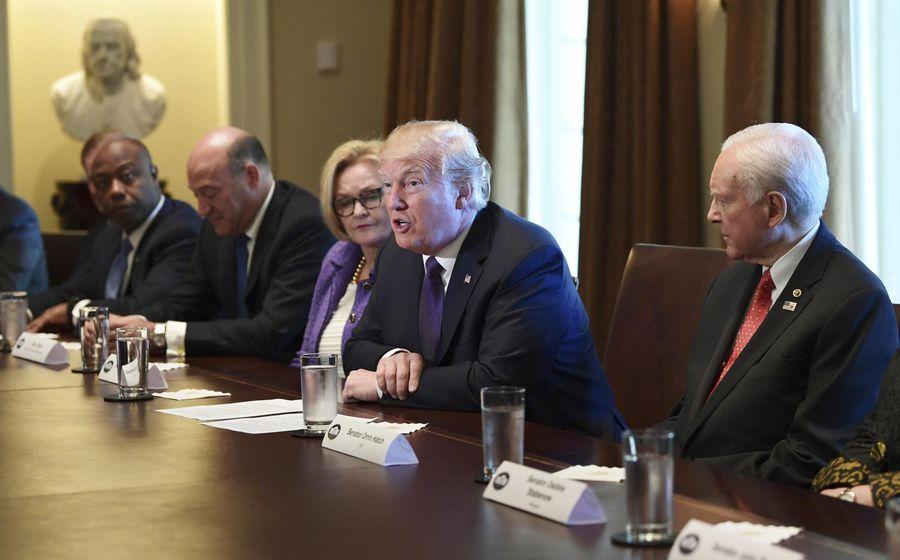
0President Trump will travel to Missouri on Wednesday as part of an ongoing effort to pressure Senate Democrats in states he won to back the Republican tax plan. Yet such lawmakers have shown they see no political incentive in supporting the legislation, which could come up for a vote in the upper chamber later this week.
Missouri’s Claire McCaskill, whom the president will likely call out while on her home turf, joined more than a dozen fellow Democratic senators from red or swing states for a press conference Tuesday condemning the bill and calling for a bipartisan process to overhaul the tax code. The event was a remarkable demonstration of how the president and congressional Republicans have been unable to sway some of the most vulnerable senators up for re-election next year.
Instead, Trump and the White House have spent the week trying to secure Republican votes for the bill, a dynamic that has given Democrats some political cover in holding out. A score released by the non-partisan Congressional Budget Office on Sunday showed negative effects on middle-class taxpayers, which is buttressing Democratic opposition, as are polls showing the plan to be unpopular among voters.
And if red state Democrats had been eager to back a tax reform measure, the Republicans’ inclusion of a repeal of the health care law’s individual mandate has provided an easy reason to say no to the GOP bill.
“We all want to do tax reform, we all believe it needs to be done,” said West Virginia Sen. Joe Manchin, who organized the Democrats’ press conference. “We’re willing to work and sit down. … There’s not one person here who hasn’t worked with a Republican.”
Sanders Seeks Caucus Trifecta Win to Close Delegate Gap
Sanders Fighting Perception He Can't Overcome Clinton Edge
Clinton Targets Trump as Sanders Circles
Sanders, Clinton Differ Sharply at Flint Debate
Manchin hails from Trump country. His state voted for Trump over Hillary Clinton by 42 percentage points and gives the president his highest approval ratings in the nation. Unlike many of his Democratic colleagues, Manchin would likely be comfortable voting for something with the president’s name on it. But on both taxes and health care, Democrats have been united in opposition to GOP proposals, an indication of how they see political dynamics playing out in their states ahead of the 2018 midterms.
“It has been staggering. It’s just amazing how poorly the president and GOP leaders have played their hand,” says Democratic operative Jim Manley, a former top aide to retired Sen. Harry Reid. “There is a handful of Democrats who would have been desperate to vote for a tax bill. But they’re feeling no pressure because the bill is so skewed towards the wealthy.”
The CBO estimated the tax plan would add $1.4 trillion to the deficit over a decade, and would cause 4 million Americans to lose health insurance by 2019 and 13 million by 2027. (Republicans dispute the CBO analysis, arguing that the effect would be Americans would simply no longer be mandated to buy insurance, not that it would be taken away.) The report also estimated that Americans earning less than $75,000 would end up paying more in taxes by 2027, as individual tax cuts would expire.
“We can do better in the Senate. We can actually come up with bipartisan solutions. ... Everyone here would agree we need a simpler tax code,” said Sen. Heidi Heitkamp, arguing that working-class Americans would shoulder unfair burdens under the current proposal.
Trump tried to court Heitkamp early on in the process. He invited the North Dakota Democrat aboard Air Force One to accompany him to a planned rally in her state in September. There to plug the bill, the president summoned Heitkamp on stage and called her a “good woman,” irking Republican operatives who hoped he would be tougher on the first-term incumbent. The event appeared to benefit Heitkamp, who faces a tough re-election next year.
Trump also traveled to Indiana with Sen. Joe Donnelly, another Democrat facing a difficult re-election in 2018. Donnelly also joined Vice President Mike Pence for a tax reform event in their home state, which Trump carried by 19 points. During Tuesday’s press conference, Donnelly recalled those visits, attempting to show constituents he was willing to work with the White House. But the eventual legislation, he said, did not do enough for middle-class voters or for keeping jobs from going overseas. “This country is better off with a tax bill with 60 or 70 votes,” Donnelly said.
Jon Tester of Montana, which Trump carried by 21 points, also participated in the press event.
Trump has treated McCaskill more harshly than the others. During a visit to Springfield in August, he told the audience there to vote her out of office if she didn’t back the tax plan. “She’s got to make that commitment. If she doesn’t do it, we just can’t do this anymore with the obstruction and the obstructionists,” he said.
Republicans in the state note that while McCaskill is a savvy politician, a no vote could come with peril. “She was never going to vote for tax reform,” says John Hancock, a former state GOP chairman. He labeled the two-term senator “a rhetorical moderate” who in fact is “actually quite liberal and out of step with Missouri voters.”
Though McCaskill defeated a Republican incumbent to win her seat in 2006, Missouri has reddened since then. Last year, Trump carried it by 18 points, outperforming Mitt Romney’s 2012 support by eight points. Nonetheless, McCaskill isn’t feeling much pressure. She voted against the Senate bill in the Banking Committee earlier this month. “I wanted to support real tax reform. This isn’t it — this is a bad deal for Missouri families,” she said in a statement.
In a sign of how the legislation is unlikely to garner bipartisan support, the Democratic Senatorial Campaign Committee launched new ads this week slamming the measure as a tax increase for families.
“These wrong and self-serving priorities are guaranteed to turn off voters of every political persuasion, and every GOP Senate candidate will be held accountable for their toxic and unpopular tax scam,” said the DSCC chairman, Sen. Chris Van Hollen.
Still, the legislation appeared to pick up some needed momentum on Tuesday when Trump traveled to Capitol Hill to meet with Republican lawmakers. The bill passed the Finance Committee afterward on party lines, with skeptics Bob Corker of Tennessee and Ron Johnson of Wisconsin coming aboard. Unlike with the unsuccessful health care repeal effort, Republicans in Congress appear more eager to get to a yes vote, cognizant of the political backlash they would face following another GOP defeat.

A RealClear Thanksgiving: Investing in a Better Future
David DesRosiers • RealClearPolitics
Trump’s Newsom Problem: Antagonist-in-Chief
Carolina Lumetta • RealClearPolitics
America’s Free Spirit
John Maxwell Hamilton • RealClearPolitics
The GOP Majority Should Go Out in Glory
Daniel McCarthy • RealClearPolitics
Republican Majorities Could Return Sooner Than Expected
J.T. Young • RealClearPolitics
The Danger Before the Attack
Leslie J. Sullivan • RealClearPolitics
RCP Today
Top stories on RealClearPolitics
The Takeaway
Polling intelligence and analysis delivered to your inbox
World News
Featuring the latest world news
Policy
Featuring the latest policy news
Support Our Mission
As part of RealClearPolitics, authors aim to provide balanced, non-partisan analysis by presenting top reporting and commentary from all sides of the political spectrum.
Trusted by policymakers and citizens alike since 2000