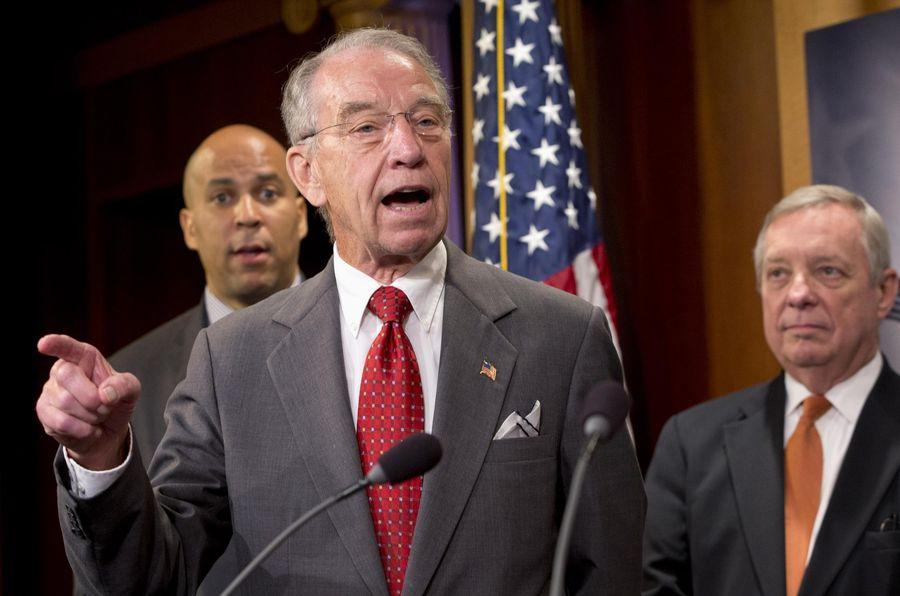
Senate Judiciary Committee Chairman Sen. Charles Grassley, R-Iowa, center, flanked by Sen. Cory Booker, D-N.J., left, and Senate Minority Whip Richard Durbin of Ill., speaks about criminal justice reform, Thursday, Oct. 1, 2015, during a news conference on Capitol Hill in Washington. A long-awaited bipartisan proposal to cut mandatory prison sentences for nonviolent offenders and promote more early release from federal prisons is scheduled to be disclosed Thursday by an influential group of senators who hope to build on backing from conservatives, progressives and the White House. (AP Photo/Jacquelyn Martin)
On Criminal Justice Reform, Bipartisanship Is Back
Commentary
Published Oct. 5, 2017 • Read time: 4m
When Jared Kushner, senior adviser and son-in-law to President Trump, recently hosted a White House meeting with congressional champions of criminal justice reform from both sides of the aisle, fresh air swept through Washington. And Lordy, did the capital need some airing out.
For months, hyper-partisan rhetoric has been the rule. Republicans and Democrats retreated to their corners, refusing to come to the table to hammer out solutions to our country’s biggest problems. But the failure to pass any significant legislation, from a health care fix to immigration reform, started a tip-toe back across the aisle. When Trump sat shoulder-to-shoulder with Nancy Pelosi and Chuck Schumer, the message was clear: Politics is politics, but business is business, and if we are to be successful at the business of passing bills, we have to work together.
This concept never waned in the states. In Pennsylvania, for example, conservative Republican state Sen. Scott Wagner teamed up with Democratic state Sen. Anthony Williams on a clean slate bill, first-in-the-nation legislation that provides for automatic record sealing for certain offenders after a crime-free waiting period. After a unanimous bipartisan vote in the Senate, the House version of “clean slate” will be shepherded by the unlikely bipartisan alliance of Republican state Rep. Sheryl Delozier and Democratic state Rep. Jordan Harris.
Gene Mills, president of the Louisiana Family Forum, perhaps the Pelican State’s most conservative organization, recently honored progressive Democrat and Speaker Pro-Tem Rep. Walt Leger for his longtime commitment to criminal justice reform. Both men were key supporters of a successful package of reforms to reduce Louisiana’s prison population. In Kentucky, conservative Gov. Matt Bevin stood arm-in-arm (literally) with Kate Miller of the ACLU to advocate for successful reentry legislation that breaks down barriers for the formerly incarcerated so they can secure jobs, support their families, and turn away from crime.
Gavin Newsom's Misguided Redistricting Initiative
A Warning Against the Overuse of Sanctions
Open The Books on the California State Checkbook
Senate Passes Bill Addressing Heroin, Opioid Crisis
Which brings us back to the recent White House meeting of criminal justice reform advocates. The roster of guests was wildly diverse, from the aforementioned Gov. Bevin, who sat right next to Kushner, to Democratic Rep. Sheila Jackson Lee, Koch Industries Vice President and General Counsel Mark Holden, and progressive Rhode Island Sen. Sheldon Whitehouse. Although each brought a unique perspective, everyone agreed on the need for innovative ideas at the federal level to improve a justice system that is churning out better criminals rather than better citizens.
On Wednesday, Senate Judiciary Committee Chairman Chuck Grassley, an Iowa Republican, and Illinois Democrat Dick Durbin reintroduced the Sentencing Reform and Corrections Act (SRCA), legislation that passed committee with bipartisan support last year but failed to get a floor vote.
The bill sought to reduce mandatory minimum sentences for those convicted of low-level drug offenses and give those currently in prison access to programs that will help them re-enter society. Judges would have more discretion in sentencing and law enforcement will have more tools at its disposal to keep the public safe. This would curb the growing population in our overcrowded prisons, address racial disparities in sentencing, and save money by focusing taxpayer dollars on those who most threaten public safety. The states that have enacted similar measures are seeing safer communities and better outcomes in their justice system, like reduced recidivism rates.
Our organization, the Justice Action Network, the largest bipartisan organization working at the state and federal level to safely reduce incarcerated populations, address overcriminalization, and improve reentry programming, endorsed the previously filed SRCA. The network includes groups as diverse as FreedomWorks and the Leadership Conference on Civil and Human Rights, the Faith and Freedom Coalition and the ACLU. We stand at the ready for one big, final push in 2017 on the one piece of legislation that has the votes today to pass the United States Senate.
Bipartisanship is back, baby. And for those of us who want to get stuff done, it’s not a moment too soon.

A RealClear Thanksgiving: Investing in a Better Future
David DesRosiers • RealClearPolitics
Trump’s Newsom Problem: Antagonist-in-Chief
Carolina Lumetta • RealClearPolitics
America’s Free Spirit
John Maxwell Hamilton • RealClearPolitics
The GOP Majority Should Go Out in Glory
Daniel McCarthy • RealClearPolitics
Republican Majorities Could Return Sooner Than Expected
J.T. Young • RealClearPolitics
The Danger Before the Attack
Leslie J. Sullivan • RealClearPolitics
RCP Today
Top stories on RealClearPolitics
The Takeaway
Polling intelligence and analysis delivered to your inbox
World News
Featuring the latest world news
Policy
Featuring the latest policy news
Support Our Mission
As part of RealClearPolitics, authors aim to provide balanced, non-partisan analysis by presenting top reporting and commentary from all sides of the political spectrum.
Trusted by policymakers and citizens alike since 2000