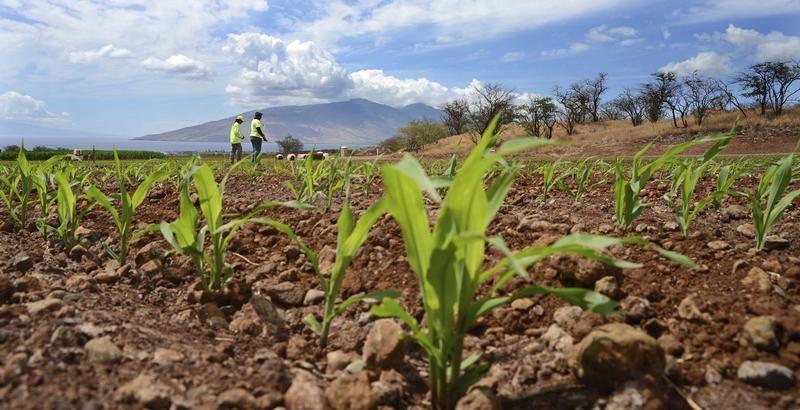
FILE- In this Sept. 10, 2014 file photo, Monsanto crew members Gerard Manuel, left, and Rommel Angale, count corn sprouts in a field of test hybrids in a breeding nursery near Kihei, Hawaii. Hawaii residents concerned about pesticide use by major agriculture companies on the islands are planning a push to strengthen regulation over chemicals they fear harm their health. (Matthew Thayer/The Maui News via AP, File)
Why the Bayer-Monsanto Deal Deserves Approval
Commentary
Published Sept. 26, 2017 • Read time: 4m
We all know that unless we dramatically ramp up global food production in coming decades, the human race faces a future threatened by famine, civil war, mass migrations, and untold misery. Projections by the Food and Agriculture Organization of the United Nations show that feeding a world population of over 9 billion in 2050 would require raising food production by an estimated 70 percent from 2007 production levels. In tandem, it is estimated that we will have almost 20 percent less arable land at that point, meaning farmers will have to grow more with even less acreage and irrigation resources at their disposal.
And while we want American farmers to meet and prosper from these demands, they won’t be able to do so simply by working harder or putting in longer hours than they already do. It’s going to require new production methods, agricultural innovations and private sector investment on a scale we have not seen before. One affective place to start would be U.S. government approval of a proposed merger between two of the world’s most innovative life sciences companies -- Bayer AG and Monsanto -- might well be a good place to start.
Following a productive meeting last January with then President-elect Donald Trump and the respective CEOs of Bayer and Monsanto, it was announced that following approval of the transaction, the combined company would commit $8 billion in U.S.-based research and development, as well add additional high-skilled jobs. That is on top of an already robust internal R&D budget and numerous innovative partnerships with academic and governmental research institutions, and a sign of confidence in both the Trump administration and the U.S. economy.
Interview with Agriculture Secretary Tom Vilsack
Environmentalism and Human Sacrifice
Interview with Agriculture Secretary Tom Vilsack
Food for Thought on Immigration
Bayer, which has a 150-year history in the U.S. (Bayer aspirin, One-A-Day vitamins, Alka-Seltzer, etc.), has proposed a cooperative acquisition of Monsanto, a Forbes 500 firm that is a respective leader of technologies complementary of those offered by Bayer. By joining the R&D resources and finances of these two innovation giants, they are set to profoundly accelerate and enhance the way farmers grow our food.
Bayer and Monsanto both have proven track records of problem solving and product innovation. Coupling Monsanto’s inventive, high-technology seed and trait capabilities with Bayer’s cutting-edge biological research and crop protection methods could help growers increase yields, fight pests and disease, and better utilize precious natural resources both here and abroad. Their collaboration would supercharge the life sciences revolution that has already reshaped the way today’s farmers manage their operations.
Successful farmers are already incredibly high-tech. From advanced seed and trait innovations to leveraging drone technologies and digital farming techniques in the field, they are helping to make farming operations more efficient and provide higher yields with less environmental impact. Still, more R&D investments will be needed to feed a growing population and support U.S. farmers in doing so. That is why this transaction and others that lead to new innovations should be embraced. Approval will provide a combined force of highly trained scientists and engineers more means of collaboration in modern state-of-the-art laboratories, financed by investments that only large R&D budgets can support.
Of course there are some critics of these types of acquisitions, including the usual naysayers who routinely demonize all big companies, in spite of the jobs they create and the benefits they provide to consumers, and who do so purely for political expediency. But this is a merger of complementary resources, technologies and people that will pay big dividends. There will still be plenty of competition in seed and other farm-related industries, with innovators undoubtedly stepping in to provide even more new products as opportunities created by a changing agricultural universe present themselves.
U.S. agencies and regulators involved in the approval process should fast-track review of this deal and let the Bayer-Monsanto innovators get down to the important work ahead. Failure to do so could jeopardize the billions in R&D commitments made by Bayer last January, as well as send signals to other companies looking to make major capital investments in the U.S. following Donald Trump’s election victory.
The Bayer-Monsanto union is not unlike the Dow-DuPont merger that is about to finalize. Both are common-sense partnerships of innovative, well-funded companies that will be even stronger and more productive together than they were separately.

A RealClear Thanksgiving: Investing in a Better Future
David DesRosiers • RealClearPolitics
Trump’s Newsom Problem: Antagonist-in-Chief
Carolina Lumetta • RealClearPolitics
America’s Free Spirit
John Maxwell Hamilton • RealClearPolitics
The GOP Majority Should Go Out in Glory
Daniel McCarthy • RealClearPolitics
Republican Majorities Could Return Sooner Than Expected
J.T. Young • RealClearPolitics
The Danger Before the Attack
Leslie J. Sullivan • RealClearPolitics
RCP Today
Top stories on RealClearPolitics
The Takeaway
Polling intelligence and analysis delivered to your inbox
World News
Featuring the latest world news
Policy
Featuring the latest policy news
Support Our Mission
As part of RealClearPolitics, authors aim to provide balanced, non-partisan analysis by presenting top reporting and commentary from all sides of the political spectrum.
Trusted by policymakers and citizens alike since 2000