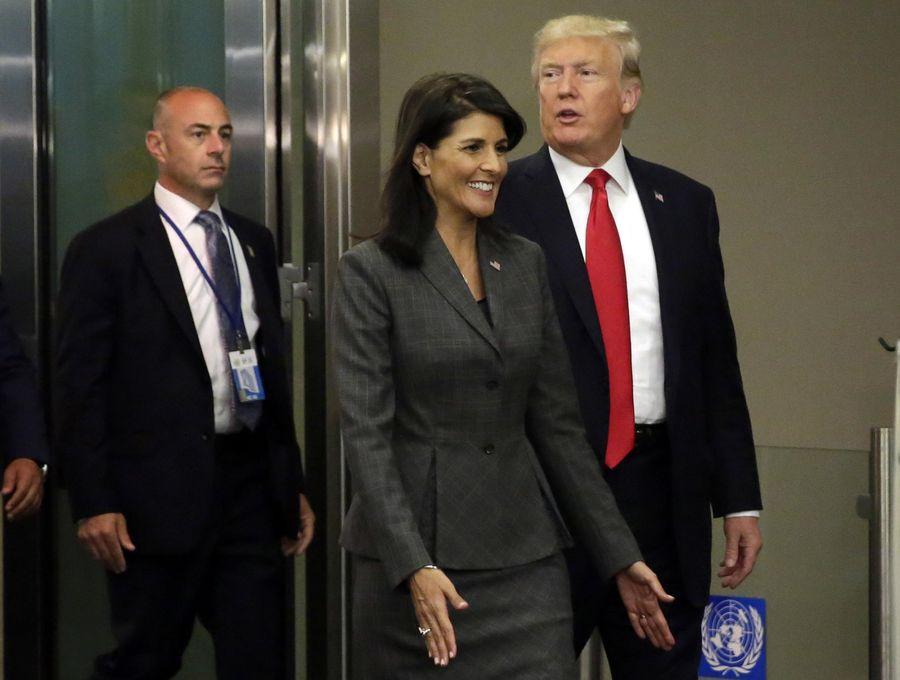
President Donald Trump, accompanied by U.S. Ambassador Nikki Haley arrives at the United Nations, Monday, Sept. 18, 2017. (AP Photo/Richard Drew)
Trump's U.N. Trip Draws Spotlight to Nikki Haley
Published Sept. 19, 2017 • Read time: 7m
Join the Conversation
0As President Trump prepares to deliver his maiden speech to the United Nations General Assembly on Tuesday, his visit to the Manhattan headquarters also places a spotlight on his top ambassador, Nikki Haley, who has emerged as a high-profile player on the foreign policy stage.
The former South Carolina governor has seen her political star rise rapidly over the past few years. Now, just eight months into her new job as the nation’s U.N. envoy, speculation abounds about possible future roles for her — as an eventual successor to Secretary of State Rex Tillerson and, later, to the president himself.
Haley's perch in New York has afforded her unique opportunities. For starters, the job helps burnish her credentials in the realm of international relations, while expanding her political network in the Big Apple. And being removed from Washington leaves her untarnished by controversies inside or around the White House.
An experienced and charismatic politician, Haley has increased her national profile as a frequent guest on cable news shows, booked to speak for the administration on pressing foreign policy issues. Her high visibility, compared to that of Tillerson -- a former corporate chief executive who favors a low-key approach to diplomacy and whose relationship with Trump appears tenuous — has sparked questions about whether she might soon replace him.
Haley has been navigating the tricky territory between publicly supporting the president despite controversies and advancing a more traditional party policy agenda. Trump's speech to the United Nations and its reception could provide clues about her influence.
Paul Says He'd Be "Happy" to Dissolve the U.N.
Reason to Smile About Durban Climate Conference
Long Faces in Durban
The Conquest of the West
“I personally think he slaps the right people, he hugs the right people, and he comes out with the U.S. being very strong in the end," Haley told reporters last week during a briefing at the White House.
Anthony Cordesman, a national security analysist at the Center for Strategic and International Studies, sees a similarly well-defined role for the U.N. ambassador: “It's certainly clear people know who she is and take her seriously."
Cordesman noted that "there has been a significant shift in this president's approach to the international community, and that is more a product of his national security adviser than the ambassador to the U.N., but I think it's also true that [Haley] has emerged as a very articulate spokesman and that she has found a reasonably good way as someone who reinforces the president's messages and finding a diplomatic, and probably a more broadly acceptable, way of saying these points."
On Monday, Haley welcomed the president to her turf at the U.N. and introduced him ahead of his brief remarks to a session on reforms to the organization.
"Donald Trump has a businessman's eye for seeing potential, and he sees great potential" in the United Nations, Haley said.
As a candidate, Trump was highly critical of the organization, from its bureaucracy, costs and effectiveness to the décor of its headquarters in New York City. Such criticisms hang over his impending speech there, though he has since pledged partnership.
“In recent years, the United Nations has not reached its full potential due to bureaucracy and mismanagement. ... We are not seeing the results in line with this investment," Trump said Monday to a panel that included Haley and U.N. Secretary General António Guterres.
"I think the main message is ‘make the United Nations great.’ Not 'again.' 'Make the United Nations great.’ Such tremendous potential, and I think we'll be able to do this," Trump said later Monday as he exited the headquarters.
Haley has tried to strike a balance between Trump's America First rhetoric and promoting the work of the U.N. "We said that we needed to get value for our dollar. And what we're finding is the international community is right there with us in support of reform," she told CNN on Sunday. "So, it is a new day at the U.N."
The ambassador has also defended the president's rhetoric when it comes to North Korea, and even escalated her own. "We wanted to be responsible and go through all diplomatic means to get their attention first. If that doesn't work, Gen. Mattis will take care of it," she told CNN. "If North Korea keeps on with this reckless behavior, the United States has to defend itself or defend its allies in any way. North Korea will be destroyed, and we know that and none of us want that. None of us want war."
And, in line with the Trump administration's approach to Israel, Haley pushed the U.N to end what she and the administration see as anti-Israel bias. “I have never taken kindly to bullies. And the U.N. has blamed Israel for a very long time," she said in Jerusalem in June. "And we're not going to let that happen anymore."
When it comes to the Iran nuclear deal, which will likely be a key item of discussion at the assembly this week as the president weighs withdrawal, Haley has suggested Trump could render Iran uncompliant with the agreement and kick the issue to Congress.
But there have been areas of distance between Haley and the president on key foreign policy areas. For example, Haley has been unequivocal in condemning Russian interference in the election. She has said the independent counsel investigation into the meddling and possible collusion with Trump associates is necessary, while Trump has called it a witch hunt.
More recently, Haley touted a new round of North Korea sanctions unanimously approved by voting members of the U.N. Security Council, which would strike at the country's oil imports and textile exports, among other areas. Trump called the new sanctions "not a big deal," as the administration had argued for tougher measures.
She has also set out to strike a more humanitarian tone on the refugee crisis, even as she supported the administration's proposed travel ban. As Trump took his first foreign trip to Saudi Arabia, Haley embarked on a tour of her own, visiting Syrian refugee camps in Jordan and Turkey. During various stops, she pushed for increased financial support from the United States.
And when it came to the president's controversial response to racial violence in Charlottesville, Va., last month, Haley indicated that she made her objections clear. "I picked up the phone and I had a private conversation with the president about Charlottesville, and it was taken very well,” she said during a television interview at the time.
That's not to say Haley hasn't been critical of Trump. She endorsed one of his rivals, Marco Rubio, during the Republican primary, arguing for a more diverse and inclusive GOP. Haley garnered national attention for her response to the murders of black church-goers at a prominent Charleston, S.C., church, calling for the Confederate flag to be removed from statehouse grounds.
In January of 2016, she was tapped to deliver the GOP response to President Obama's final State of the Union address, a moment typically given to rising stars in the party. In it, Haley took not so subtle swipes at Trump and his rhetoric, calling on Americans to ignore "the angriest voices." A daughter of Indian immigrants, she evoked her heritage throughout the speech and received bipartisan praise afterward, though some supporters of then-candidate Trump criticized her address.
Haley declined to speak at the GOP convention, but said she ultimately voted for the nominee. Trump's appointment of her to the U.N. post was seen as a reaching beyond his base of loyalists for top posts. Haley lacked foreign policy experience, but many say her selection was a launching pad. Trump's transition team also noted a chemistry between the president-elect and Haley after they met to discuss positions within the administration, and Trump expressed admiration for her business sense as governor.
Supporters at the time also pointed to Haley's connection to the military as an important credential. Her husband is a captain in the Army National Guard and served in Afghanistan.
At the president's speech on Afghanistan in Arlington, Va., last month, when he pledged an increase in U.S. troops, Haley was also in the spotlight; soldiers lined up to take selfies with her.

A RealClear Thanksgiving: Investing in a Better Future
David DesRosiers • RealClearPolitics
Trump’s Newsom Problem: Antagonist-in-Chief
Carolina Lumetta • RealClearPolitics
America’s Free Spirit
John Maxwell Hamilton • RealClearPolitics
The GOP Majority Should Go Out in Glory
Daniel McCarthy • RealClearPolitics
Republican Majorities Could Return Sooner Than Expected
J.T. Young • RealClearPolitics
The Danger Before the Attack
Leslie J. Sullivan • RealClearPolitics
RCP Today
Top stories on RealClearPolitics
The Takeaway
Polling intelligence and analysis delivered to your inbox
World News
Featuring the latest world news
Policy
Featuring the latest policy news
Support Our Mission
As part of RealClearPolitics, authors aim to provide balanced, non-partisan analysis by presenting top reporting and commentary from all sides of the political spectrum.
Trusted by policymakers and citizens alike since 2000