
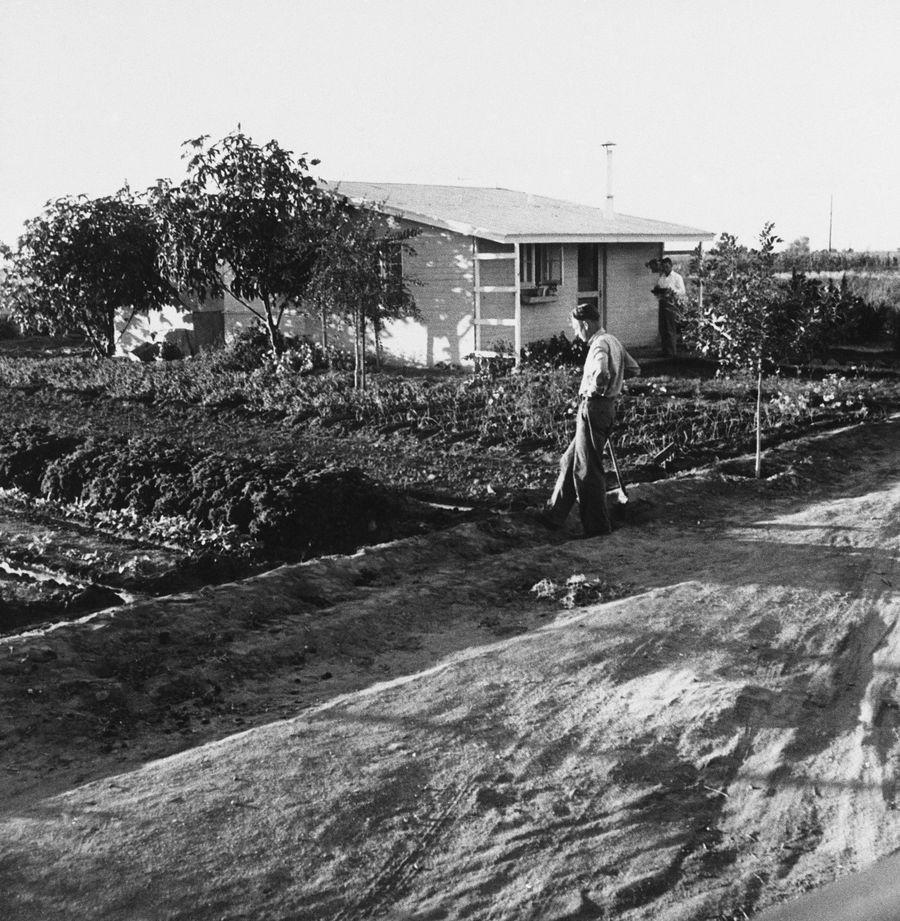
Migrant Garden Home 1939
'Government Project': Lessons for a New Millennium
COMMENTARY
Published June 11, 2024 • Read time: 6m
Nearly 45 years ago, I paid a visit to a fertilizer plant in Chengju, South Korea. The low-slung, dingy gray facility had been built with U.S. assistance a quarter of a century earlier. The equipment was a mosaic of rust and peeling patches of paint. The original equipment was no longer in use. Of the 60 original workers, only one was still there. The rest had left.
The Korean officials who took me to Chengju said it was a great success story. And they were correct.
I thought of this experience when reading “Government Project,” a book published in 1951, around the time that the South Korean fertilizer plant was being built. The book was, in effect, an after-the-fact report about a New Deal-era project to lift up poor farmers in Pinal County, Arizona. The federal government initiated this collective agriculture enterprise in 1936. It ended in 1944. The author of “Government Project,” Edward C. Banfield, pronounced it a failure. No one disagreed.
The wisdom or lunacy of government intervention is a matter of hot debate. Some go so far as to think the government should stay out of nearly everything, while others argue the opposite. The truth, as is almost always the case, is more complicated, and anyway, almost everyone wants government intervention – for the things that help them.
“Government Project,” recently reissued by the American Enterprise Institute, is a classic. Ed Banfield was a renowned political scientist and public policy expert on urban renewal and antipoverty programs. His book is a case study about what can doom government assistance.
Interview with Agriculture Secretary Tom Vilsack
Environmentalism and Human Sacrifice
Interview with Agriculture Secretary Tom Vilsack
Food for Thought on Immigration
The story goes like this. In an effort to find a solution to rural poverty, the Farm Security Administration purchased 5,000 acres of Arizona farmland and leveled it before building roads, farm buildings, fences, and community buildings. Casa Grande Valley Farms included new homes for the nearly 60 families who were to work together to make a go of the agriculture cooperative.
Over the brief life of the project, the lives of the farmers improved. Some families previously lived in sheds divided by chicken wire. Now they had decent homes, jobs, and hope. The corporation returned an annual profit.
Then, in 1944, the enterprise was liquidated. “It collapsed,” Banfield wrote, “at the very moment when to all outward appearances its chances for prosperity and success were greatest.”
We all know that government-funded programs can have unimaginable consequences. Think what happened when the World Health Organization introduced DDT in Borneo in the 1950s to kill mosquitoes. That worked out, but the chemical built up in roaches’ bodies. Lizards became less nimble from eating the roaches, so cats could more easily catch them, which caused the felines to die. With the decline of cats came an increase in rats and rat-borne disease. The WHO eventually had to airlift cats into Borneo.
But the situation at Casa Grande was not a litany of weird consequences. One main thing went wrong: The farmers did not have a close allegiance to each other when they became a government-made community. They lived and worked under the auspices of a plan that was handed to them. On paper it looked good. On the ground Casa Grande was a hotbed of distrust, feuding, and general discontent. The enterprise did not have the social cohesion to carry on.
Casa Grande did not have to turn out this way. Bureaucrats skipped a step or two. For one thing, workers from a different New Deal program, for instance, had been brought in to build the homes, instead of having Casa Grande people do that work. “This was not the traditional way of making a farm in the West,” Banfield wrote.
The original plan, Banfield concluded, was rational, and the struggle for power and autonomy was not. If they had stuck to the script, everything would have been fine. But human beings don’t want to be moved like pieces on a chessboard. The government planners, Banfield wrote, did not understand that “only the satisfaction of the settlers could lead to the financial success of the project.”
Assistance programs are successful when they give people agency. Some of the best foreign aid programs are those that promote female literacy. Teaching women to read gives them more opportunities to earn money for themselves and their families and to take better care of their children. (Mothers can read the labels on medicine bottles, which reduces infant mortality, and they can help their children learn.) It also gives the women more freedom over their bodies when it comes to reproduction. Female literacy is a good way of lowering population growth rates.
A similar kind of agency underpinned the success of the Chengju fertilizer plant.
Following the Korean War, which partitioned the country, the south was devastated. Two-thirds of the industry was in the north, as was 90% of hydroelectric power. Agriculture was wrecked. Many policymakers in the United States considered South Korea hopeless.
The idea behind Chengju came from the head of the U.S. aid program. He thought the country needed more than relief and suggested financing a plant that put people to work. At first it looked like a worse idea than anything in Casa Grande. Construction-cost overruns were outrageous, from $19.5 million to $33.3 million. The plant was not completed on time.
Meanwhile, the employees had to be sent abroad for training on a new Swiss chemical process for making urea fertilizer. Could they be adequately equipped to do this technical job?
The answer to that question turned out to be yes. And the training made all the difference. The plant was a huge success. Its production exceeded projections. The reason the old plant was idle when I visited was that it had been replaced by more modern equipment. The reason only one of the original employees remained on the payroll was that the others had gone on to jobs in new chemical plants. The diaspora of technical expertise and management power uplifted the country.
Once-struggling South Korea became a net exporter of fertilizer and was doing well in chemical industries generally. As for the overall economy, per capita annual income had risen from less than $100 a year in the mid-1950s to more than $33,000. And all because we educated people and let them manage their own affairs, rather than making them feel helpless on the perimeter of decisions.
There is another lesson from Banfield’s classic book, one that applies to the politics in our country today. It comes from Kevin Kosar, a fellow at the American Enterprise Institute and author of an introduction to the reissued volume. Edward Banfield, he writes, reminds us of “the eternal challenges of fostering human cooperation for mutual benefit.”
That is something we desperately need to think about today. Political leaders drive us apart with extreme political agendas, when we need something quite different. Disparate Americans need opportunities to build community, just as Banfield thought was done with barn-raising in the old West. That can only happen if leaders of all political stripes compete with ideas that open spaces for cooperation.

Democrats Won the Midterms. Common Sense Won, Too
Jordanne Kemper • RealClearPolitics
The 120th Congress Shapes Up
Carolina Lumetta • RealClearPolitics
Flooding GOP Primaries With Democrats
Robert Natelson • RealClearPolitics
Washington Keeps Rewarding Oracle—Veterans Keep Paying the Price
Darin Gaub • RealClearPolitics
The Seeds of Unrestricted Warfare
John Teichert • RealClearPolitics
The Primary System Is Losing the Next Generation
Sean Trende • RealClearPolitics
RCP Today
Top stories on RealClearPolitics
The Takeaway
Polling intelligence and analysis delivered to your inbox
World News
Featuring the latest world news
Policy
Featuring the latest policy news
Support Our Mission
As part of RealClearPolitics, authors aim to provide balanced, non-partisan analysis by presenting top reporting and commentary from all sides of the political spectrum.
Trusted by policymakers and citizens alike since 2000