Gun Control: Founding Fathers vs. Today's Lawmakers
Published Feb. 4, 2013 • Read time: 14m
Join the Conversation
0The second of a three-part series
Within hours of the Jan. 8, 2011, mass shooting in Tucson that killed six people and wounded 13 others, including Arizona Rep. Gabrielle Giffords, the local sheriff blamed the state’s lenient gun laws.
“I have never been a proponent of letting everybody in the state carry weapons under any circumstances that they want -- and that's almost where we are,” complained Pima County Sheriff Clarence Dupnik. “I think we’re the Tombstone of the United States of America.”
Dupnik would prove to have a knack for intemperate remarks, and this one was historically inaccurate, but the frustration of law enforcement officials in the urban areas of his state was genuine.
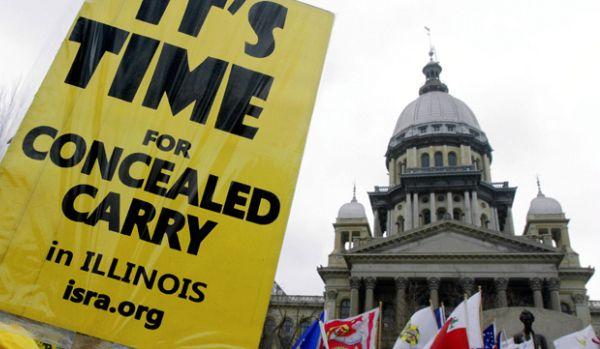
In 2009, legally armed men showed up at a Phoenix rally for President Obama. One of them explained he was doing so “because I can.” The guns were in plain sight, but today they wouldn’t have to be. In 2010, the year before the Tucson carnage, Arizona enacted a law allowing residents to carry concealed weapons without a permit. Even before that statute took effect, some 154,000 Arizonans were already permitted to conceal and carry.
“I believe this legislation not only protects the Second Amendment rights of Arizona citizens,” said Gov. Jan Brewer in her signing statement, it “restores those rights as well.”
The Right to Bear Arms
In 1991, five years after he’d left the bench, former chief justice of the Supreme Court Warren E. Burger was asked whether he believed the Constitution afforded private American citizens the right to bear arms. Burger, a conservative Republican, replied that the Second Amendment “has been the subject of one of the greatest pieces of fraud -- I repeat the word ‘fraud’ -- on the American public by special interest groups that I have ever seen in my lifetime.”
Gun Control Supporters Facing Recall Bids in Colorado
God, Guns, and Suicide
The Right Way to Combat Gun Violence
On Guns, Obama Finally Talks About the Culture of Fatherlessness
The special interest group Burger primarily had in mind was the National Rifle Association, and in a speech one year later the former jurist proclaimed flatly that “the Second Amendment doesn’t guarantee the right to have firearms at all.”
The jurisprudence on this question, let alone the Framers’ intentions, is hardly that simple. But what Warren Burger did reveal was how Americans’ perceptions of the constitutional meaning of the Second Amendment -- and of firearm ownership itself -- have constantly shifted over time.
Views consigned primarily to right-wingers and constitutional originalists today were once -- and only a generation ago -- the rallying cry of the left, particularly black radicals. Likewise, what was previously mainstream conservatism is now liberal orthodoxy. Martin Luther King Jr.’s Alabama home was described -- by a friend -- as “an arsenal.” In those days, the NRA was a moderate organization supporting gun control. In California, Gov. Ronald Reagan pushed for it.
And whether the shifting sands of the Second Amendment stem from the pitfalls of special interest influence, as Burger asserted, or from evolved political thought, today’s debates on gun control could benefit from a healthy dose of historical perspective.
The Constitution is mum on skeet shooting, which President Obama recently claimed to do at Camp David, just as it is on hunting, which was simply part of 18th century life. Nor does it mention personal protection, at least not in the sense of violent crime. And yet it was this issue -- the predilection of early Americans to assault one another fatally in the street -- that generated this nation’s first gun control laws.
As early as 1813, Kentucky and Louisiana passed state laws banning concealed weapons, including pistols, dirks, daggers, and the preferred weapon of Kentuckians -- Bowie knives.
But in 1822, in a case called Bliss v. Commonwealth, Kentucky’s Supreme Court tossed out the conviction of a defendant fined $100 for concealing a sword inside a cane. The court relied on Kentucky’s own constitution, which guaranteed “the right of the citizens to bear arms in defense of themselves and the state.”
Although litigated in Kentucky’s courts, this legal dispute had its origins in the U.S. Constitution. During the ratification process, several states, including North Carolina and Pennsylvania, discussed adding their own declarations spelling out the right to bear arms irrespective of any language about militias. Some, like the Commonwealth of Kentucky, added such language to their state constitutions.
Today, according to UCLA constitutional law scholar Adam Winkler, some 43 state constitutions have language protecting an individual’s right to own firearms. But how, and when, and where these arms can be carried constitutes a patchwork of complex and confusing statutory law.
Remember, Kentucky’s original argument was over concealed weapons, a problem legislatures have been wrestling with for 200 years.
In 1893, Texas Gov. James S. “Big Jim” Hogg declared in his annual message to the legislature that “the practice of carrying concealed deadly weapons marks the unmanly spirit and cowardice of those who indulge in it.”
“Intent to murder, and not the spirit of self-protection, lies in the heart of most men when they deliberately violate this law,” Gov. Hogg added, “and no quarter should be extended them in the application of severe penalties.
But attitudes change, even in Texas -- or rather, especially in Texas.
A century after Hogg’s remarks, a disturbed loser named George Hennard strode through a Killeen, Tex., restaurant methodically shooting diners with two semiautomatic handguns. One patron, 32-year-old Suzanna Hupp, reflexively reached for the pistol she always carried in her purse. But as Hupp later testified, she had that day decided to leave her gun in her car before going into the restaurant, worried that violating Texas’ guns laws might jeopardize her chiropractic license.
Hupp was hiding with her parents behind a table her father had overturned, and recalled having an open shot at the gunman who ended up shooting 50 people, killing 23 of them, including her mother and father.
“My state has gun control laws,” she explained later. “It did not keep Hennard from coming in and killing everybody. What it did do was keep me from protecting my family.”
Hupp went into politics and began agitating -- quite successfully -- for changes in state laws regulating carrying firearms in public. This attitudinal change, welcomed by gun rights advocates, signaled a counter-revolution in the long debate over guns. Until the 1990s, shocking crimes of violence committed with firearms tended to engender a backlash against guns themselves.
The first sweeping federal gun legislation was the National Firearms Act of 1934. Passed as Prohibition was ending, it imposed a $200 tax -- a significant sum at the time -- on the sale or transfer of machine guns and sawed-off shotguns. These “gangster guns” had achieved widespread notoriety during Prohibition, an era of violent lawlessness epitomized in many Americans’ minds by the St. Valentine’s Day Massacre on Feb. 14, 1929.
That day, four gunmen, two dressed as policemen, arrived at the Chicago hangout of bootlegger Bugsy Moran and ordered seven men to disarm and line up against the wall. The victims, believing it was a police shakedown, complied -- and were machine-gunned to death. Never officially solved, that crime is believed to have been carried out on the orders of Al Capone.
The 1963 assassination of John F. Kennedy was accomplished by an unstable ex-Marine Corps sniper who had defected to the Soviet Union and returned to the United States -- where he was able to purchase an Italian-made military surplus rifle and scope through the mail.
In 1968, Kennedy’s brother was murdered with a .22 caliber pistol bought privately in Los Angeles, no questions asked and no laws broken. The same year, Martin Luther King was murdered by a career criminal who’d bought his deer rifle at a Birmingham, Ala., sporting goods store.
That summer, race riots broke out in cities across the country. In many of them, responding emergency personnel were fired on by snipers. The day after Bobby Kennedy was killed, Congress passed the long-debated Omnibus Crime Control and Safe Streets Act of 1968.
Later that year, the Gun Control Act of 1968 was passed and signed into law by President Johnson. Its three main purposes were banning interstate shipments of guns between unlicensed dealers; denying access to felons and those adjudicated as mentally ill; ending the importation of surplus military arms unless they were “suitable . . . for sporting purposes.”
It was a time when America’s civic fabric seemed to be unraveling. The year before, on May 2, 1967, newly installed California Gov. Ronald Reagan was getting ready to host a picnic on the Capitol lawn in Sacramento with a class of eighth-grade students when 30 heavily armed young black activists interrupted the tableau.
The men and women, members of the Black Panther Party, were led by Bobby Seal and Huey Newton. Seale read a manifesto denouncing a pending gun control measure being considered by the California legislature as a racist attempt to abrogate the constitutional rights of citizens to bear arms.
The measure was called the Mulford Act, after its sponsor, and it would make it unlawful to carry loaded weapons in public. It was indeed aimed at preventing the “Black Panther Police Patrols.” When Seale finished reading, he said to the group, “All right, brothers, come on. We’re going inside.”
With that, they strode into the Capitol, taking their loaded shotguns and pistols with them. It was all perfectly legal, although it wouldn’t be for much longer. The Mulford Act passed quickly and was promptly signed by Reagan.
The NRA, which had endorsed the 1934 act, lined up behind this one, too. But its membership was becoming less accommodating -- and it would never again back a major gun control law. Neither would Reagan, even after being shot by a mentally unstable would-be assassin.
“Shall Not Be Abridged”
The most striking aspect of Second Amendment jurisprudence in federal courts over the past two centuries is how scant it is -- and how little this subject interested legal scholars. In “The Embarrassing Second Amendment,” a 1989 essay in the Yale Law Journal, prominent law professor Sanford Levinson postulated that political bias was the main reason for the death of such scholarship.
Levinson himself is a liberal member of the ACLU, and a man who personally favors strict gun control laws. But in noting that the Second Amendment is essentially absent from the “legal consciousness of the elite bar,” he suggests that the reason is “a mixture of sheer opposition to the idea of private ownership of guns” along with the fear that litigating this issue on constitutional grounds would mean losing.
His argument would prove prescient. In 2008, a narrowly divided U.S. Supreme Court did indeed decide that the Second Amendment guarantees some rights of gun ownership, at least in one’s own home. In that case, District of Columbia v. Heller, the court did not say that localities, states, and Congress cannot regulate firearms -- far from it -- but the high court did uphold the basic premise that the Second Amendment does apply to private citizens.
Most arguments over the constitutionality of gun control laws start, as did the spirited debate between the justices in Heller, with the opening phrasing of the Second Amendment itself: “A well regulated militia being necessary to the security of a free state, the right of the people to keep and bear arms shall not be infringed.”
If the right to own firearms is an individual right -- such as freedom of speech and religion -- what’s that business about “a well-regulated militia” doing in there? Much of the Heller deliberations, like the national discourse on this subject, delves into whether the Framers envisioned “militias” as bulwarks against a standing federal army.
The most instructive word in the Second Amendment may be “infringed,” a word that implies a pre-existing right. As legal scholar David E. Vandercroy pointed out in a Valparaiso University Law Review article 14 years before Heller was decided, the rights of private citizens were delineated in England a century before the American Revolution. The codification came in Parliament’s 1689 Declaration of Rights. Among these rights was access to arms.
“The Declaration didn’t create a right,” Vandercroy maintained. “The English had been able to possess individual arms for centuries.”
This is what Jan Brewer was alluding to when she signed legislation loosening Arizona’s gun laws: the idea that the right to bear arms is a foundational one, codified by the Framers, but not originally conceived by them.
There is little consensus on this point among modern legal scholars, nor was there among the Framers, either, although a fair reader of their sentiments reveals attitudes about firearms generally at odds with liberal thinkers of today.
In a draft of the Virginia Declaration of Rights, Thomas Jefferson wrote, “No freeman shall ever be debarred the use of arms.” Fellow Virginian George Mason addressed the militia question during a debate by saying, “I ask, sir, what is the militia? It is the whole people, except for a few public officials."
Even John Adams, in countering this benign view of armed militias, defended in passing the right of citizens to use guns for purposes of “private self-defense.”
To liberal thinkers, parsing such comments and applying them to our times is not entirely rational for one basic reason: Changes in technology since the U.S. Constitution was written have made private ownership of firearms a qualitatively deadlier proposition.
Yet some things haven’t changed at all. In the Heller case, for example, the justices wrestled with a gun control so strict that a resident of Washington, D.C., could not own a handgun. And if such a resident managed to go through the many hoops required to register a rifle or shotgun for hunting or sport, that gun could not be kept loaded or operable and could not, under the city’s case law, be fired inside the city limits -- even at a rapist coming through a bedroom window.
“In essence, the District’s position was that individuals had a right to have long guns in the city, they just couldn’t fire it in the city,” noted UCLA’s Adam Winkler. “It is a bit like having the right to free speech, but being barred from opening your mouth.”
It is a measure of the nation’s current polarization that even such a draconian statute was only tossed out on a 5-4 vote. One of the justices who voted to uphold Heller was John Paul Stevens, who revealed the depth of modern liberals’ antipathy to gun ownership at a lunch sponsored by the Brady Campaign to Prevent Gun Violence.
“Maybe you have some kind of constitutional right to have a cellphone with a pre-dialed 911 in the number at your bedside, and that might provide you with a little better protection than a gun which you’re not used to using,” he said sarcastically, in remarks met by appreciative chuckles from the audience.
But taking away Americans’ guns is not usually a laughing matter. Nor is it a new idea.
In Tombstone’s heyday, contrary to the Pima County sheriff’s description, the town had a fairly stringent gun control law. When coming into town, visitors were told to check their firearms at either the sheriff’s office or the Grand Hotel. It wasn’t a popular ordinance with outsiders. The day of the shooting at the O.K. Corral, in fact, a local judge had fined a member of Ike Clanton’s gang (called “The Cowboys”) $25 for violating it.
The iconic gun battle of the Old West was ignited when Wyatt Earp and his two brothers, backed by their friend Doc Holliday, kept trying to enforce the gun ban against Ike Clanton, now joined by his brother Billy and two other Cowboys, Tom and Frank McLaury.
One witness reports that Virgil Earp, who was acting as city marshal and a U.S. deputy, told them, “We have come to disarm you.” Virgil’s own recollection was that he said, “Boys, throw up your hands, I want your guns.”
That’s when the shooting began.
Tomorrow: Part 3 -- Public Opinion and the Firearms Paradox

A RealClear Thanksgiving: Investing in a Better Future
David DesRosiers • RealClearPolitics
Trump’s Newsom Problem: Antagonist-in-Chief
Carolina Lumetta • RealClearPolitics
America’s Free Spirit
John Maxwell Hamilton • RealClearPolitics
The GOP Majority Should Go Out in Glory
Daniel McCarthy • RealClearPolitics
Republican Majorities Could Return Sooner Than Expected
J.T. Young • RealClearPolitics
The Danger Before the Attack
Leslie J. Sullivan • RealClearPolitics
RCP Today
Top stories on RealClearPolitics
The Takeaway
Polling intelligence and analysis delivered to your inbox
World News
Featuring the latest world news
Policy
Featuring the latest policy news
Support Our Mission
As part of RealClearPolitics, authors aim to provide balanced, non-partisan analysis by presenting top reporting and commentary from all sides of the political spectrum.
Trusted by policymakers and citizens alike since 2000