
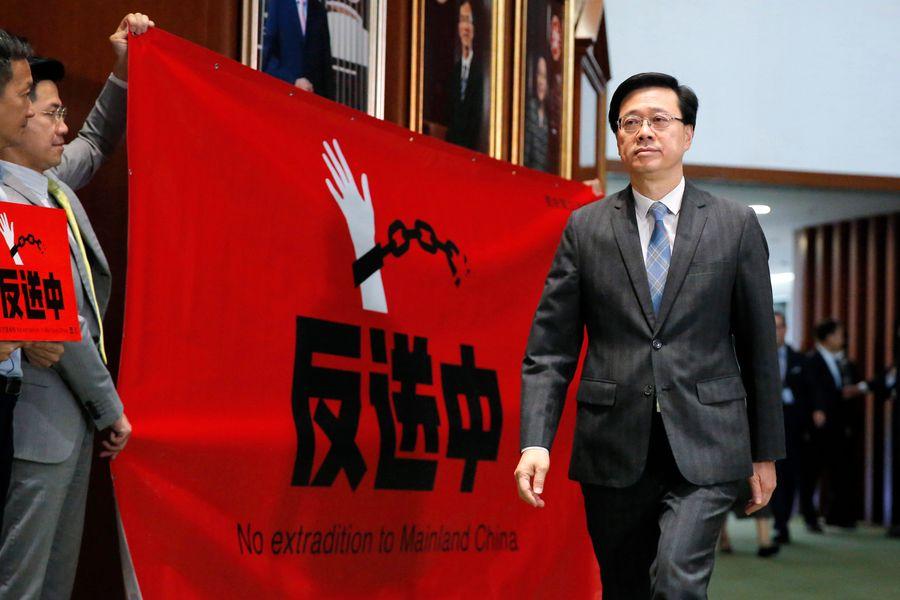
Hong Kong Extradition Law
China Critics to Blinken: Disinvite Hong Kong From APEC
Published June 9, 2023 • Read time: 9m
The Biden administration is under increasing bipartisan pressure from Congress to punish Hong Kong’s leaders for following Beijing’s orders in their continued crackdown on pro-democracy protests and religious freedom.
A bipartisan group of U.S. lawmakers is calling on Secretary of State Antony Blinken to rethink plans to invite Hong Kong leader John Lee Ka-chiu to the Asia-Pacific Economic Cooperation trade summit scheduled to take place in San Francisco this fall.
Sens. Marco Rubio and Jeff Merkley, as well as Reps. Chris Smith and Jim McGovern, four leading champions of human rights in Congress, sent a letter to Blinken this week urging him to bar Lee from entering the United States to attend the summit.
“Inviting a sanctioned human rights abuser is an affront to all those who have been persecuted by the Chinese Communist Party and the People’s Republic of China and its proxies in Hong Kong, including American citizens … as well as prominent Hong Kong leaders,” the lawmakers wrote.
In a previous role as Hong Kong’s secretary of security, Lee worked with the Chinese Communist Party to authorize and launch a violent crackdown against Hong Kong pro-democracy protesters in 2019.
The protesters were taking a stand against the city’s national security law, which criminalizes any form of government protests, characterizing different forms of pro-democracy activism as subversion, secession, collusion with foreign or external forces, and terrorism, defined as the use of violence or intimidation against people.
Paul Says He'd Be "Happy" to Dissolve the U.N.
Reason to Smile About Durban Climate Conference
Long Faces in Durban
Sudanese Genocide Attention Fatigue?
Those prosecuted include journalists and online protest organizers, even those whose crime is limited to displaying flags or banners or chanting slogans critical of the Chinese government. Over the weekend, Hong Kong police arrested dozens of activists and artists on the eve of the 34th anniversary of the military suppression of the 1989 pro-democracy protests in Tiananmen Square.
The Trump administration’s Treasury Department sanctioned Lee for his role in the 2019 crackdown, noting that he was involved in “coercing, arresting, detaining, or imprisoning individuals under the [national security law] … as well as being involved in its development, adoption, and implementation.”
A State Department spokesperson told RealClearPolitics on Wednesday that the invitations for the APEC gathering “have not been finalized at this time” and said the agency “as a general matter” does not comment on congressional correspondence.
“The United States will work towards participation of all delegations in APEC events in accordance with U.S. laws and regulations, and on the basis of the spirit and principles of APEC,” the spokesperson said in a written statement.
The four lawmakers said they had previously asked Deputy Secretary of State Wendy Sherman whether the State Department was planning to invite Lee to the San Francisco meeting, and she confirmed to them in a letter that it is planning to do so.
“As the host, we believe it is important to foster regional economic dialogue for the United States and the [People’s Republic of China] to work together to maintain global macro-economic stability,” she responded in writing.
Sherman stressed, however, that the invitation did not absolve individuals of their role in “undermining protected rights and freedoms in Hong Kong.”
On Thursday, however, a State Department spokesperson told RCP that those written comments by Sherman were issued to Congress by mistake and that no decisions about the APEC invitations have been made.
“An incorrect version of this answer was inadvertently transmitted to Congress,” the spokesperson said in a statement. “The Department regrets the error. No decisions about [APEC] invitations have been made, and the United States has committed to work towards participation of delegations from the 21 member economies in APEC events but has made clear this participation must be in accordance with U.S. laws and regulations, including with respect to sanctions.”
The spokesperson said it has notified Congress about the mistake, but at least two key offices on the Hill who had taken issue with Sherman’s original comments told RCP they had not heard anything about the retraction.
This is the second time in a week that the State Department has angered key lawmakers on Capitol Hill regarding China and Hong Kong. Some Republican members lambasted the decision earlier this week to have Assistant Secretary of State for East Asian and Pacific Affairs Daniel Kritenbrink’s travel to Beijing on the 34th anniversary of the June 4, 1989, Tiananmen Massacre. Chinese police in Beijing and Hong Kong marked the day with a massive presence around the square in Beijing and arrests of dozens of people who tried to commemorate the anniversary in Hong Kong.
“While in Beijing, the assistant secretary raised human rights in his meetings,” a State Department spokesperson told Politico.
The statement did nothing to quell GOP lawmakers’ irritation.
The timing of the trip “is an outrage. … There must have been a late night of celebratory toasts inside the Central Propaganda Department when the State officials landed,” said Rep. Mike Gallagher, a Wisconsin Republican who chairs the House Select Committee on China.
“Unless it was to commemorate the Tiananmen Square massacre, Assistant Secretary Kritenbrink should not have gone to Beijing,” Rubio stated.
National Security Council spokesman John Kirby argued that critics were “making a whole heck of a lot out of nothing,” prompting Smith and Rep. Darrell Issa to pen a letter to Blinken and Kirby demanding to know why Kritenbrink decided to travel to Beijing on June 4.
Smith and other top China critics in Congress have repeatedly condemned the Hong Kong government’s use of the national security law to prosecute Jimmy Lai, the Hong Kong entrepreneur and media titan whose Apple Daily newspaper was known for criticizing the Chinese government until it was shut down after a police raid in 2021. Lai is serving a five-year prison sentence and previously served 20 months for unauthorized assemblies. Wong Wai-keung, Lai’s fellow media executive, was found guilty of fraud and jailed for 21 months.
Others prosecuted include Cardinal Joseph Zen, the highest-ranking Catholic bishop in Hong Kong, and Joshua Wong Chi-fung, the secretary-general of the pro-democracy party Demosisto until it was forced to disband after the implementation of the national security law.
Earlier this week, the House Congressional-Executive Commission on China, led by Smith, urged British Prime Minister Rishi Sunak to pressure China on behalf of Lai and other political prisoners in Hong Kong and pressed U.S. and British officials to coordinate their Hong Kong policies. Sunak is on a two-day trip to the United States. Last month during testimony before Congress, Sebastien Lai, Jimmy Lai’s son, expressed disappointment that the United Kingdom had not publicly condemned his father’s detention and had not strongly advocated for his release.
After three years of Hong Kong officials wielding the national security law to silence dissent and control its people, it’s past time for the West to treat its government as an extension of Beijing, U.S. national security experts highly critical of China contend.
“The fact that the U.S., U.K., and others continue to treat Hong Kong as separate from China is a farce,” said Amy Mitchell, a former senior official at the Defense and State Departments and a founding partner at Kilo Alpha Strategies. “Hong Kong is fully under the control of the CCP – from its imprisonment of Jimmy Lai to squashing any Tiananmen protests just this past week.”
U.S. policy needs to officially recognize the shift, she argued.
“The wishful yearning for a return to the vibrant and free Hong Kong we all loved needs to end,” Mitchell told RCP. “If the U.S. doesn’t want this change to be permanent, it must begin to act accordingly. Any sanctions, trade, and human rights actions taken against the PRC must also apply to Hong Kong, including the visit of the chief executive of the Hong Kong Special Administrative Region.”
Craig Singleton, senior fellow at the nonpartisan Foundation for Defense of Democracies, said known human rights abusers, such as Lee, should never be “welcomed” to the United States, borrowing a term Sherman used in describing her intent to invite the Hong Kong leader.
“A successful APEC summit does not hinge on Lee’s participation, nor does Beijing have any intention of liberalizing its economy,” Singleton said. “In welcoming Lee, the Biden administration risks adopting a negotiating posture that accommodates and normalizes China’s malign behavior, including its rampant human rights abuses.”
The pleas by the lawmakers and China critics come amid efforts by the Biden administration to begin a thaw in the frosty relations between Washington and Beijing. CIA Director William Burns made a secret trip to China in May to keep the lines of communication open after months of acrimony following a Chinese spy balloon’s flight over the United States earlier this year.
Tensions flared again Thursday over news that China and Cuba had reached a secret agreement for China to establish an electronic eavesdropping facility on the island that would allow Beijing intelligence services to collect electronic communications throughout the southeastern U.S., where many military bases are located. A Chinese base with advanced military and intelligence capabilities situated just 100 miles from Florida poses an unprecedented new threat in the U.S.’ backyard.
Rep. Mike McCaul, who chairs the House Foreign Affairs Committee, said the discovery of plans for a Chinese spying facility in Cuba shows that Beijing is escalating its “aggressive behavior” against the United States.
“It is extremely shameful the Biden administration continues begging the CCP for talks while the CCP’s malign actions speak for themselves,” he said in a statement.
“Joe Biden needs to wake up to the real Chinese threats on our doorstep,” Nikki Haley, a former South Carolina governor, United Nations ambassador, and current GOP presidential candidate, tweeted.
Despite the widespread alarm in Washington over Chinese spying, President Biden and his top foreign policy team have repeatedly stressed the need to continue diplomatic relations with China and appear reluctant to isolate Hong Kong from international gatherings – even when they take place in the United States.
Hong Kong joined APEC in 1991 and continued to participate in meetings as a separate and full member after the city returned to Chinese control in 1997. A spokesman for Lee quoted his previous remarks that APEC does not belong to any country or economy and has a responsibility to invite members to its meetings.

The GOP Majority Should Go Out in Glory
Daniel McCarthy • RealClearPolitics
Republican Majorities Could Return Sooner Than Expected
J.T. Young • RealClearPolitics
The Danger Before the Attack
Leslie J. Sullivan • RealClearPolitics
Jon Finer’s Old and Dangerous ‘New Approach’ to Israel
Peter Berkowitz • RealClearPolitics
The President Deserves Better
John Ullyot • RealClearPolitics
Congress Doesn’t Need Another Blame Game. It Needs To Find What’s Broken
Jarrod Bernstein • RealClearPolitics
RCP Today
Top stories on RealClearPolitics
The Takeaway
Polling intelligence and analysis delivered to your inbox
World News
Featuring the latest world news
Policy
Featuring the latest policy news
Support Our Mission
As part of RealClearPolitics, authors aim to provide balanced, non-partisan analysis by presenting top reporting and commentary from all sides of the political spectrum.
Trusted by policymakers and citizens alike since 2000