
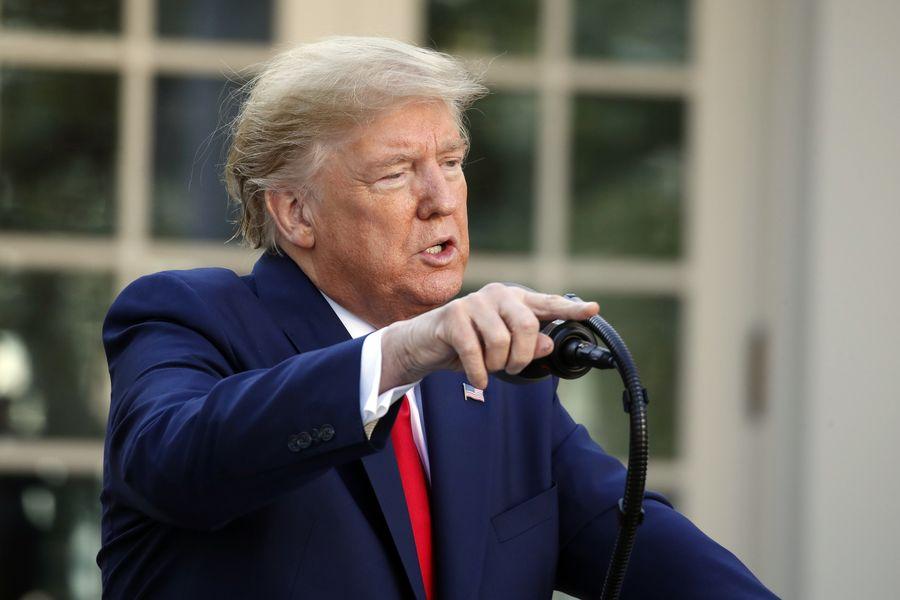
President Donald Trump speaks about the coronavirus in the Rose Garden of the White House, Monday, March 30, 2020, in Washington. (AP Photo/Alex Brandon)
Within Parties, Trump's Crisis Ratings Vary Widely: Week 2
ANALYSIS
Published March 31, 2020 • Read time: 5m
On March 25 we wrote that both partisan affiliation and intra-party ideology affected the public’s reaction to the coronavirus pandemic. We were not surprised by the partisan differences, given polarization, but we were surprised by the extent of intra-party differences. In the YouGov survey taken March 15-17, we found that the president had near-universal support from very conservative Republicans, but support lessened among those who say they are conservative or more moderate. We also found that very conservative Republicans were less likely to have changed behavior in response to COVID-19 than those to their left in the party.
Similarly, moderate Democrats, while still critical of the president, are more likely to agree with him than are those self-identifying as liberal or very liberal. We wondered if the president’s shift from treating the pandemic as a hoax to fighting a war and the corresponding shift in the FOX News (literally the unanimous network choice of 99% of the very conservative) coverage of the pandemic would result in changes in perception and behavior. The most recent YouGov poll -- March 22 to 24 -- allows us to update our results.
Table 1 shows the results for the two surveys for various perceptions regarding the pandemic across parties and intra-party ideologies. The shift in treatment of the crisis seems to have paid off, as the very conservative Republicans continue to say they strongly support his handling of the crisis and conservatives moved to more than 60% agreeing. More importantly, moderate Republicans have moved from only 34% strongly approving of the president to 55% within just one week. Both very liberal Democrats and liberal Democrats, on the other hand, increased their strong disapproval of the president, but moderate Democrats’ opinion of the president actually improved by 4 points. When asked to compare the U.S. response to the virus to other countries’ actions, conservatives in increasing numbers rate the American response better than others, while the moderates remain below 50%. In contrast, the number of very liberal Democrats saying that the United States did worse increased to 66%, while liberals stayed at 61%, and again, moderate Democrats’ impression of the U.S. response improved by 4 points.
The FBI Gained Access; We'd Already Lost Our Privacy
Is Trump Right About NATO?
Arizona's Voting Rights Fire Bell
U.S. Officials Say 2 Americans Died in Brussels Attack
A week ago, a majority of conservatives in the Republican Party did not agree that the pandemic would result in a recession. A week later that has changed, as increases of about 15% across conservatives brings them up to 48% and 54%, while over 60%of moderate Republicans believe in a recession. Democrats, of course, were much more likely to stipulate that a recession was in the wings, and this was true across all intra-party positions; in Week Two, those numbers rise at least 10 points, but the pattern of agreement falls as ideology shifts rightward.
There have been major shifts in behavioral responses toward the pandemic (Table 2). The conservative portion of the GOP who say they reduced eating out and going out more than doubled in the case of the very conservative, and it almost doubled among the conservative, with 73% of both going out less. Their more moderate partisans moved from 65% to 91% saying they went out less. The number of Republicans who have changed travel plans -- regardless of ideological self-placement -- went up, with the most conservative (at 35%) and the moderates (at 49%) changing travel plans. Democrats in both surveys reported changing their behavior more than Republicans, but the original liberal-to-moderate differences have disappeared on going out and lessened in the case of changing travel, as across categories, all are at or above 50%. Republicans across the board have worked more from home, but again, moderates are at almost 60%, compared to less than 30% of conservatives. The pattern for Democrats shows an increase in the numbers working at home for very liberal and moderates, but a decline for liberals.
What can we conclude from these changes in data, one more week into the national coronavirus pandemic?
First, on attitudinal measures, partisan differences and intra-party ideological differences remain clearly visible. Republicans still believe that the president’s response has been appropriate and better than that of other countries’ leaders; Democrats hold the opposite view. Republicans are less likely to believe that the pandemic will result in a recession than are Democrats. Though the numbers have moved, slightly in some cases and more significantly in others, the differences in partisan reception has remained remarkably consistent.
Similarly, the intra-party ideological differences that we noted in attitudes earlier has remained, again with the caveat that movement can be seen in all numbers. Very conservative Republicans remain more in line with President Trump’s positions than do conservative Republicans, and both of those are more closely aligned with his views than are moderate Republicans. And the parallel ideological differences, in the opposite direction, are observed among Democrats.
But, second, on measures of behavior — eating out, traveling less, working from home —respondents have clearly changed how they are acting. While partisan and ideological differences remain, on the first two measures they have narrowed significantly, and we cannot discern any pattern on the measure of working at home, perhaps, as we speculated last week, because the decision to do so or not is often beyond the respondent’s control.
We see little reason to suspect that partisan and ideological reactions to President Trump’s actions in the coming weeks will differ in the general pattern of support /opposition by party. However, as the president has indicated a desire to ease restrictions on business closings and other restrictions on Americans’ personal activities, we need to be cognizant of partisan and ideological differences in response to these major potential changes in his policies.

The GOP Majority Should Go Out in Glory
Daniel McCarthy • RealClearPolitics
Republican Majorities Could Return Sooner Than Expected
J.T. Young • RealClearPolitics
The Danger Before the Attack
Leslie J. Sullivan • RealClearPolitics
Jon Finer’s Old and Dangerous ‘New Approach’ to Israel
Peter Berkowitz • RealClearPolitics
The President Deserves Better
John Ullyot • RealClearPolitics
Congress Doesn’t Need Another Blame Game. It Needs To Find What’s Broken
Jarrod Bernstein • RealClearPolitics
RCP Today
Top stories on RealClearPolitics
The Takeaway
Polling intelligence and analysis delivered to your inbox
World News
Featuring the latest world news
Policy
Featuring the latest policy news
Support Our Mission
As part of RealClearPolitics, authors aim to provide balanced, non-partisan analysis by presenting top reporting and commentary from all sides of the political spectrum.
Trusted by policymakers and citizens alike since 2000