
What Governor Race Outcomes Could Tell Us
Published Nov. 4, 2014 • Read time: 7m
Republican National Committee Chairman Reince Priebus recently visited Wisconsin to campaign for GOP candidates in his home state. Following a rally, a reporter asked him how he would feel Tuesday night if Gov. Scott Walker lost his re-election bid but Republicans took control of the Senate.
Priebus replied, “That’s not a good night.”
The national party chair -- who helped lay the groundwork for Walker’s 2010 victory and other historic GOP gains in the Badger State four years ago -- has a personal interest in seeing his good friend re-elected. But Priebus’ response underscored a broader point: For all the attention paid to the Senate, close gubernatorial races also keep national political operatives up at night.
The policy implications of gubernatorial elections are huge, as state chief executives can shape the lives of their constituents in ways that newly elected senators can only dream of. From restructuring tax codes to expanding gun rights -- governors, especially those on good terms with the legislature, can reshape their states’ destiny in just a few years.
About 250 million Americans live in the 36 states holding gubernatorial elections this year. Twenty-two of these states currently have Republican governors, and Democrats control the remaining ones. RealClearPolitics rates 14 contests as tossups (evenly split between Democratic and GOP administrations). Only one out of every four races overall is rated “safe” for the current officeholder’s party.
Altogether, Republican governors run 29 states, and Democrats have the helm in 21. Without considering the tossups, Republicans are looking at a net loss of two governor’s mansions, according to RCP polling averages. But they could lose four. Or win five. The RCP average shows nine races within three percentage points (which is less than a typical survey’s margin of error).
National dynamics don’t influence gubernatorial races in the same way they do Senate contests, which makes it hard to draw broad conclusions about the outcomes. Yet, it’s still possible to pull meaning from Tuesday’s results.
Here’s what to look for tonight.
A (Bad? Terrible? Horrific?) Year for Incumbents
In the last 50 years, about 80 percent of incumbent governors have won re-election. They’ve done even better recently. None lost in 2012 and just two were consumed by the Republican wave in 2010. Since 1990, no more than four have lost their jobs in any single election. The 2014 roster could break that streak.
It’s extremely unlikely that challengers will beat incumbents in every tossup race, but this is shaping up to be an unusually tough year for sitting governors. It’s hard to find a unifying geographic or political pattern: Democrats and Republicans alike face crushing losses from Hawaii to Pennsylvania.
Hawaii’s Neil Abercrombie finished second in the Democratic primary earlier this year, dashing his re-election hopes. Tonight, Pennsylvania Gov. Tom Corbett is expected to lose to his Democratic challenger, who is ahead by double digits. Alaska’s Republican governor, Sean Parnell, has trailed his independent opponent in three of the last five polls. Some Kansas Republicans privately concede that they don’t think Gov. Sam Brownback will survive. And other close contests in Illinois, Colorado, Florida, Maine, Michigan, Wisconsin, and Connecticut provide plenty more opportunities for failed re-election bids.
The biggest question tonight: Will 2014 go down as a bad year for incumbents, or a horrific one?
2016 Implications
During the 1998 midterms, then-Texas Gov. George W. Bush won re-election with 68 percent of the vote, a convincing victory that boosted his presidential aspirations. Seeking to replicate Bush’s model for 2016, Gov. Chris Christie campaigned especially hard in New Jersey and won with 60 percent of the vote in his 2013 re-election.
Ohio Gov. John Kasich -- a former congressman with executive experience in a swing state -- is often touted as a potential dark horse candidate for the Republican presidential nomination. He also leads his challenger by more in a purple state (21 percentage points) than Democratic Gov. Jerry Brown leads in deep-blue California (18.5 percentage points). A convincing win tonight will bolster the rationale for a Kasich candidacy.
Scott Walker has more modest hopes -- just winning in a blue state is enough to keep his 2016 chances alive. If he holds off challenger Mary Burke, Walker 2016 will begin the next day -- assuming the final tally is known by Nov. 5.
Possible vice presidential picks are also up for re-election, and driving up big margins will make them even more attractive choices. Republican Gov. Brian Sandoval might get 70 percent of the vote in Nevada, though he told RCP earlier this year that he has no plans beyond winning and finishing his second term. New Mexico Gov. Susana Martinez, another Hispanic whose name has been bandied about as a Republican VP pick, should win by double digits.
What Happens to New England?
Nothing serves as better proof that gubernatorial races are distinct from national trends than what’s happening in New England. RCP classifies almost every New England contest as a tossup. (Vermont, once “safe” for Democrats, is now rated “likely Democrat.”)
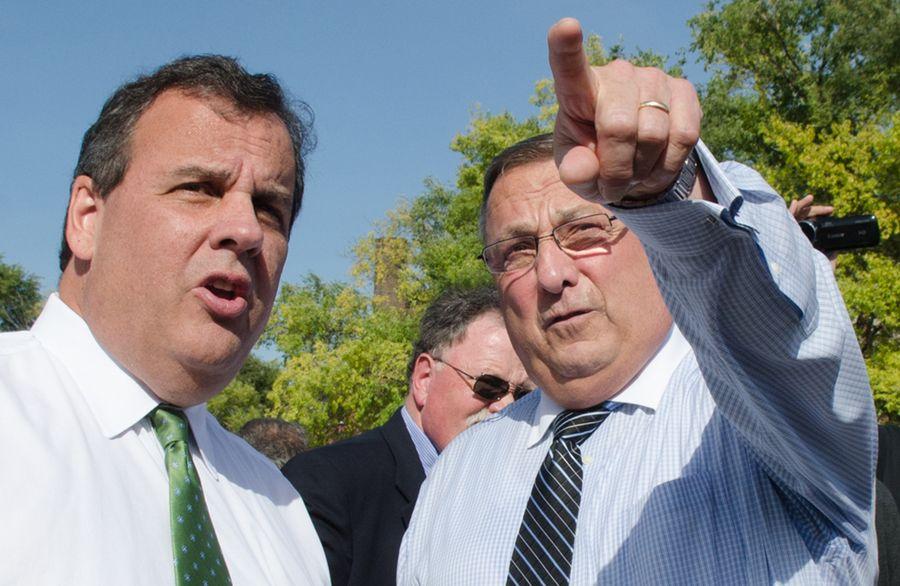
Maine Gov. Paul LePage (pictured), a Republican, leads a three-way race by just over one percentage point. Connecticut Gov. Dan Malloy is similarly vulnerable, though he is in a traditional Democrat-Republican matchup. Democrat Martha Coakley has trailed Republican Charlie Baker in the last five Massachusetts governor polls. New Hampshire Gov. Maggie Hassan leads her Republican challenger, Walt Havenstein, by an average of three points, though a recent poll showed him down by just one. In Rhode Island’s open race, Democrat Gina Raimondo is ahead of Republican Allan Fung in a surprisingly close race.
Today, just one of the six New England states has a Republican governor; that number could increase to five. Likewise, Republicans could become extinct in the region. The election will test how well the GOP can contend in New England this year -- and perhaps teach national Republicans lessons about winning over independents and Democrats.
Red State Democrats
Speaking with reporters earlier this year, Democratic Governors Association Chairman Pete Shumlin, who is also governor of Vermont, said he felt “optimistic” about his party’s chances in red states like Georgia, South Carolina, Kansas, and Arizona.
The South Carolina effort has fizzled -- as has the Arizona one, to a lesser extent. Yet, Democrats could well win in Kansas, and Georgia remains a tossup. These competitive red state races could provide some hope for Democrats in an otherwise bleak year. If their candidates win or lose by smaller-than-expected margins in the South, expect them to use a similar campaign model in the future to seek inroads in GOP strongholds.
The Long Game
Candidates typically won’t acknowledge it, but sometimes they don’t expect to win their elections. In fact, sometimes they aren’t even running to win. Candidacies have been used as a stepping-stone to television gigs or appointed positions, among other aspirations.
But doomed candidacies aren’t always selfish. One rationale for running impossible races is to improve the image of the candidate’s political party. A Republican might not pull off a win in a blue state, but he could soften his party’s image. Likewise, a Democrat could build fundraising infrastructure and demonstrate a pragmatic bent during a losing campaign -- setting up competitive challenges in the future.
In Texas and California, state Sen. Wendy Davis and former U.S. Treasury official Neel Kashkari are almost certain to lose -- and they’re likely to lose by double digits. But building a better future for their parties was always part of the reason for their candidacies.
Election Day will test that reasoning. Did Davis and Kashkari hurt or help their party (and themselves)? The results in California and Texas could speak volumes about what effect candidates had on their moribund party’s status. It doesn’t look good for either -- Davis has made countless flubs and Kashkari is poised to lose by more than the Republican did in 2010.
But election night still might offer some surprises. That’s part of the fun.

RCP Today
Top stories on RealClearPolitics
The Takeaway
Polling intelligence and analysis delivered to your inbox
World News
Featuring the latest world news
Policy
Featuring the latest policy news
Support Our Mission
As part of RealClearPolitics, authors aim to provide balanced, non-partisan analysis by presenting top reporting and commentary from all sides of the political spectrum.
Trusted by policymakers and citizens alike since 2000