
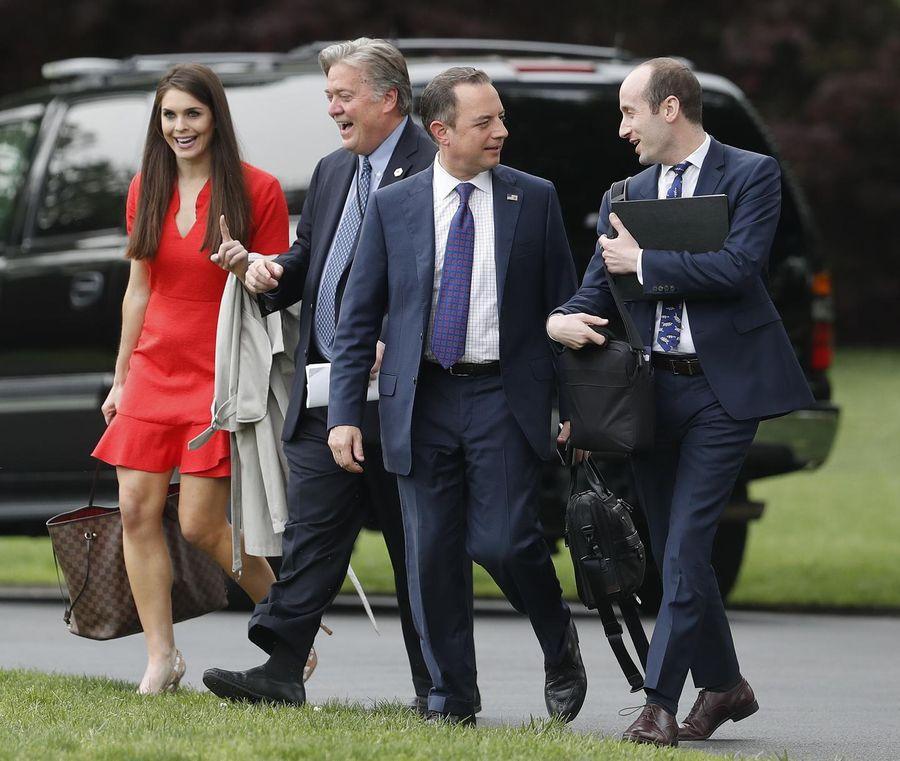
White House adviser Hope Hicks (L-R), Chief White House Strategist Steve Bannon, White House Chief of Staff Reince Priebus and senior adviser Stephen Miller, walk across the South Lawn of the White House in Washington, Saturday, April 29, 2017, to board Marine One helicopter and join President Donald Trump for the short flight to Andrews Air Force Base, Md., before traveling to Harrisburg, PA., for a rally. (AP Photo/Pablo Martinez Monsivais)
Trump Veterans Stay the Course Amid WH 'Chaos'
Published June 2, 2017 • Read time: 6m
Join the Conversation
0For White House staffers who are veterans of Donald Trump’s 2016 presidential campaign, the ups and downs of this week have been just another day at the office.
“We suffer from Stockholm syndrome that has been forged in battle,” one former senior transition official told RealClearPolitics, mischaracterizing somewhat the psychological condition in which captives come to sympathize with their captors. The meaning here is that these staffers forged bonds on the rough and tumble campaign trail, a dynamic that has fortified them against pushback from other White House staffers who worked at the Republican National Committee, as well as from the party itself and the press.
Their daily working environment includes random tweets from the boss, a constant barrage of unwelcome breaking stories about the administration on the cable news programs blaring from televisions in their offices, the desire for this president to unravel decades of policies forged under previous administrations of either party—along with the specter of multiple Russia investigations consuming official Washington.
But this was how the campaign operated. Take Thursday’s announcement that the United States would walk away from the Paris climate accord, for example. Although it had leaked days before, until the moment the formal announcement was made in the Rose Garden, even Trump loyalists were unsure it would happen. Their skepticism had a basis in reality. In April, the president indicated the United States was leaving NAFTA, until later in the day when he announced it wasn’t.
That confusion is par for the course for those who were with the Trump campaign since before he won the GOP nomination. “New people [who] don’t understand that chaos of the mad scramble here, they get demoralized,” the official said. “They get frustrated.”
The “new” people are identified as those who came aboard in the latter stages of the campaign, such as White House Chief of Staff Reince Priebus and press secretary Sean Spicer. The divisions among the president’s staff – between those who worked on the pre-nomination campaign and those who worked at the RNC – persist.
Trump is said to be more comfortable with those who were with him when the entire Republican Party establishment was dismissive of his candidacy. Even after he revealed his strength as a candidate, GOP leaders didn’t exactly rush to embrace their nominee. House Speaker Paul Ryan took a month once Trump had the nomination locked up to finally endorse his candidacy. Priebus reportedly encouraged Trump to withdraw from the race in October after the infamous 2011 “Access Hollywood” recording came to light.
If Trump has shown one consistent behavior, it’s that he doesn’t forget a slight. He also demands that his staff demonstrate their personal loyalty to him, which means it has to be proven with regularity in front of the cameras. Spicer has borne the brunt of that burden. Forget all that has happened in the first 4 ½ months of this administration – even forget that very first press conference Spicer held, where he berated the media for giving what the White House claimed were inaccurate estimates of inauguration day crowds -- let’s take the past week.
Can you say “covfefe”? The president’s Twitter account tweeted early Wednesday morning: “Despite the constant negative press covfefe.” The confusing tweet was live six hours before it was deleted, having by then become an Internet sensation. Apparently, the president meant to type “coverage,” and hit the send button before auto-correct came to his aid. Later, Trump tweeted, “Who can figure out the true meaning of "covfefe" ??? Enjoy!”
Was this glee at confounding his critics, or Trump’s version of self-deprecation? No one seemed to know, but one thing was certain: It was up to Spicer to defend it. In doing so, he showed another side of the White House, the one where it can’t be admitted the president made a mistake. "The president and a small group of people know exactly what he meant,” Spicer said when asked about the tweet.
Spicer is a victim of constant rumors and speculation that he will be out of a job soon (or not – it depends on the news cycle). But, as he spends more time in the White House and more time with Trump, his briefings have changed. They have become shorter in length, less frequent in occurrence, and more subdued in their language.
On Tuesday, the first briefing after the president’s trip abroad, Spicer offered few specifics to several questions. He was asked whether the U.S. Embassy in Israel would be moved to Jerusalem. “When the president has a decision to make we'll let you know,” he replied.
Asked about whether a new FBI director was being considered and about a possible timeline for filling the post, he answered, “The president is the ultimate decision-maker. And when he makes a decision as to who he believes is best to lead the FBI, he will let us know.”
In trying to figure out how to please his new boss, Spicer doesn’t have the advantage enjoyed by Hope Hicks, a longtime Trump aide who’s now in the press office.
When asked by the Washington Post to comment on Trump’s treatment of staffers, she offered this glowing comment: “President Trump has a magnetic personality and exudes positive energy, which is infectious to those around him. He has an unparalleled ability to communicate with people, whether he is speaking to a room of three or an arena of 30,000. He has built great relationships throughout his life and treats everyone with respect. He is brilliant with a great sense of humor … and an amazing ability to make people feel special and aspire to be more than even they thought possible.”
Although the statement was widely mocked, it served a purpose. It showed the kind of adulation Trump expects of his staff when it comes to defending him. It also shows how the president views himself, whether the reality matches the sound bite or not.
These staff divisions and the demands of trying to please the boss have led to mixed messages coming out of all parts of the West Wing and a sense of the tumultuous way the White House operates. The one person who could provide clarity is Trump himself.
And the biggest way he could do it is with the chief of staff job. There has been speculation for nearly all of Trump’s time in office that Priebus will be out. Whether that will actually happen, only the president knows. But if Priebus does go, who gets the job next will be telling. Will the president pick a campaign veteran – such as David Urban, who won Pennsylvania for him – or will he choose someone who came aboard later, such as Gary Cohn, a former Goldman Sachs president who is director of the National Economic Council?
That decision will determine the direction of his presidency – at least for a while. In the meantime, as that senior transition official told RCP when speaking of this administration: “It will never be boring.”


RCP Today
Top stories on RealClearPolitics
The Takeaway
Polling intelligence and analysis delivered to your inbox
World News
Featuring the latest world news
Policy
Featuring the latest policy news
Support Our Mission
As part of RealClearPolitics, authors aim to provide balanced, non-partisan analysis by presenting top reporting and commentary from all sides of the political spectrum.
Trusted by policymakers and citizens alike since 2000