
Election 2025 Redistricting California
Newsom's Prop 50 Pays Off as GOP Gerrymanders Flop
ANALYSIS
Published Nov. 5, 2026 • Read time: 9m
Midway through Tuesday night, as the blue wave began to crest, the man who drew California’s new congressional map poked a little fun at the GOP’s expense. Paul Mitchell, whose firm Redistricting Partners executed Gov. Gavin Newsom’s map-drawing effort, was watching election returns come in from Florida, Texas, and North Carolina. All three are states where Republicans redrew their lines at President Trump’s urging.
“Night of the Broken Gerrymander,” Mitchell posted on X.
Three hours later, the wave had clearly washed away much of what Republicans hoped to gain through redistricting, and Mitchell sharpened the jab. He referred to GOP efforts as the “DummyMander,” crediting the fictional Massachusetts Gov. Elbridge Dummy, a riff on Elbridge Gerry, the real governor who gave the gerrymander its name.
The namesake was a joke. The rebuke behind it was not, and it added a fresh sting to an already painful night for Republicans.
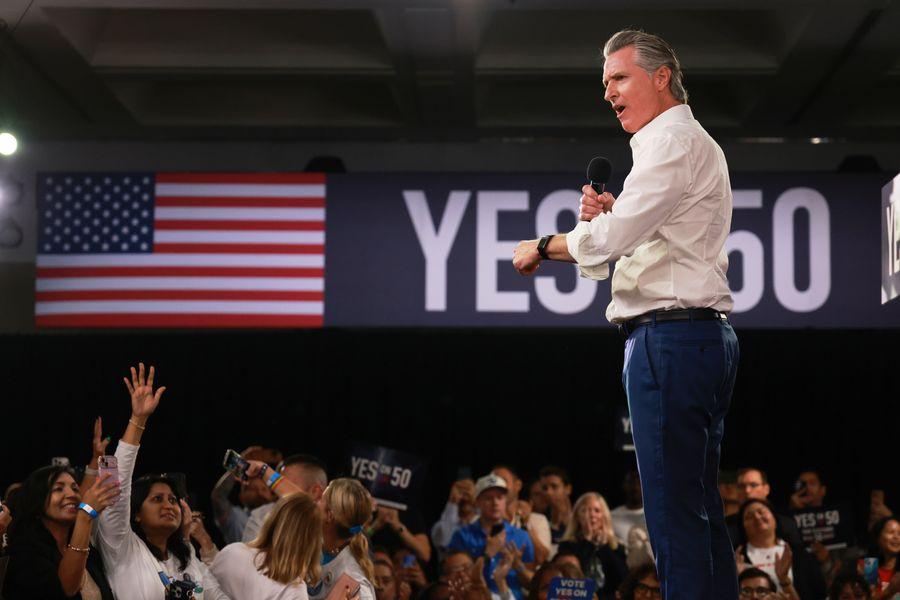
When Newsom answered Texas’ Trump-ordered gerrymander last summer by vowing that California would redraw its own map, critics called it a vanity project and a betrayal of the state’s independent redistricting commission. A year later, California Republicans are set to lose five seats, and the redistricting scoreboard heavily favors the outgoing governor. The gamble earned him bragging rights and a claim to at least a stake in the Democrats’ flipping control of Congress.
At a San Francisco rally late last month Newsom framed the stakes bluntly, saying Democrats had “fought fire with fire” but still had to deliver the five seats, not just redraw them. They did.
All five Republican-held California seats targeted by Proposition 50 have flipped or are projected to flip to Democrats, according to the most recent election results. California’s Republican House delegation, which stood at nine after the 2024 election, is on track to fall to four. Meanwhile, the Republican redraws in Texas and elsewhere that set off the redistricting arms race have largely collapsed. Of the 15 seats the GOP drew in its favor across the country, Republicans are projected to win just two.
Prop 50 was approved by roughly 65% of voters in a November 2025 special election and left in place by the U.S. Supreme Court in February. It replaced the commission-drawn map with lines drawn by the Democratic Legislature for 2026 through 2030. The Democrats aimed squarely at five Republican-held seats – and got them all:
CA-1 (North State). Democrats flipped this seat, previously held by Republican Doug LaMalfa. After LaMalfa passed away in January, state Sen. James Gallagher ran in his place against former state Senate leader Mike McGuire, who won comfortably. The redrawn district helped Democrats by shedding conservative areas near the Oregon border.
CA-6 (Placer County to North and West Sacramento). Democrats gained this seat as former state Sen. Richard Pan defeated Kevin Kiley, roughly 57.5% to 42.5% in unofficial returns. Kiley, now an independent after leaving the Republican Party, previously represented the old CA-3 and ran here after Prop 50 dismantled his district. He conceded Tuesday night.
CA-22 (Central Valley). Democrats flipped this seat, with Randy Villegas ousting Republican David Valadao. Valadao has served a total of 12 years in Congress; he lost in 2018, then won the seat back in a big upset in 2020.
CA-41 (now southeast L.A. County). This is a Democratic gain in a district rebuilt as a D+16 seat. Rep. Linda Sánchez (D) ran here against Republican Mitch Clemmons. Republican Ken Calvert, the previous incumbent, moved to run in CA-40.
CA-48 (inland San Diego/Riverside). Democrats are projected to flip this seat, which was held by retiring Republican Darrell Issa. The race pits Democrat Marni von Wilpert against Republican County Supervisor Jim Desmond in a district that shifted about 18 points toward Democrats.
The redraw also shored up Democrats elsewhere. Rep. Ami Bera, whose old CA-6 was carved up, moved to the redrawn CA-3 and won Tuesday. Democrat Rep. Adam Gray was declared the winner in CA-13. The end result is that California Republicans were pitted against each other in a party that is a shell of its former self.
Prop 50 merged the districts of Republicans Ken Calvert and Young Kim into the new, safely Republican CA-40, guaranteeing one of them would be out of a job. Calvert led Kim about 54.5% to 45.5% Wednesday night with 42% of the vote counted.
Add Reps. Tom McClintock (CA-5), Vince Fong (CA-20), and Jay Obernolte (CA-23), all in districts where registered Republicans outnumber Democrats, and the delegation lands at four. A drop to three would require Democrats to win one of those Republican-registration seats, which looked unlikely Wednesday.
The rest of the country: GOP gerrymanders backfired
Nine states used new maps in 2026, putting 21 seats in play. Fifteen were drawn to favor Republicans. Here is where each landed.
Texas (target: +5 GOP). The map that started the war converted five Democratic seats into districts Trump would have carried by 10 points or more. Republicans won only one: the Dallas-area TX-32, where Jace Yarbrough beat Democrat Dan Barrios by nearly 3 points.
Democrats held TX-28 (Henry Cuellar) and TX-34 (Vicente Gonzalez). They also won TX-9 (Leticia Gutierrez, whose opponent conceded within an hour of polls closing), and TX-35 (Johnny Garcia). Democrats took two GOP-held seats as well, including TX-15, where Tejano star Bobby Pulido unseated Rep. Monica De La Cruz in a district Trump won by 18 points. Net result: Republicans end up with fewer Texas seats than before they redrew.
Florida (target: +4 GOP). Zero for four so far. Reps. Kathy Castor (FL-14) and Jared Moskowitz (FL-25) won reelection, Moskowitz despite $26 million spent against him. Democrat Pia Dandiya won the open FL-22. Rep. Darren Soto holds a narrow lead in FL-9, which remains uncalled.
Ohio (target: +2 GOP). Both targeted Democrats, Greg Landsman (OH-1) and Marcy Kaptur (OH-9), won. Democrats also flipped OH-7 and OH-15, and Kristina Knickerbocker leads Rep. Mike Turner in OH-10.
North Carolina (target: +1 GOP). Rep. Don Davis (D) leads in the redrawn NC-1, which is uncalled. Republican Greg Murphy, whose district was reshaped in the process, leads by just 0.1 point. Democrats flipped the open NC-11 and lead GOP incumbents in five other districts.
Tennessee (target: +1 GOP). This is one of the GOP’s two wins: Republicans are projected to take TN-9. But Democrat Victoria Broderick leads Rep. Scott DesJarlais in TN-4, which would cancel the gain.
Alabama (target: +1 GOP). Rep. Shomari Figures (D) held AL-2 despite a map Republicans considered friendlier after a Supreme Court ruling.
Louisiana (target: +1 GOP). LA-6 heads to a Dec. 12 runoff.
Missouri. The GOP’s redraw was tied up in court and then rejected by voters in a referendum Tuesday. Democrats also flipped MO-2.
Utah. A court-ordered map, the product of a separate yearslong legal fight, created one Democratic-leaning seat.
Why California worked
It was built for a bad Republican year, not a good one. Prop 50 didn’t need a perfect night. It moved targeted districts sharply left (CA-48 by about 18 points; CA-41 into a D+16 seat), so the new lines held even under ordinary conditions. In a wave year, the margins became lopsided, as Valadao’s 2-1 loss showed.
It packed Republicans rather than spreading them thin. Instead of trying to win everywhere, the map concentrated GOP voters into a handful of safe seats, most visibly by forcing Calvert and Kim into the same district. That conceded a few seats in exchange for making the rest unwinnable for Republicans.
Voters owned it. Because the map went to the ballot and passed with about two-thirds support, Democrats could campaign on it as a popular mandate rather than a shady backroom deal.
It drove incumbents out early. Issa retired rather than run in the redrawn 48th. Calvert abandoned his seat to fight a fellow Republican. Kiley, one of Newsom’s sharpest critics, saw his district broken apart and had to introduce himself to new voters in CA-6. Each move deprived the GOP of incumbency advantages where it needed them most.
Why the GOP maps failed
They assumed 2024 voting patterns were the new normal. It was a costly miscalculation. Shifting voter behavior did much of the damage. At the margins, it was helped along by what political scientists call a dummymander: a map whose authors spread their own party’s voters too thin or misread where the electorate is headed. Michael Li, a redistricting and voting-rights attorney at the Brennan Center for Justice, has posited that American politics has been unusually volatile since Trump first won in 2016. That makes every gerrymander a big wager on a future no one can see clearly, and an expensive one when the bet goes wrong.
Texas Republicans have been burned this way before. State legislative maps drawn after 2010 to maximize GOP gains looked far less favorable by 2018, after the Dallas suburbs swung left and once heavily white districts grew more diverse. This year’s congressional map repeated the mistake. It assumed Republicans would keep Trump’s 2024 gains with Hispanic voters, who made up a majority of eligible voters in four of the five targets. Instead, Hispanics swung back toward Democrats, driven by the economy and anger over the excesses of the administration’s aggressive deportation policies.
The 2026 maps stretched Republican voters too thin. To create new GOP seats, mapmakers shaved Republican margins in districts they already held. In a neutral year that works; in a wave, it puts safe seats in play. That is how De La Cruz lost a previous Trump +18 district and how Murphy ended up in a near tie.
Candidates and incumbents mattered. Cuellar and Gonzalez were well known in their districts and won easily on unfamiliar lines. Republicans fielded weaker challengers and, in some cases, were badly outraised. Experts in Texas also cited weak GOP messaging.
The national environment swamped the lines. Democrats won control of both chambers and posted gains well beyond redrawn districts. According to AP projections, that included Senate pickups in Texas, Iowa, Kansas, North Carolina, Ohio, and South Carolina. No map could insulate Republicans from a swing that size.
Support Our Mission
The Internet provides an endless stream of content. Not all of it is worth your time. That's why, every day, RealClearPolitics curates the most essential news and information—from all sides and across mediums. The links, videos, and podcasts curated here are the product of human judgment, not algorithms or AI. Please help power our mission of presenting a thoughtful, balanced public discourse through a tax-deductible donation.
Would you consider supporting us today?
Contributing to RealClear Politics through the RealClear Media Foundation supports essential initiatives that drive meaningful change.



RCP Today
Top stories on RealClearPolitics
The Takeaway
Polling intelligence and analysis delivered to your inbox
World News
Featuring the latest world news
Policy
Featuring the latest policy news
Support Our Mission
As part of RealClearPolitics, authors aim to provide balanced, non-partisan analysis by presenting top reporting and commentary from all sides of the political spectrum.
Trusted by policymakers and citizens alike since 2000