
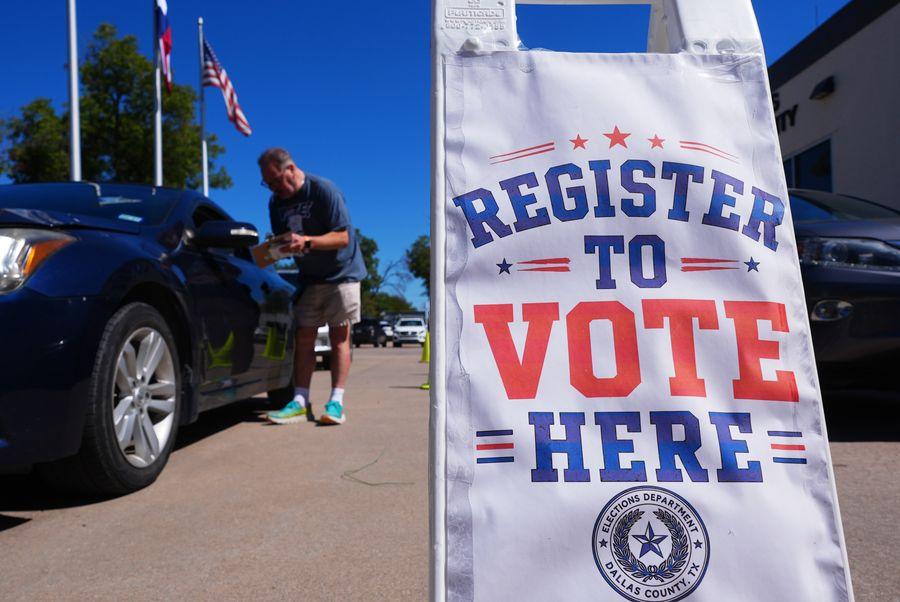
Election 2026 Voter Registration
Locked Out, But Not Checked Out
POLL ANALYSIS
Published Oct. 9, 2026 • Read time: 6m
Join the Conversation
0Three in four registered voters sat out this year’s primaries, something analysts typically chalk up to voter apathy. It’s not a crazy assumption. In fact, that’s the most common reason non-voters gave for not voting in the latest RCINI/Emerson College Polling survey, sponsored by Unite America: They were busy or forgot. But this isn’t the entire story. Some 15% of non-voters, including 28% of independents who didn’t vote, gave a different answer: They said they weren’t eligible to participate. While this might seem like a relatively small number, it is 11.5% of the registered voters in the sample, and translates to millions of voters who say that the reason they didn’t vote in a primary was simply that they weren’t allowed to (we should note that this group is 173 people in the survey response group, giving a margin of about plus or minus 7.5 points).
What’s more, these voters look little like the rest of the “stay-at-homes.” Fifty-five percent have a college degree, compared with 34% of non-voters overall. Forty-two percent are 60 or older. And just 5% are undecided about November, against 21% of all non-voters. In other words, these are voters who are invested in the process but say that they don’t have a means for getting involved. And they’re also the angriest about the way we select nominees.
We began by asking whether people voted in their state’s 2026 primary elections. Thirty-five percent of Democrats reported doing so, while 24% of Republicans answered yes. Among independents, the number was the smallest: just 17%. When we followed up and asked why they didn’t vote, only 4% of Republicans chose “I am not eligible to vote in primaries as an independent/state holds closed primaries.” Among Democrats the number is 12%. This may seem odd on its face, but if one party didn’t have a primary and it is a closed-primary state, then you would be prohibited from participating in the other party’s primary. In any event, among independents the number is 28%. Notably, this is the most common answer given by independents. The top choices given by both Republicans and Democrats were “I was busy/forgot,” and “I did not like any of the candidates.”
Obviously, we can’t know for sure whether people are being honest about their reasons. Voting is a socially desirable activity, and when confronted by a stranger, even over the Internet, people don’t want to confess that they forgot or didn’t care. Nevertheless, those who said they weren’t eligible resembled primary voters. College-educated voters comprise 55% of this group, compared with 34% of non-voters overall, and just 5% are undecided about November, in line with the 6% of primary voters. They are also older than non-voters and receive their news from different sources: 26% are 70 or older, double the share among those who stayed home, while 29% rely primarily on independent outlets such as Substack for their news, compared with 14% of non-voters overall. Nor do they appear to be closet partisans: Their job approval of Trump is 35%, close to the 34% among all voters.
These are also the system’s angriest critics. When asked “How well do you think the primary election system is working to give voters meaningful choices and produce nominees who represent their communities?” only 30% said “very” or “somewhat” well, far below the 49% rate given by primary voters. Another 31% of this group said, “not at all well,” double the rate among non-voters overall. When asked whether national parties, ideological voters, and wealthy donors had too much influence over the process, the “not eligible” voter gave more negative responses than non-voters overall in each category.
Overall, these voters support reform. Only 14% would oppose requiring open primaries, while 70% support it (higher than among independents in general). Asked about Washington-style primaries (where the top vote-getters advance regardless of party), 63% of the “not eligible” group support it, while 54% of independents and 56% of voters overall support it.
Finally, we find in the data support for a national solution. As noted above, these voters don’t appear to be lying, as they are demographically different from other non-voters and give consistent answers. Yet some are plainly confused, as only about half of them live in closed-party states. One respondent wrote, “I live in AZ. Our state does not allow independent voters to participate in primary elections. This cuts out about 1/3 of eligible voters.” But this isn’t true; Arizona allows independents to vote in non-presidential primaries. This reminds us of the importance of perception in politics. Our patchwork of registration laws can be confusing, and subtle rules allowing independents to vote in either primary, but disallowing partisans from crossing over, can fuel misperceptions among the average voter.
Outtakes
It’s a tough environment for people involved in politics, so I thought I would share some of my favorite responses to open-ended questions. I’ve tried to keep them good-natured. At the same time, we might take this as a reminder that the broader American public really is different in important ways from the average person who enjoys reading 1000-word pieces on primary reform. Without further ado:
When asked why people didn’t vote in the primary, my favorite responses were “I was in jail,” “parole,” and the winner: “I wasn’t properly motivated but my God I am now.” When asked “why” as a follow-up for people who think the primary system works well, we got “The primary is the worst method for selecting a party’s candidate, except for every other option we’ve come up with”; “Piss poor democratic candidate. Zero personality. But I will definitely vote for her because Perry is damn bum!”; “While I do think primary elections are good for selecting a representative of a community … Also the median voter is an idiot”; and my favorite: “Because Stone Cold Said So.” Bonus points for honesty to the respondents who answered, “I just want this money from this survey”; and “You ask to [sic] many stupid questions, you act like the government. Get a real job,in a real business ,doing something you can be proud you are a part of.”
Finally, from people who thought the system was not working well: “For the reasons you said and have clearly manipulated me to think so I won’t fight it and will just continue with your manipulative questions here”; and “Someone distracted me. I forgot the question.”
Despite the heading here, this really isn’t just frivolity. These are Americans who have a stake in the political process, and who cast votes that count just as much as ours. People who pursue reform must remember that the pitch can’t just work for high-information respondents; it should be able to convince these Americans.
Support Our Mission
The Internet provides an endless stream of content. Not all of it is worth your time. That's why, every day, RealClearPolitics curates the most essential news and information—from all sides and across mediums. The links, videos, and podcasts curated here are the product of human judgment, not algorithms or AI. Please help power our mission of presenting a thoughtful, balanced public discourse through a tax-deductible donation.
Would you consider supporting us today?
Contributing to RealClear Politics through the RealClear Media Foundation supports essential initiatives that drive meaningful change.


RCP Today
Top stories on RealClearPolitics
The Takeaway
Polling intelligence and analysis delivered to your inbox
World News
Featuring the latest world news
Policy
Featuring the latest policy news
Support Our Mission
As part of RealClearPolitics, authors aim to provide balanced, non-partisan analysis by presenting top reporting and commentary from all sides of the political spectrum.
Trusted by policymakers and citizens alike since 2000