
FDR's Ghost Is Smiling on Wisconsin's Governor
Published Feb. 19, 2011 • Read time: 4m
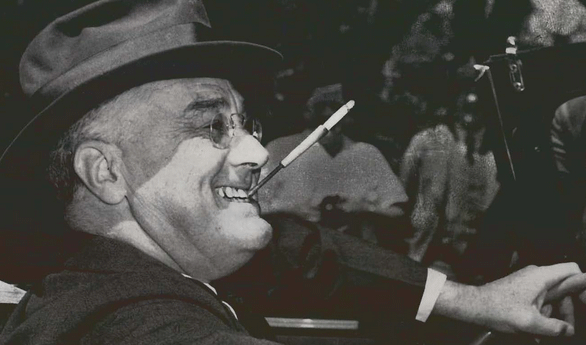
Somewhere, Franklin Delano Roosevelt is grinning past his cigarette holder at Wisconsin's governor. They are on the same page regarding government unions.
Except that Scott Walker -- Republican cheapskate, his visage Hitlerized on signs waved by beet-faced union crowds besieging the Capitol -- is kind of a liberal squish compared to FDR. He's OK with some collective bargaining.
Walker, you might have heard, wants some changes in how Wisconsin deals with unions. He wants state employees to pay 5.8% of their salaries toward their pensions (they pay almost nothing now) and he wants them to cover 12.6% of their health care premiums (their share would go up from $79 a month to about $200; the average private-sector sap pays about $330).
Unions are enraged. They've been calling such increases unspeakable since Walker was elected handily in November. Then, Feb. 10, Walker went further. He'd allow public-sector unions to negotiate only pay, not benefits, mainly because he wants HSA-style health plans and 401(k)-style retirements for state workers, and unions would fight that, tooth and ragged red claw.
So unions erupted. Teachers faked illness in such numbers as to close school districts for days. Mobs beat on the doors of legislative chambers. And in some heavenly Hyde Park, the great liberal god of the 1930s is saying he saw it all along.
Roosevelt's reign certainly was the bright dawn of modern unionism. The legal and administrative paths that led to 35% of the nation's workforce eventually unionizing by a mid-1950s peak were laid by Roosevelt.
The FBI Gained Access; We'd Already Lost Our Privacy
Is Trump Right About NATO?
Arizona's Voting Rights Fire Bell
U.S. Officials Say 2 Americans Died in Brussels Attack
But only for the private sector. Roosevelt openly opposed bargaining rights for government unions.
"The process of collective bargaining, as usually understood, cannot be transplanted into the public service," Roosevelt wrote in 1937 to the National Federation of Federal Employees. Yes, public workers may demand fair treatment, wrote Roosevelt. But, he wrote, "I want to emphasize my conviction that militant tactics have no place" in the public sector. "A strike of public employees manifests nothing less than an intent on their part to prevent or obstruct the operations of Government."
And if you're the kind of guy who capitalizes "government," woe betide such obstructionists.
Roosevelt wasn't alone. It was orthodoxy among Democrats through the '50s that unions didn't belong in government work. Things began changing when, in 1959, Wisconsin's then-Gov. Gaylord Nelson signed collective bargaining into law for state workers. Other states followed, and gradually, municipal workers and teachers were unionized, too.
Even as that happened, the future was visible. Frank Zeidler, Milwaukee's mayor in the 1950s and the last card-carrying Socialist to head a major U.S. city, supported labor. But in 1969, the progressive icon wrote that rise of unions in government work put a competing power in charge of public business next to elected officials. Government unions "can mean considerable loss of control over the budget, and hence over tax rates," he warned.
There was "a revolutionary principle rather quietly at work in American government," he wrote.
The principle was working at about 100 decibels in Wisconsin's Capitol last week, once the union drum-beaters got going. What worked them up was the money they'd concede, they said, but even more that Walker would make their unions surrender the control they'd gained over every government budget.
Walker, like other Republicans, was long accused of hating government. For eight years as chief executive of heavily Democrat Milwaukee County, he would not raise taxes, which opponents said showed his contempt for government.
Yet all this past week, he praised public employees and he said the work government does is so necessary, taxpayers should get as much of it for their money as possible. Meanwhile, thousands of schoolteachers on the Capitol lawn manifested their intent to obstruct Government and their belief that the tots back at Roosevelt Elementary could darn well spend a day or three watching Nickelodeon at home.
And, to beat all, the president who now professes to be the new Reagan weighed in to say Walker was being unduly mean to unions. President Obama gave no audible word on whether unions were being unduly mean in shutting down schools.
Walker, good Republican, is no FDR but he is offering Wisconsin a new deal, lower-case. Wisconsin's been a seedbed of bad ideas since it hatched Progressivism, and for years it's stuck with unionized government even as the price swelled. Walker's radical shift is to try securing necessary government at a better price. The unions, whose model depends on making government labor as costly as taxpayers will bear, object.
May they be haunted by the ghost of the 32nd president, and his little dog, too.
The GOP Majority Should Go Out in Glory
Daniel McCarthy • RealClearPolitics
Republican Majorities Could Return Sooner Than Expected
J.T. Young • RealClearPolitics
The Danger Before the Attack
Leslie J. Sullivan • RealClearPolitics
Jon Finer’s Old and Dangerous ‘New Approach’ to Israel
Peter Berkowitz • RealClearPolitics
The President Deserves Better
John Ullyot • RealClearPolitics
Congress Doesn’t Need Another Blame Game. It Needs To Find What’s Broken
Jarrod Bernstein • RealClearPolitics
RCP Today
Top stories on RealClearPolitics
The Takeaway
Polling intelligence and analysis delivered to your inbox
World News
Featuring the latest world news
Policy
Featuring the latest policy news
Support Our Mission
As part of RealClearPolitics, authors aim to provide balanced, non-partisan analysis by presenting top reporting and commentary from all sides of the political spectrum.
Trusted by policymakers and citizens alike since 2000