
Bono: To Defeat Extremism, Fund Needy Nations
Published April 12, 2016 • Read time: 5m
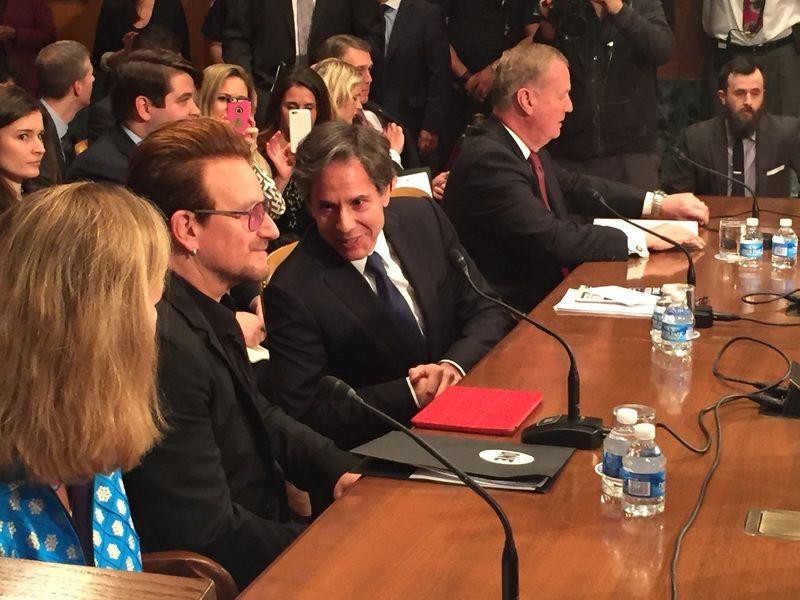
International rock star and humanitarian Bono captivated Capitol Hill Tuesday as he advocated a modern Marshall Plan to combat violent extremism across the globe.
Dressed in black, with his trademark pastel-colored glasses, the singer argued that helping countries in need -- as the United States helped economically devastated Western European countries after World War II -- isn’t just an act of kindness.
“The fact is that aid can no longer be seen as charity -- a nice thing to do when we can afford it,” he told a Senate subcommittee. “It is national security, and when it’s structured properly with a hard focus on fighting corruption and improving governance to qualify for that aid, it could be the best bulwark we have against the violent extremism that is gaining traction ... ”
The U2 lead singer is cofounder of the ONE Campaign, which works to fight extreme poverty and disease, especially in Africa. He recently returned from a trip to Jordan, Kenya, Turkey and Egypt. There, he said he realized that the Syrian refugee crisis was neither temporary nor isolated to the Middle East. An average refugee crisis, Bono said, lasts 25 years. Today, refugees are flowing across the globe, but especially into Africa, home to five of the top 10 host countries for refugees, he added.
Africa’s population will double to more than 2 billion people by 2050, meaning 40 percent of young people in the world will be African, he said. If the United States does not make an effort to improve life for African people, future generations will have to answer to a large, disenfranchised population down the line, said the singer.
Bono’s testimony before the Senate Appropriations subcommittee on State, Foreign Operations, and Related Programs, drew an unusually large crowd of photographers, who sat on the floor in front of the panelists. The press table was also entirely full. Press and audience members took selfies with Bono immediately after the hearing, even waiting in the halls for him as left the room.
Sen. Lindsey Graham, R-S.C., subcommittee chairman, told the gathering that educating the youth in war-torn countries is a much more powerful way to combat terrorism than dropping bombs. He said he tells his constituents, “Either we invest over there or they’re coming here.”
After the terrorist attacks on Sept. 11, 2001, the United States spent about a trillion dollars, plus another $1.5 trillion on the wars in Afghanistan and Iraq, Graham said. He thinks this crisis could be solved at a fraction of that cost with a worldwide effort.
“If we do nothing I know exactly what’s going to happen,” he said. “Some of our friends are going to fall, and the people in these camps today are going to be our enemies. So you have two choices when it comes to these young people: get in their lives now or fight them later.”
Retired Gen. James Jones, a national security adviser to Obama from 2009 to 2010, said the United States needed to shift its focus from reaction to anticipation and prevention to these threats, a more cost-effective move. Human need threatens global security more than any religious or political ideology, he added. Many young people are motivated to join extremist causes simply to get basic necessities such as food, energy, water and dignity, Jones said.
Sen. Jeanne Shaheen, D-N.H., agreed that the United States has not yet aligned these priorities into its spending patterns, noting how much is spent on humanitarian aid versus the amount spent on the military -- “a huge disparity,” she said.
Bono argued that chaos in the Middle East could spread to other parts of the world, including Africa and Europe.
He praised Angela Merkel, chancellor of Germany, for her leadership in the refugee crisis, noting that Germany has become the heart of Europe. All countries need to take in more refugees, he said.
He also called on the international community to stop simply holding meetings and issuing press releases and instead start cutting checks. As of last month, the United Nations’ humanitarian response plan for 2016 had received only 9 percent of the funding it required. Additionally, these nations need commerce, new trade agreements and loans from the World Bank to get back on their feet, he said. Humanitarian aid and long-term development efforts should go hand in hand to combat the crisis, he said.
“The military is ahead of the politicians on this one,” he said. “I mean, they really understand what has to be done, and I’m amazed by that. In an asymmetrical conflict, you just can’t use the old strategies, and there’s new weapons needed, and sometimes those weapons are education, you know, fighting disease.”
Bono said he has worked with congressmen on both sides of the aisle and that this is the one topic that they all can agree on—the need to intervene in the crisis. Failure to address the issue and appropriate money now to combat it would be the “worst foreign policy mistake of the start of the 21st century,” he warned.
“America becomes America when it looks outward,” Bono said. “You know, when you’re a continent behaving like an island, you’re not America. It’s just not who you are.”


RCP Today
Top stories on RealClearPolitics
The Takeaway
Polling intelligence and analysis delivered to your inbox
World News
Featuring the latest world news
Policy
Featuring the latest policy news
Support Our Mission
As part of RealClearPolitics, authors aim to provide balanced, non-partisan analysis by presenting top reporting and commentary from all sides of the political spectrum.
Trusted by policymakers and citizens alike since 2000