
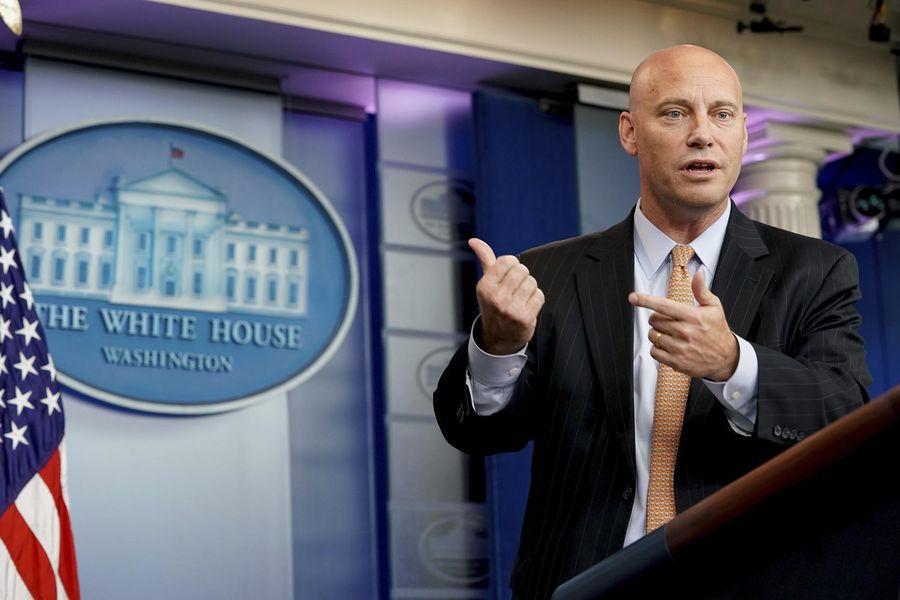
White House Director of Legislative Affairs Marc Short talks to the media about the GOP Senate healthcare bill during the daily press briefing at the White House in Washington, Wednesday, July 19, 2017. (AP Photo/Andrew Harnik)
Trump Seeks to Speed Up Hill Deliberation on Taxes
Published Sept. 12, 2017 • Read time: 5m
Join the Conversation
0Here’s what tax reform advocates don’t have this week: actual legislation; lots of time this year; consensus.
Here’s what they do have: a seriously impatient president.
To add some octane to what he sees as a slow-moving Congress, President Trump is preparing this month to unveil some specifics in any tax bill he would sign, ideally with buy-in from members of his party, White House Legislative Affairs Director Marc Short said Tuesday.
Whether a more prescriptive Trump can produce results by December remains uncertain (the president has not ruled out down-shifting to tax cuts rather than more ambitious “reform,” if it means getting something signed in 2017).
“We're focused on making sure we get a complete tax reform package. That's the goal,” White House Press Secretary Sarah Huckabee Sanders said this week. “And if that doesn't happen, we'll look at other options at that point.”
On Friday, Trump registered his impatience with a GOP game plan hatched with the White House months ago that cedes bill drafting and momentum to the House Ways and Means and Senate Finance committees, along with GOP leaders.
“Republicans must start the Tax Reform/Tax Cut legislation ASAP. Don't wait until the end of September. Needed now more than ever. Hurry!” the president tweeted.
On Saturday during a Cabinet meeting at Camp David, Trump linked the federal urgency attached to hurricane response to his sense of urgency to lower taxes.
“I think now with what’s happened with the hurricane, I’m going to ask for a speed-up,” he said about tax legislation. “I wanted a speed-up anyway, but now we need it even more so.”
House Freedom Caucus conservatives have advised the White House that without first seeing tax-bill specifics, they are reluctant to vote on a budget for fiscal 2018, Short said. The White House, in turn, understands that without budget instructions, it cannot enact tax reform in the Senate with a simple majority, as planned.
Trump intends to offer some additional specifics this month before the tax-writing committees on Capitol Hill produce draft tax legislation for lawmakers’ consideration, a document Short called “a unified outline with Congress.”
“I think you will be seeing in a matter of days, not weeks, this administration pushing out more details on what we believe should be needed in tax reform,” Short said, arguing that “differences” among Republican factions are now closer to resolution.
“I think there are some preferences on just the mechanics of just getting through the month of September,” he continued. “The White House is anxious to do that now. So I think you’ll see the White House go ahead and push to get that laid out sooner.”
Rep. Kevin Brady, the chairman of the Ways and Means Committee, gave no indication of speeding up the process on Capitol Hill, telling reporters Tuesday that "we always want to do it sooner rather than later" but that lawmakers' focus is on "getting the policy right." Brady will brief the full House GOP conference Wednesday morning during their weekly meeting to update members on current tax reform status.
Trump has twice this year unveiled spare outlines of tax principles coordinated with House and Senate Republicans, but disagreements continue to simmer within the GOP as the congressional calendar shrinks. The House expects to be in session 42 more days through December, while the Senate plans 50 more work days.
Trump continues to insist he wants to lower the corporate tax rate to 15 percent, assessed by some Republicans in the Senate as overly ambitious to attract sufficient votes for passage.
“We should aim for what we think is best, “ Short explained during a question-and-answer event on Tuesday, sponsored by the Christian Science Monitor. Trump also believes that getting corporate rates down is “more important” than full, immediate expensing of capital investments for businesses, he added. And the president is “committed” to extending lower corporate rates to small-business filers, Short said.
At the same time, middle-income tax “relief” is also a Trump priority, the president’s top legislative affairs adviser told reporters.
Trump, restless to mark a significant legislative victory after Republicans failed to repeal and replace the Affordable Care Act, more than ever wants to sign legislation in 2017, not early in 2018 – a calendar extension some Republicans, including Senate Majority Leader Mitch McConnell, signaled could become a fallback.
Asked if Trump would settle for a slimmer measure that could lower taxes for individuals and corporations this year, rather than holding out for a more complex rewriting of the tax code, Short said the president ideally wants a “territorial” system that would tax income earned in the United States, and exclude income earned abroad by companies with U.S. headquarters. In the president’s view, that change, which Republicans acknowledge as controversial, would be “reform” that could spur increased domestic U.S. investment, Short said.
Trump will host a White House dinner with GOP senators Tuesday to discuss tax reform. Six red-state Democrats are expected to attend. The president says he has reached out to the minority party on taxes, but to date he’s limited his focus to Democratic senators who represent states he won in 2016 and who face re-election next year.
The squeeze play is intended to be political as well as a form of insurance, in case any tax bill that emerges struggles to attract support from every Senate Republican. Budget reconciliation – which permits passage of some measures by a simple majority in the Senate rather than a 60-vote threshold -- remains the “path forward,” from Trump’s perspective. Getting 60 votes for a measure Trump wants to sign is not possible, the administration and GOP lawmakers have concluded.
Many Democrats are “looking to try to deny victories to the administration,” Short added, “rather than looking out for the interests of the American people.”
James Arkin contributed to this report.





RCP Today
Top stories on RealClearPolitics
The Takeaway
Polling intelligence and analysis delivered to your inbox
World News
Featuring the latest world news
Policy
Featuring the latest policy news
Support Our Mission
As part of RealClearPolitics, authors aim to provide balanced, non-partisan analysis by presenting top reporting and commentary from all sides of the political spectrum.
Trusted by policymakers and citizens alike since 2000