
Election 2026 California Billionaires Tax
The Global Wealth Tax 'Movement' Just Hit a Wall in California
COMMENTARY
Published Nov. 12, 2026 • Read time: 6m
Tuesday’s election results delivered a verdict on the wealth tax movement: It has hit a wall, and the wall was in California.
California, a state that in 2024 voted for Kamala Harris over Donald Trump by 20 points, just rejected a wealth tax 52.8% to 47.2% at current count. This came on the best night the Democrats have had since Watergate. If you are a wealth-tax supporter, not only are you in the super-minority among all U.S. voters – you are in the minority among progressive voters.
Maybe overseas looks better? Oops, maybe not. In October, France – mon Dieu! – once again rejected a 2% wealth tax on fortunes over 100 million euros. The wealth tax has been repealed in nine of the 12 European nations that had one as of 1990. It turns out the only members of this so-called global movement are French academics, tax attorneys who know a heap of good-paying work when they see it, and soak-the-rich politicians on the left.
The Paris School of Economics’ Gabriel Zucman, the French-born economist leading the push for the tax, has described his campaign as “the beginning of an international movement to finally make the super-rich pay their fair share.” He had predicted that a victory for California’s Proposition 40 would have “a ripple effect not only in the U.S., but globally” and “pave the way for a federal tax on extreme wealth.” “This is a historic moment,” he said, as he barnstormed the state. California’s voters disagreed.
Proponents object that billionaires spent $304 million to defeat Proposition 40, which is true. But the claim that money determines elections has been repeatedly tested and found wanting. Elon Musk spent $158 million backing Ken Paxton in Texas; the results can tell you how effective that was. Kamala Harris spent about $1 billion and Hillary Clinton and affiliated groups about $1.2 billion in their presidential campaigns. The lesson never seems to get learned, but it is irrefutable: Money can amplify a message. It cannot manufacture votes where they don’t exist.
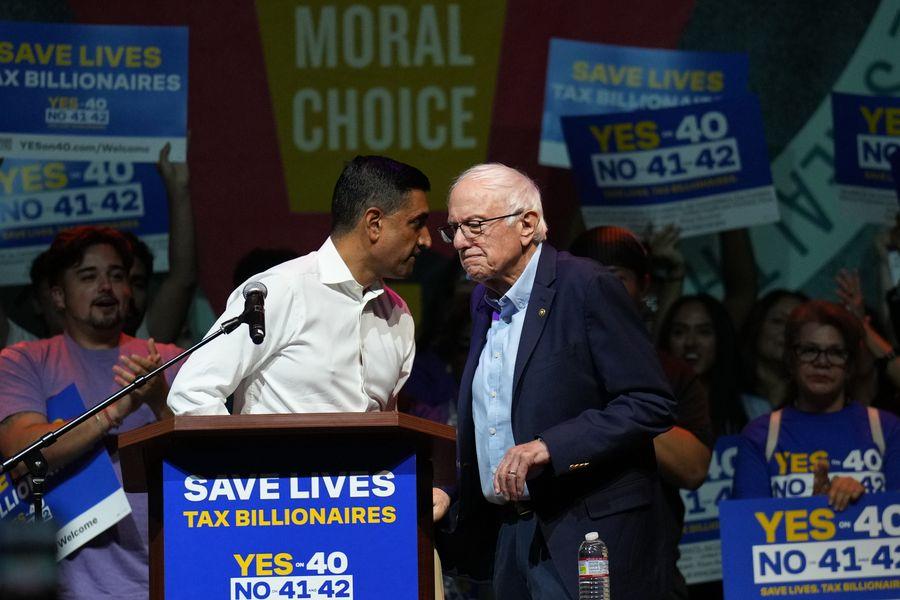
Nonetheless, after the loss, Rep. Ro Khanna (D-California) immediately called for a 2028 do-over. Proponents might convince some hard-left legislators to try another ballot initiative, but they may never get a more favorable electorate than the angry progressive wave that showed up at the polls Tuesday. Worse, a second vote would be expensive. California spent $6.5 million to $7.2 million putting Proposition 40 on the ballot, while some fraction of billionaires fled the state over the mere possibility of this tax, taking billions of dollars of income tax payments with them.
To appreciate the proposal’s logic, try applying it in reverse. What if any public proponents of another wealth tax initiative were required to pay $6.5 million to $7.2 million out of their personal assets before it can be considered? Call it a Fair Share of Democracy Assessment. Naturally, this obligation would apply retroactively to cover the costs of Proposition 40 as well. They would have five years to pay, ample time by the proposal’s own reassuring arithmetic to earn the money back, so in the end they “wouldn’t lose any money.” Anyone short of cash could sell assets. Anyone understating those assets would face penalties.
If this sounds objectionable when applied to wealth tax proponents, that is the point. The opportunity to earn back a required payment does not make it costless. Retroactivity and selective targeting do not become fair (or legal) because the people affected are unpopular. Those saying “they can afford it” ought to consider the wisdom in “do unto others as you would have them do unto you.”
Zucman is right on one thing, however: Nothing that begins in California stays in California, and Tuesday’s results have implications for the federal level too. Since some proponents of wealth taxation also happened to have been elected to the U.S. Senate, there is a newfound audience for this “movement.” Those incoming senators will swear an oath to uphold Article I, Section 9, Clause 4 of the U.S. Constitution: “No capitation or other direct tax can be laid” unless it is proportional to the state-by-state population census.
This Direct Tax Clause requires that the revenue raised from a direct tax be proportional to each state’s share of the U.S. population. Thus, the clause prevents a regional alliance of states from imposing a direct tax on, say, wheat or cotton in order to extract revenue from states in another region that produce the thing being directly taxed. The limitation prevents taxation from being used as a cudgel by a majority of states against a minority.
The same logic applies to tech or finance today. A wealth tax would be a direct tax. Therefore, for it to be constitutional, it would require that the rate paid by all asset holders produce an amount of revenue proportional to a given state’s population. That means proponents would need to sell the country on different tax rates for different states – a higher tax rate in Delaware and Rhode Island, where there are fewer high-wealth individuals, and a lower one in New York or California, where there are more.
The income tax hit the same wall. In 1895, the Supreme Court struck down a federal income tax as an unapportioned direct tax. It took nearly two decades from that point to pass the 16th Amendment, which authorized Congress to tax incomes without apportionment among the states. A wealth tax on unrealized assets is not an income tax. It would need its own constitutional amendment, requiring two-thirds of Congress and three-quarters of state legislatures.
Good luck with that. The only alternative is a Supreme Court willing to contort the words of the income tax amendment to include unrealized ownership of assets. In other words, the federal path is less viable than a state one.
But if the people have their way, as they should, none of that will happen – in the United States or anywhere else. If proponents could not pass a wealth tax in California last week, they are very far away from convincing the electorate in two-thirds of states to support an amendment.
In practice, no global movement for a wealth tax has demonstrated any strength at the ballot box. The only movement is Gabriel Zucman on his long flight back to Paris after his losing California campaign. C’est la vie.
Support Our Mission
The Internet provides an endless stream of content. Not all of it is worth your time. That's why, every day, RealClearPolitics curates the most essential news and information—from all sides and across mediums. The links, videos, and podcasts curated here are the product of human judgment, not algorithms or AI. Please help power our mission of presenting a thoughtful, balanced public discourse through a tax-deductible donation.
Would you consider supporting us today?
Contributing to RealClear Politics through the RealClear Media Foundation supports essential initiatives that drive meaningful change.






RCP Today
Top stories on RealClearPolitics
The Takeaway
Polling intelligence and analysis delivered to your inbox
World News
Featuring the latest world news
Policy
Featuring the latest policy news
Support Our Mission
As part of RealClearPolitics, authors aim to provide balanced, non-partisan analysis by presenting top reporting and commentary from all sides of the political spectrum.
Trusted by policymakers and citizens alike since 2000