
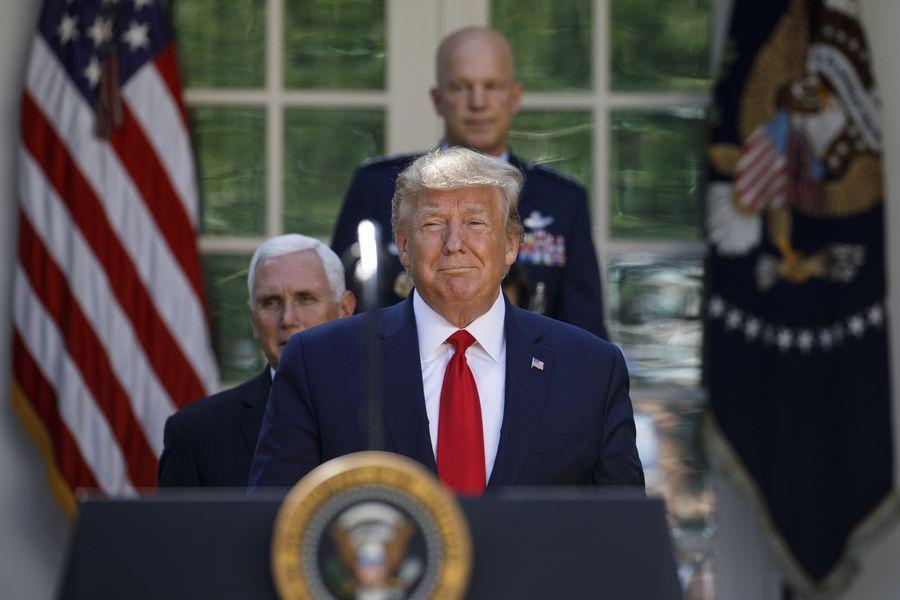
President Donald Trump arrives with Vice President Mike Pence, and Gen. John
Some Clarity on President Trump's Economic Policies
Published Aug. 30, 2019 • Read time: 4m
It's a fact that President Donald Trump has a remarkably large number of supporters among the voters and pundits who label themselves as "free market." They usually say something like, "Sure, I don't like his trade and immigration policies, but the rest are good." I disagree.
With the exception of a few policies, the Trump presidency -- aided by a largely GOP Congress -- will end up being, by a large margin, a very pro-government intervention administration.
This is not about assessing the president's personality, behavior or impact on the "presidency": It's about economic policy. Further, it's mostly about legislation the administration has molded or supported, not its executive orders. As good as some of Trump's executive orders have been, as we learned with the end of the Obama era, the next administration can reverse these very easily.
Most of all, this assessment is about whether the administration's policies will increase or decrease the size and scope of government and whether they will hurt or help the economy. Let's start with the good.
Some aspects of the 2017 tax reform were great. The cut in the corporate income tax rate from 35% to 21% and the reform of state and local tax deductions are important pro-market reforms. The results speak for themselves. High-income taxpayers in high-tax states can no longer shift their state tax burden onto the rest of us through a generous deduction. Capital investments have increased, fueling a growing economy and rising wages. The administration also deserves credit for bringing about some reduction in regulations, an area which Trump has spoken about quite eloquently.
The Brute Force of Government Spending on Autopilot
Please Lie to Us
Soaking the Rich: A Primer
Obama's 180 on 529 Plans Explained Here
Now, the bad. The administration's self-destructive protectionist trade policies are well documented. These resulted in higher tariffs on both imports and exports from many countries, higher prices shouldered by American consumers, nonstop uncertainty, bailouts for affected farmers and the first manufacturing output contraction since 2009, all with little tangible progress -- in terms of trade deals with our partners -- to show for it.
Then, there are the ruthless immigration policies doubled with numerous threats of a reduction in legal immigration and no fundamental reform.
Not all aspects of the tax reform were good policy. The rhetoric and design of an income tax cut for the middle class may have been politically valuable, but it makes no sense economically. Contrary to the administration's rhetoric, it was not the middle class that needed a tax cut. The average income tax rate for the middle-income quintile was 2.6% in 2013. In 2014, the highest-earning, top 10% shouldered around 70% of the total income tax burden, up from 49% in 1980.
In the end, the tax reform kicked more taxpayers off the tax roll, which is not a good way to make them aware of the need to solve our fiscal problems. Worst of all, because it's not offset with spending cuts, it adds to the budget deficit.
As for spending, this administration and the GOP Congress' record is a complete abdication of fiscal responsibility. From the first terrible budget deal to a second budget agreement that might qualify as our worst ever, modern Republicans make Democrats look like Calvin Coolidge. Don't get too comfortable with your tax cut because with this level of spending, it may not last long.
Then there's the president's constant bullying of Federal Reserve Board Chairman Jerome Powell to bring back loose monetary policies and inject the economy with a sugar rush to temper the consequences of bad trade policies. And there's the swamp-filling move to revive the Export-Import Bank, an antiquated bastion of cronyism that mostly benefits large domestic companies, state-owned foreign companies and subsidizes some producers in China, all backed by U.S. taxpayers.
Some will say that Democrats running for office would be more interventionist and worse for the economy, and that Trump gives us an alternative. But those of us who genuinely want less government in our lives should not pretend that these policies are acceptable.
Let's face it: This president is no more interested in fiscal discipline and free markets than his 21st-century predecessors were.
COPYRIGHT 2019 CREATORS.COM

The GOP Majority Should Go Out in Glory
Daniel McCarthy • RealClearPolitics
Republican Majorities Could Return Sooner Than Expected
J.T. Young • RealClearPolitics
The Danger Before the Attack
Leslie J. Sullivan • RealClearPolitics
Jon Finer’s Old and Dangerous ‘New Approach’ to Israel
Peter Berkowitz • RealClearPolitics
The President Deserves Better
John Ullyot • RealClearPolitics
Congress Doesn’t Need Another Blame Game. It Needs To Find What’s Broken
Jarrod Bernstein • RealClearPolitics
RCP Today
Top stories on RealClearPolitics
The Takeaway
Polling intelligence and analysis delivered to your inbox
World News
Featuring the latest world news
Policy
Featuring the latest policy news
Support Our Mission
As part of RealClearPolitics, authors aim to provide balanced, non-partisan analysis by presenting top reporting and commentary from all sides of the political spectrum.
Trusted by policymakers and citizens alike since 2000