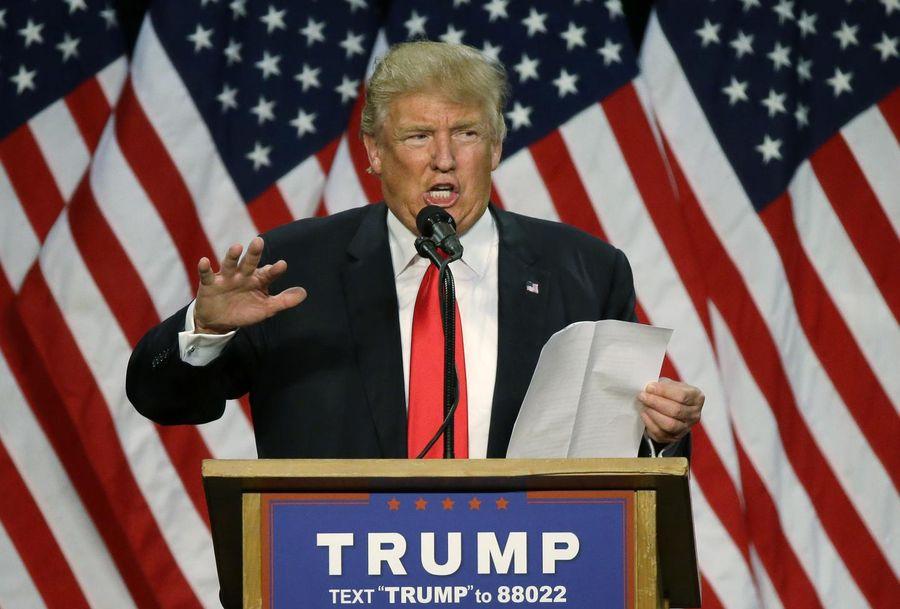
Republican presidential candidate Donald Trump speaks during a rally in Eugene, Ore., Friday, May 6, 2016. (AP Photo/Ted S. Warren)
How the Next President Can Reduce U.S. Debt
Published May 18, 2016 • Read time: 4m
There was a little confusion over presumptive GOP nominee Donald Trump’s recent pronouncements on the national debt. Critics argued he was threatening to default on the full payment of obligations to Treasury bond holders. Trump said he was simply considering whether the government should buy back Treasury bonds at a discount once interest rates rise.
In any case, America’s creditors need not worry that the full faith and credit of the United States is anything other than the ironclad guarantee it has always been and which has made our bonds the safest investment in the world. That guarantee is assured in the 14thAmendment to the U.S. Constitution, which in Section 4 states: “[t]he validity of the public debt of the United States ... shall not be questioned.”
That sweeping proclamation means, in effect, defaulting on the national debt would be unconstitutional. Our debts must be paid no matter what political candidates say about it, no matter how profligately government spends our money, no matter how reluctantly Congress raises the debt ceiling.
Our greater concern ought to be about what the debt level -- now topping $19 trillion or about $150,000 of debt for every household in America -- means for our future. Interest on the debt is the fastest growing item in the federal budget. The U.S. spent an astounding $223 billion in interest payments last year. That number is projected to reach $1 trillion by 2020, “a lot of money,” one analyst observed, “to be spending on something that doesn’t do anything for you.” It’s a lot of money that won’t be spent on repairing America’s aging infrastructure or investing in our children’s future.
The Brute Force of Government Spending on Autopilot
Please Lie to Us
Soaking the Rich: A Primer
Obama's 180 on 529 Plans Explained Here
Thanks to historically low interest rates, debt service in 2015 represented 6 percent of the federal budget, a manageable burden. But as interests rates rise in a growing economy, so will the share of government spending devoted to interest payments, consuming funding needed for other urgent national priorities.
As of today, gross debt, which includes publicly held debt and money the federal government owes itself, represents about 105 percent of GDP. It’s heading toward levels not seen since World War II, and the damaging impacts that that much debt will have on American households include a sluggish economy, slow wage growth, and rising interest rates for credit card payments, car loans, mortgages -- everything.
It is worrisome how little serious discussion there has been about our growing indebtedness from all the presidential candidates and how few detailed, concrete proposals they’ve offered to do something about it.
To help facilitate creative problem solving in the next administration and Congress, No Labels recently released a Policy Playbook for America’s Next President that features proposals that enjoy the support of a majority of the public, which we’ll present in December to members of the new administration’s transition team and the incoming Congress.
To encourage more serious debate in the campaign, we recently released 60 policy ideas that advance at least one of four national priorities: private sector job growth, saving Social Security and Medicare, balancing the federal budget and achieving energy independence. Among those ideas are many that would contribute to debt reduction.
We’ve offered tax reform proposals that would encourage economic growth and yield more revenue. To keep Social Security solvent we’ve suggested reforms that will reduce the entitlement share of the budget by increasing its revenues, slowing the growth of benefits for wealthier beneficiaries, and reducing widespread fraud. To lower Medicare costs we propose letting the government negotiate drug prices, reducing defensive medicine and paying for quality, not the quantity, of medical treatments. We suggested dozens of ideas to put the government on track to balance the budget by 2030.
Of course, we don’t expect every candidate or every American to agree with every one of our ideas. But our attempts to address the nation’s problems with concrete proposals are the kinds of serious examination and debate of the most important issues facing Americans that we ought to expect from candidates for the highest office in the land.
We fault all presidential candidates for mostly avoiding detailed debate on the subject and on other important national challenges, and for their seeming aversion to specifics in their promises to fix our country’s problems.
Don’t worry about politicians defaulting on our debt. The Constitution won’t let them. Worry about what it costs all of us to make good on our debt obligations, and whether the people we elect to high office are prepared to make that burden more bearable. No Labels is committed to helping them do exactly that.

Newsom Defies Voters, Juries and Lawmakers To Spare Murderers While Defending Abortion
Curtis Hill • RealClearPolitics
The Algorithmic Tilt
Frank Filingeri • RealClearPolitics
A RealClear Thanksgiving: Investing in a Better Future
David DesRosiers • RealClearPolitics
Trump’s Newsom Problem: Antagonist-in-Chief
Carolina Lumetta • RealClearPolitics
America’s Free Spirit
John Maxwell Hamilton • RealClearPolitics
The GOP Majority Should Go Out in Glory
Daniel McCarthy • RealClearPolitics
RCP Today
Top stories on RealClearPolitics
The Takeaway
Polling intelligence and analysis delivered to your inbox
World News
Featuring the latest world news
Policy
Featuring the latest policy news
Support Our Mission
As part of RealClearPolitics, authors aim to provide balanced, non-partisan analysis by presenting top reporting and commentary from all sides of the political spectrum.
Trusted by policymakers and citizens alike since 2000