
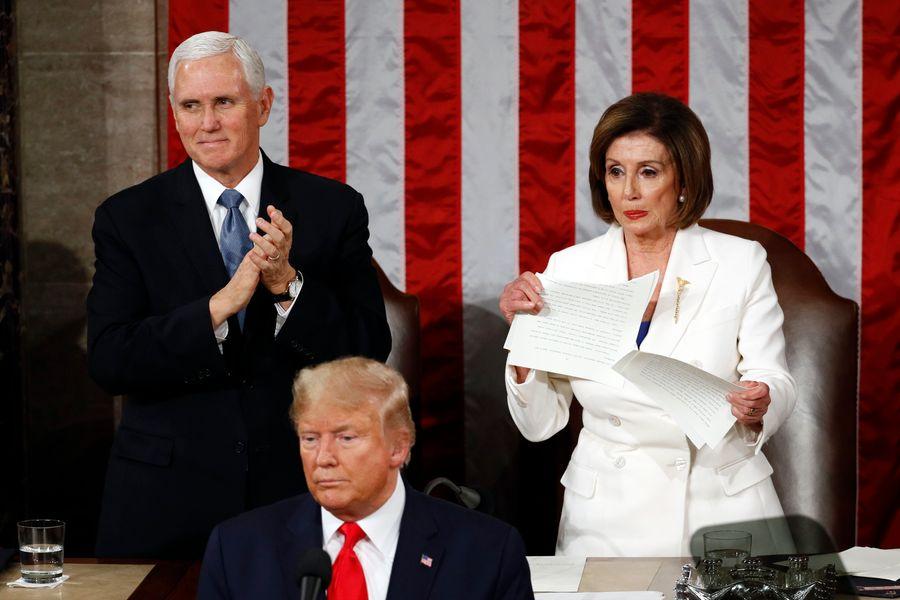
APTOPIX State of the Union
We Must Fix the Polarization Pandemic in the United States
COMMENTARY
Published Feb. 11, 2023 • Read time: 6m
I asked one of my upper-division political science classes to discuss what they thought of Tuesday's State of the Union address and I was alarmed to hear one of them say that “it was surprisingly civil.” It was difficult to hide my amazement at this observation given that to my eyes it was one of the more raucous addresses I had witnessed – including jeers and shouts that President Biden was lying to the American public. As we started to unpack the student’s comment, it became clearer to me just how little we expect of our politicians when it comes to civility.
We went on to recount that on the occasion of Donald Trump’s final State of the Union address, he failed to shake Speaker Nancy Pelosi’s hand, and she ended the night by tearing up his speech in front of the entire world. Of course, less than a year later, that same dais was occupied by rioters seeking to prevent the certification of Joe Biden’s electoral victory. It was an historic moment in the American experience and this “polarization pandemic” continues to persist.
Just before the 2022 midterms, my colleagues and I asked voters in Ohio a series of questions about the current political environment. We modeled our questions after those asked in national polls. We also asked questions relating to Jan. 6 and who deserved the blame for it. We found an electorate that is afraid to discuss politics, fears the political environment will only get worse, and fears that increased violence will likely occur as a result of our political environment. These are all conditions that point to a republic under great duress.
For instance, 70% were afraid to talk about politics, 65% reported that they had strained personal relationships because of the political environment, and 78% agreed that the current political environment was as toxic as it had ever been in their lifetimes. Both Democrats and Republicans agreed that the United States has been weakened on the world stage (77%), and 82% are worried about the country’s future because of the toxic political environment. Given the recent violence against some politicians, it is notable that 7 in 10 respondents fear increased violence as a result of the political climate.
Other polls have similar findings. They generally find that Americans are concerned about the charged political discourse and would like politicians to tone down their rhetoric. Many blame Donald Trump for the recent turn toward a more combative and poisonous political climate.
Yet, a frightening number of Americans are willing to accept violence as part of the political process. A survey from last summer found that 1 in 4 Americans believe that violence against the government is sometimes acceptable. And 1 in 10 stated that violence against the government was acceptable “right now.”
The vicious attack on Nancy Pelosi’s husband Paul (and the subsequent discourse around the attack) makes our findings that much more relevant. Recent video makes clear his assailant was motivated by conspiracy theories about Democrats, and Nancy Pelosi specifically. He indicated that he “was going to basically hold her hostage and … If she told the truth, I’d let her go scot-free. If she f**king lied, I was going to break her kneecaps.” Paul Pelosi was a guest in the first lady’s box during the State of the Union address and Biden made it a point to use Pelosi’s experience as a reason to tone down hateful discourse. Notably, immediately after the attack several key figures, including Sen. Ted Cruz, Rep. Marjorie Taylor Greene, Donald Trump Jr., and Elon Musk either made light of the incident or amplified conspiracy theories surrounding it.
This is against a backdrop in the 2020 campaign when a plot to kidnap Michigan Gov. Gretchen Whitmer surfaced. Several of the participants have been convicted and sentenced for their actions. The Republican governor of Ohio, Mike DeWine, was also a target of that same group.
Political violence is not new and has been the subject of recent research. Political scientists Lilianna Mason and Nathan Kalmoe have found that calls for civility and calm among political elites can bring down the political temperature. This is why the actions of Cruz, Trump Jr., Musk, and Greene are particularly dangerous.
When Republican House member Steve Scalise was shot in 2017, Nancy Pelosi quickly rebuked that attack, as did Joe Biden. This was not a brave thing for them to do, but the right thing. That so many are cavalierly addressing the plot against Pelosi is yet another in a long line of warning signals for our country’s democracy.
The warning lights for democracy are flashing bright red, and unfortunately, too many Americans either are unaware, or are willing to excuse undemocratic and sometimes illegal actions in favor of their own party’s fortunes. Motivated reasoning is a powerful force that blinds individuals to the wrongdoings of their own party and works to demonize the actions of opponents. It is clear that the citizenry is responsive to elite cues, which makes their actions especially important in such tense times.
In order to move beyond this “polarization pandemic,” we must start with civility. Our politicians must set a better example for all of us. Tolerance is a key feature of healthy democracies and is most likely to prevail when people of different backgrounds, ideas, and experiences talk to one another and get to know one another. When we see people as people and not as “the other,” we are far more tolerant, cooperative, and respectful of each other. We need fewer silos and more playing fields where more Americans can engage with one another.
Research experiments by scholars James Fishkin and Larry Diamond on “deliberative democracy” show great promise. They find that when members of different parties are encouraged to get to know one another and are informed on issues from multiple perspectives, their opinions often soften and they view one another more positively.
Creating deliberative democracy opportunities throughout the country would be an excellent means to stem our current toxic political environment. Such an investment in our civic infrastructure is warranted and should be embraced by all who are concerned about the future of the country. It is my hope that students of the future expect much more civility from our politicians than what currently exists. Our civic health depends on it.

RCP Today
Top stories on RealClearPolitics
The Takeaway
Polling intelligence and analysis delivered to your inbox
World News
Featuring the latest world news
Policy
Featuring the latest policy news
Support Our Mission
As part of RealClearPolitics, authors aim to provide balanced, non-partisan analysis by presenting top reporting and commentary from all sides of the political spectrum.
Trusted by policymakers and citizens alike since 2000