
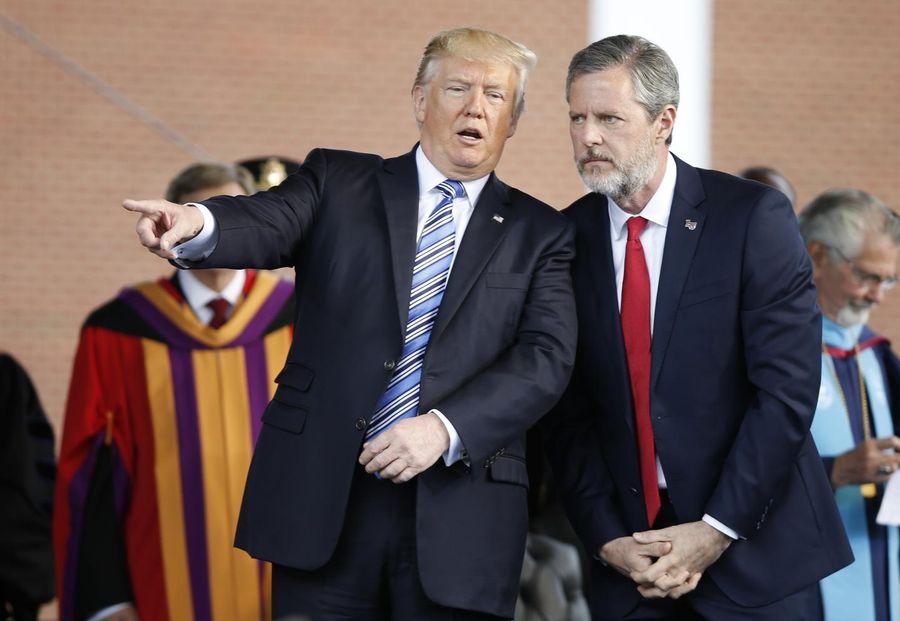
President Donald Trump gestures as he stands with Liberty University president, Jerry Falwell Jr., right, during commencement ceremonies at the school in Lynchburg, Va., Saturday, May 13, 2017. (AP Photo/Steve Helber)
Republicans: The Whigs of the 21st Century
COMMENTARY
Published Aug. 4, 2019 • Read time: 5m
In 1854, a group of political pioneers gathered in Ripon, Wis., to establish a new national party. Their purpose? To prevent slavery from spreading further west in the United States and to abolish the institution in the South. This small band would soon be known as the Republican Party. Just six years after their founding, Abraham Lincoln would be elected the GOP’s first president.
What was happening in America during the first half of the 19th century that would allow such a major political development? At the time, the two major political parties, the Democrats and the Whigs, refused to make substantive moves toward abolition. The Whigs had risen as a counterweight to Andrew Jackson’s worst instincts. The party would eventually elect four presidents and serve as the tribune of America’s entrepreneurial middle class.
The Whigs’ support for the Compromise of 1850 and the Kansas-Nebraska Act precipitated their near-electoral destruction in the first half of that decade. The party’s leaders, split between North and South, publicly projected an ambivalence about the future of slavery in the United States. While slavery served as the lever around which the Whigs would spin into oblivion, it was their moral failure regarding so odious an institution to so many Americans that ultimately killed them off.
Like the Whigs of old, Donald Trump’s GOP is staring at a similar fate should it continue on this path. Many evangelical Christians, seeing themselves as arbiters of moral righteousness, tout the president as the tonic to so many of the country’s problems. The reality is, however, that the party’s outward failures are distinctly grounded in a lack of moral compass, ugly politics and nonexistent policy; for which the electoral consequences have only just begun.
Between 1854 and today, the GOP has completed an about face. Founded as the party of equality for all races, its leader and new spiritual guide now intentionally stokes resentment as a matter of politics, policy and habit. Trump’s reasoning? An abiding fear that his overwhelmingly white, male base will desert him. We’re a long way from Abraham Lincoln and Ulysses S. Grant.
In last year’s midterm elections, many suburban congressional districts, long the bastion of Republicanism, saw Democrats elected for the first time in decades. Given these voters’ unwillingness to vote for Hillary Clinton in 2016, they took their revenge on Republicans generally, and Trump specifically, in 2018.
Based on their feelings about Trump’s language and behavior, many Republicans and conservative independents are turning away from the party. As Jonathan Martin noted earlier this week, Orange County, Calif., once the heart and soul of Reagan Republicanism, saw its GOP voter registration advantage sink from 124,000 to only 1,000 in the course of three years. The Republican Party in California is now third in line, registration-wise, behind Democrats and voters who claim “No Party Preference.”
The GOP’s decade-long war on Obamacare, and its inability to provide a credible substitute, battered and bruised the party last year. Today, health care, and the economic fallout from health crises, consistently top voters’ concerns in public surveys. Republicans are out of step with the electorate, with nothing to say and no one to say it.
The images and stories coming out of our border with Mexico cause many middle-class and suburban Americans to blanch. Despite our nation’s troubles, these voters still see America as exceptional, as humane and as an exemplar to the rest of the world. Keeping men in cages for weeks on end and taking children from their parents is beyond the pale for moderates, independents and many otherwise conservative voters.
In politics, as in life, demographics are destiny. In the 2016 election, Trump lost voters 18-29 and 30-44 by 19 percentage points and 10 percentage points, respectively. As MSNBC’s Steve Kornacki noted on Jon Ward’s podcast, “The Long Game,” one look at public polling shows there is a massive chasm between voters under/over 45 years of age.
Regarding how they see the world, their personal priorities, what they believe to be the most pressing issues facing the country, the GOP is out of step with a large and growing cohort. On the other hand, the older voters that Republicans have long relied on -- white, more conservative, more working class -- will represent a plurality of registered voters and their impact will drop accordingly.
This argument and warning to Republicans is not new. In the wake of Mitt Romney’s 2012 loss, the “Growth and Opportunity Project” was commissioned by party leaders to determine a direction forward. Their belief? Without a credible position on issues such as immigration and without the ability to draw in minority and younger voters, the way of the Whigs was their likely destination.
While those GOP leaders misread the Republican electorate of 2016, looking back they understood the arc of American politics. What the country needs now is a new collection of political pioneers, willing to find their Ripon moment. The opportunity for new entrants and new energy is there. Harnessing the energy, attention and passion of millennials and Generation X to chart our course forward is completely possible and absolutely necessary.




RCP Today
Top stories on RealClearPolitics
The Takeaway
Polling intelligence and analysis delivered to your inbox
World News
Featuring the latest world news
Policy
Featuring the latest policy news
Support Our Mission
As part of RealClearPolitics, authors aim to provide balanced, non-partisan analysis by presenting top reporting and commentary from all sides of the political spectrum.
Trusted by policymakers and citizens alike since 2000