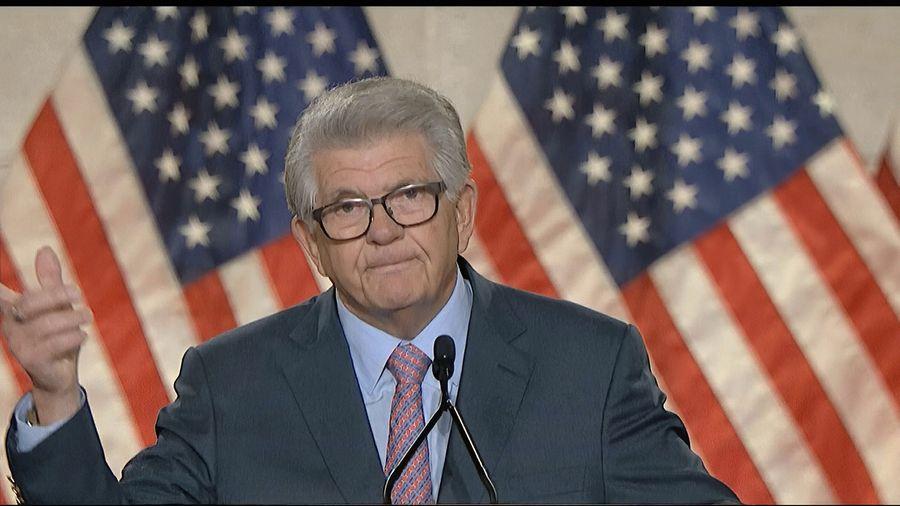
In this image from video, Maximo Alvarez speaks from Washington, during the first night of the Republican National Convention Monday, Aug. 24, 2020.(Courtesy of the Committee on Arrangements for the 2020 Republican National Committee via AP)
GOP 2020: The Good, the Bad and the Unseemly
ANALYSIS
Published Aug. 28, 2020 • Read time: 13m
Join the Conversation
0Long before 2020, there were too many speeches at political conventions and four nights was too long. Three would have sufficed, two might have been better. But when thousands of delegates, politicians, lobbyists, journalists, and assorted activists mingled freely -- sans face masks -- at the quadrennial nominating soirees, at least there was a social factor, along with the possibility for mishap, even scandal. Not this year.
The exigencies of this summer’s pandemic lockdown stripped away the pretense. Without balloon drops, mini-dramas and after-hours parties, anyone could see that modern political conventions consist of little more than four consecutive nights of informercials. It would have been overkill even without Hurricane Laura or another gruesome police shooting and the ensuing round of riots and social unrest. That said, the Republicans’ 2020 virtual convention, which wrapped up Thursday night with a rambling 70-minute acceptance address by President Trump, had its moments -- and moments that are best forgotten.
The Republican National Committee’s official theme for this convention was “Honoring the Great American Story.” Its unofficial theme was “We’re taking the word ‘white’ out of the phrase ‘white nationalism.’”
Nationalism? Absolutely, but the Republicans’ pro-America message came from faces of many hues. It was the opposite of race-specific. How well the GOP succeeded in making this case, and in humanizing the president -- while insisting that he didn’t cluck the response to COVID-19 and also instilling deep doubts about the Democratic Party ticket -- depends on viewers’ own political predilections. But here is a nonpartisan first draft of history on the GOP’s attempts to hold a convention in the time of COVID-19, summer storms, and national protests.
Cruz's Path to Nomination
Trump Stands by His Manager
With Tweets on Heidi Cruz, Trump Sinks to New Depths
A Vote for Kasich Is a Vote for Trump
HIGHLIGHTS
Palmetto State Cover. Republicans were supposed to meet in Charlotte, and then Jacksonville, but when convention time rolled around most of the speeches were pre-taped in several cities, including Baltimore and Washington. But the emotional hub of opening night was South Carolina, the home state of two GOP stars-in-waiting, former Gov. Nikki Haley and Sen. Tim Scott.
“In much of the Democratic Party, it’s now fashionable to say that America is racist,” Haley said. “That is a lie. America is not a racist country.”
“This is personal for me,” she continued. “I am the proud daughter of Indian immigrants. They came to America and settled in a small Southern town. My father wore a turban. My mother wore a sari. I was a brown girl in a black and white world. We faced discrimination and hardship. But my parents never gave in to grievance and hate. My mom built a successful business. My dad taught 30 years at a historically black college. And the people of South Carolina chose me as their first minority and first female governor.”
If anything, Tim Scott’s personal story was even more compelling. Appointed to his Senate seat by Haley herself, he explained how his mother’s love -- and an emphasis on education -- instilled a sufficient sense of upward mobility that he was able to defeat the son of old Dixiecrat Strom Thurmond in his first campaign for an open congressional seat in the state.
“You may be asking yourself, how does a poor black kid from a single-parent household run and win a race in a crowded Republican primary against a Thurmond?” Scott said. “Because of the evolution of the heart, in an overwhelmingly white district the voters judged me on the content of my character, not the color of my skin.”
Hispanic Business Owners. The Republicans did an excellent job, with superb production values, of producing videos showcasing ordinary Americans making their case for their candidate. One evening, the program featured two Latina sisters who said their parents taught them the value of self-reliance and to “love this country unapologetically.” One of them, Madeline Lauf, benefited from a small business PPP loan after the coronavirus lockdown threatened her company’s existence. “It’s now more than ever so important to have a president and an administration that understands that small business is the backbone of our economy,” added Catalina Lauf.
Their warnings were supplemented by an older voice of experience, a man named Maximo Alvarez, who fled Fidel Castro’s Cuba with his family as a boy and built a thriving business in Florida. Alvarez portrayed Joe Biden as a type -- a career politician “mostly concerned about power” and one who had made accommodations with the leftist wing of his party that would inevitably lead to socialist policies taking root in the United States.
“I’ve seen movements like this before. I’ve seen ideas like this before. I am here to tell you – we cannot let them take over our country,” he said. “I heard the promises of Fidel Castro. And I can never forget all those who grew up around me, who looked like me, who suffered and starved and died because they believed those empty promises. They swallowed the communist poison pill.”
Perhaps this is too dire a vision, but it came from a man with first-hand experience.
Melania Trump. Speaking of immigrants, Donald Trump’s rebuttal -- yes, his trump card -- against the claim that he hates foreigners is that he’s married to one. He doesn’t often play that card, which is to say that Melania rarely speaks at length in public. She did Tuesday night, however, from the newly landscaped Rose Garden, where she told of setting her cap on coming to America. She also struck an empathetic tone toward victims of COVID-19, drug addiction, and racial injustice. The first lady could have used an editor. Her speech was too long and had too many clichés, but even that worked in her favor: These were apparently her own words this time, unlike the 2016 speech she gave in Cleveland that borrowed liberally from Michelle Obama.
She looked marvelous, as always, and her delivery was affecting. She even tried to find common purpose with the media, urging the press to focus on the plight of Americans dealing with addiction who may fear seeking help during the lockdown. You knew her performance had resonance because it irritated progressives. In a baffling display of hypocrisy, some mocked Mrs. Trump’s accent. “Oh God, she still can’t speak English,” tweeted Bette Midler. The singer and Hollywood actress followed this outburst with another: “Get that illegal immigrant off the stage.” This is called punking yourself.
LOW POINTS
The Rest of the Trump Clan. Kim Guilfoyle was widely panned for yelling into the microphone in a performance so jarring that Fox News cut away just before she concluded, while CNN gleefully stayed with it until the bitter end. Partly, this showed the difficulty of giving an address to an empty hall that normally would have had thousands of cheering Republicans. There also was a larger problem. Her boyfriend, Donald Jr., also gave a speech and he wasn’t any better. Eric Trump made a forgettable speech, too. Lara Trump, Tiffany Trump, and Ivanka Trump all addressed the convention as well. Are we forgetting anyone? Oh, yes, Donald Sr. -- more on him later -- but you see the pattern. Some of the Trumps were better than others, but at some point the question raised itself: What have any these people done in life to earn speaking gigs at a national political convention?
Family members aren’t always the best ones to make the case anyway. On Thursday night, Ivanka introduced her father by saying America “needs four more years of a warrior in the White House.” He’s no longer around to roll his eyes, but think how this line would have struck John McCain, a war hero ridiculed -- for his heroism -- by Donald Trump, a Baby Boomer who used alleged bone spurs to avoid serving in Vietnam.
“Washington has not changed Donald Trump,” Ivanka also said. “Donald Trump has changed Washington.” It was sly wordplay, but perhaps too clever by half. Many in the audience might have mused, “It would have been nice if the presidency had changed this guy a bit.”
Trump Steps on His Own Lines. It certainly made for good television when the RNC pre-taped the scene of a naturalization ceremony at the White House where five grateful new U.S. citizens were personally sworn in by the president. Earlier in the evening, this was supplemented by a video of Trump pardoning a convicted robber who teamed up with the cop who arrested him to run a nonprofit aimed at finding employment for ex-cons. To complete the empathy trifecta, the campaign focused attention on the safe return of 50 American hostages from 22 countries by filming Trump talking to some of them in a half-circle at the White House.
Suddenly, Trump went strangely off-script, ruining the moment by turning to released American pastor Andrew Brunson and blurting out his admiration for Turkish strongman Recep Tayyip Erdogan. This was more than gratuitous praise for an autocrat. Turkey’s president had kept Brunson in bondage for nearly two years. “To me, President Erdogan was very good,” Trump said -- a comment that not only undermined the photo op, but made a discerning viewer wonder if Erdogan had been playing Trump all along.
Lies, Damn Lies, and Statistics. Perhaps the Republican speakers were banking on “fact-checker fatigue,” or just assuming their audience discounts the scolds in the mainstream media. Yet it’s undeniable that amid the impressive staging, the speakers unleashed a torrent of tall tales and twaddle. Some were trivial, some were deadly serious, such as when Trump claimed Thursday night that “the United States has among the lowest fatality rates of any major country in the world.” One supposes that the rhetorical hedges are “among” and “major,” but this assertion still isn’t true.
Trump also made the oddball claim that he’d done more for African Americans than any president since Lincoln, a cohort that would include the president who led the Union Army (Grant), the one who desegregated the armed forces (Truman), the one who sent federal troops to integrate Little Rock schools (Eisenhower) and the one who signed historic civil rights legislation (Johnson). Trump also said, erroneously, that he inherited a “badly depleted” military, took credit for a Veterans Administration reform bill signed by President Obama, and so badly garbled the issue of NATO funding that he made it clear he doesn’t even know how the alliance operates. He claimed that Biden has vowed to “close all charter schools.” This, too, is false.
Eric Trump said that Biden “has pledged to defund the police,” that under his father’s leadership America will “soon” send astronauts to Mars, and that this administration “delivered the largest tax cuts in American history.” None of these assertions are true. Perhaps commentators touting the political future of Don Jr. are looking at the wrong brother.
MAKING THE BEST OF THE SITUATION
Herschel Walker and Clarence Henderson. What do you do if your campaign is attempting to make inroads in the black community, but eight out of 10 African Americans think you’re a racist? You call Superman. And a civil rights hero.
One of three black former pro football players to speak on behalf of Trump, Herschel Walker was the most impressive. That’s always been true. A high school champ in track and football, star of the Georgia Bulldogs’ 1980 national championship team, Heisman Trophy winner, featured running back in two professional football leagues (when he met Donald Trump), mixed martial arts fighter, and member of the 1992 U.S. Olympic bobsled team, Walker is the black version of “Chuck Norris Facts.”
You think I’m exaggerating? While in college, Herschel was out running one day when an auto mishap left a 67-year-old woman trapped in her vehicle. While onlookers frantically tried to extricate her, Walker calmly ripped off the door of the car. On Monday night, he was trying to rescue Trump from America’s politically polarized racial wreckage. He started by saying that accusations the president is racist “hurt my soul.”
“I take that as a personal insult, that people would think I’ve had a 37-year friendship with a racist,” Walker added. “People don't know what they're talking about. Growing up in the Deep South, I’ve seen racism up close. I know what it is. And it isn’t Donald Trump.”
Clarence Henderson is a hero of another sort. As a 19-year-old student at North Carolina A&T, he participated in the legendary sit-ins at the Woolworth’s counter in Greensboro that helped ignite the civil rights movement across the South. Now 79, Henderson recalled his trepidation when he joined the protest on its second day. “I didn’t know whether I was going to come out in a vertical or prone position -- in handcuffs or on a stretcher, or even in a body bag,” he said.
“Donald Trump is offering real and lasting change -- a country that embraces the spirit of the civil rights movement of the ’60s. … This is the America I was fighting for 60 years ago. This is the America Donald Trump is fighting for today.”
The People’s House. Okay, so you can’t hold a regular convention because of the pandemic, and protesters would have tried to close it down if you could. You have a president who feeds off a crowd when he speaks. What to do?
In 1968, the last time street protests cast this kind of shadow over a U.S. presidential campaign, President Lyndon Baines Johnson (who wasn’t running for reelection) took to speaking at military bases so he wouldn’t be heckled. Vice President Mike Pence chose that route, speaking at Baltimore’s Fort McHenry, the iconic citadel that inspired the writing of “The Star-Spangled Banner.”
Even though Pence is the father in a proud military family, some Americans were uncomfortable seeing the fort employed as a backdrop for political purposes. The president and first lady used the White House itself. Melania’s speech in the Rose Garden seemed okay. She was there to promote her husband’s candidacy, no doubt, but it wasn’t a hard-edged speech. Her husband’s marathon session Thursday night was another matter. Even those who had figured it would be all right, given everything that’s happening, were taken aback by the night’s naked partisanship.
In 1940, Franklin D. Roosevelt accepted his party’s nomination from the White House and delivered a radio address on the occasion. He spoke for about half an hour, mentioned the Republican Party once in passing, and neither mentioned nor alluded to his opponent, GOP nominee Wendell Willkie. By contrast, in his 70-minute talk, Donald Trump mentioned Joe Biden 41 times, usually in the proximity of the word “socialist,” to cheering supporters. The South Lawn was festooned with huge TRUMP-PENCE signs and Trump even altered his speechwriters’ attempts to acknowledge that he was speaking from “the people’s house” by making it into a gibe. “The fact is, we’re here and they’re not,” he ad-libbed.
This was jarring even to those who hadn’t minded the president speaking from the White House. Moreover, his taunt reminded undecided voters that they, not he, get to decide which family lives there.
C-SPAN

Newsom Defies Voters, Juries and Lawmakers To Spare Murderers While Defending Abortion
Curtis Hill • RealClearPolitics
The Algorithmic Tilt
Frank Filingeri • RealClearPolitics
A RealClear Thanksgiving: Investing in a Better Future
David DesRosiers • RealClearPolitics
Trump’s Newsom Problem: Antagonist-in-Chief
Carolina Lumetta • RealClearPolitics
America’s Free Spirit
John Maxwell Hamilton • RealClearPolitics
The GOP Majority Should Go Out in Glory
Daniel McCarthy • RealClearPolitics
RCP Today
Top stories on RealClearPolitics
The Takeaway
Polling intelligence and analysis delivered to your inbox
World News
Featuring the latest world news
Policy
Featuring the latest policy news
Support Our Mission
As part of RealClearPolitics, authors aim to provide balanced, non-partisan analysis by presenting top reporting and commentary from all sides of the political spectrum.
Trusted by policymakers and citizens alike since 2000