
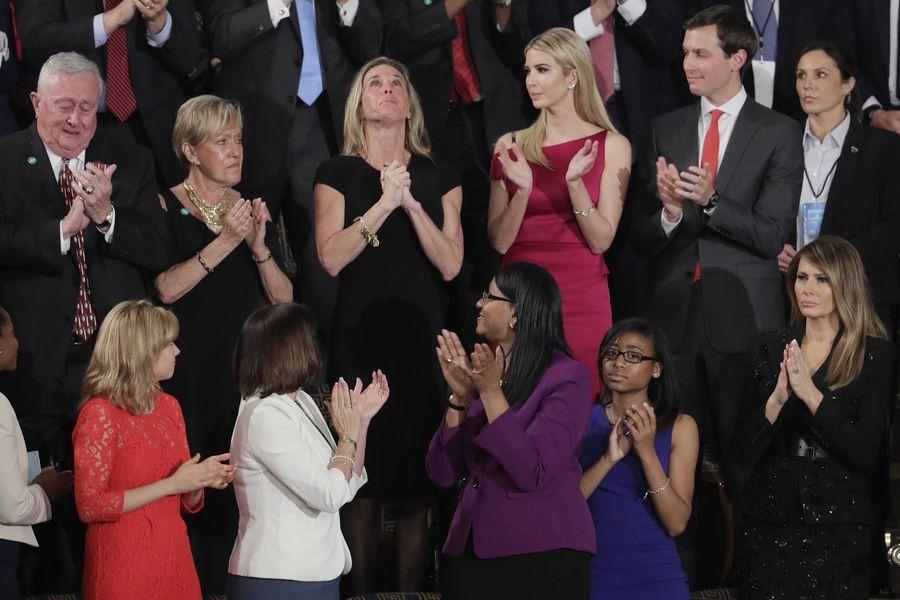
Carryn Owens, widow of widow of Chief Special Warfare Operator William âRyanâ Owens, is applauded on Capitol Hill in Washington, Tuesday, Feb. 28, 2017, as she was acknowledged by President Donald Trump during his address to a joint session of Congress. (AP Photo/J. Scott Applewhite)
What the 'First Lady's Box' Has to Tell Us
Published Jan. 29, 2018 • Read time: 6m
Join the Conversation
0Want a sneak peek at a president’s priorities ahead of the State of the Union address? Take a look at the first lady’s box. This section of benches in the southwestern corner of the gallery in the House chamber is part of the “Ladies Gallery,” thusly labeled since the new chamber opened in 1857. The White House invites guests who embody policy priorities of the president to sit with the first lady and watch him deliver his State of the Union speeches and addresses to joint sessions of Congress.
As Michelle Obama wrote in 2016, “These individuals exemplify the themes and ideals that the President lays out in his address.”
The tradition began with Ronald Reagan, whose remarks in 1982 highlighting the high character of average Americans were underscored by the invitation of reluctant hero Lenny Skutnik, a government employee who jumped into the icy Potomac River to help a plane crash victim to safety. After Reagan related the story, the entire audience comprised of members of the House, Senate, Supreme Court, and Cabinet gave Reagan – and Skutnik -- a standing ovation. The attention was overwhelming to the humble man. “My mind went blank, I didn’t move a muscle,” he told Time magazine in 1982. “I was stunned. Not many people get standing ovations, and for somebody like me…”
At some point, these guests became known eponymously as Skutniks. “That's the name given by the professionals to the hero placed somewhere in the galleries,” wrote columnist William F. Buckley in 1995. “President Clinton was awash with Skutniks,” who were, he complained, put at the end of the speech “when people were panting to get on with the evening, to go to a party, get a drink, go to sleep, read a book, anything.” Clinton’s 1995 address was the longest any president has ever delivered.
Occasionally an invitation to sit in the first lady’s box can be a source of conflict. In 2007, a member of the senior staff for my boss, President George W. Bush, wanted to highlight the owner of a company that made educational videos for babies as an example of an entrepreneur in his speech, with a concomitant invitation to sit in the first lady’s box. A senior member of the first lady’s staff strenuously objected to the plan. She pointed out that screen time for children under the age of 2 was considered detrimental to child development and that one of Laura Bush’s signature initiatives was promoting early literacy and encouraging parents to read to young children.
But the West Wing trumps the East Wing, I suppose. The example stayed in the speech and the entrepreneur was invited.
Only a few articles at the time criticized the choice. It became a bigger issue in 2009 after the Walt Disney Company offered a refund to anyone who purchased the videos since 2004. The agreement to offer a refund was part of a settlement in a silly lawsuit by consumer group Campaign for a Commercial-Free Childhood, which felt that parents who believed the videos’ marketing claims of being educational for infants deserved their money back. Being mentioned in the speech inextricably linked the company to the Bush administration, with articles as recently as last year mentioning the connection.
The episode suggests that sometimes it might be wise to listen to the ladies.
The guest list for Melania Trump’s box at this year’s State of the Union will be announced Monday. That list, along with the theme of this year’s address, “Building a Safe, Strong and Proud America,” and issues announced by the Trump White House will show the framework the president and his speechwriters have fleshed out.
To humanize “jobs and the economy,” expect to see a business owner, someone who has been able to add jobs, increase wages, or both, thanks to the strong economy of 2017. It might be an employee of Apple, which announced new domestic investments after the passage of tax reform. Or it could be employees of AT&T, American Airlines or Walmart, all of which gave employee bonuses because of the new law.
To illustrate his stance on immigration, there could be someone negatively affected by an undocumented immigrant, possibly a victim of a crime. That was the tack Trump took in last year’s address to a joint session of Congress, when he highlighted the stories of four Americans “whose government failed them” in that they were the victims of crimes by what Trump termed illegal immigrants. Alternatively, in keeping with the White House’s emphasis on the optimistic tone of this year’s speech, the guest could be a member of law enforcement or a property owner in a border state who stands to benefit from stricter immigration policy. It would be a stroke of genius if a guest in the box were a college-attending Dreamer who supported Trump.
There will definitely be at least one member of the military in the box to highlight the “national security” theme. At the risk of sounding cynical, the very touching moment in Trump’s 2016 address to Congress where Carryn Owens opened her arms to the heavens as the room acknowledged the terrible cost of her husband, Ryan Owens, laying down his life for the country might encourage the West Wing to again invite a member of a Gold Star family.
Trump’s focus on “infrastructure” might come in the form of a transportation company owner who can add employees if there’s increased spending on public works. “Trade” could be underscored by the attendance of a person whose manufacturing job, previously scheduled to go overseas or otherwise be liquidated, is being retained because of Trump’s policies. Or it could be someone from Chrysler who will benefit from the company’s announcement of bringing jobs back from Mexico.
The opioid crisis also will be addressed in the speech and the White House said a gallery guest will be reflective of drug addiction’s impact.
Whoever ends up with the high honor of sitting with the first lady on Tuesday night, they will have in common their outside-of-Washington credentials. They represent in the flesh the average Americans that are the president’s ultimate audience, the voters who will decide exactly how many times the Trumps get to fill those gallery seats.
RCP Today
Top stories on RealClearPolitics
The Takeaway
Polling intelligence and analysis delivered to your inbox
World News
Featuring the latest world news
Policy
Featuring the latest policy news
Support Our Mission
As part of RealClearPolitics, authors aim to provide balanced, non-partisan analysis by presenting top reporting and commentary from all sides of the political spectrum.
Trusted by policymakers and citizens alike since 2000