
Trump
Trump's Bid To Thwart Midterm History Flops
Published Nov. 3, 2026 • Read time: 6m
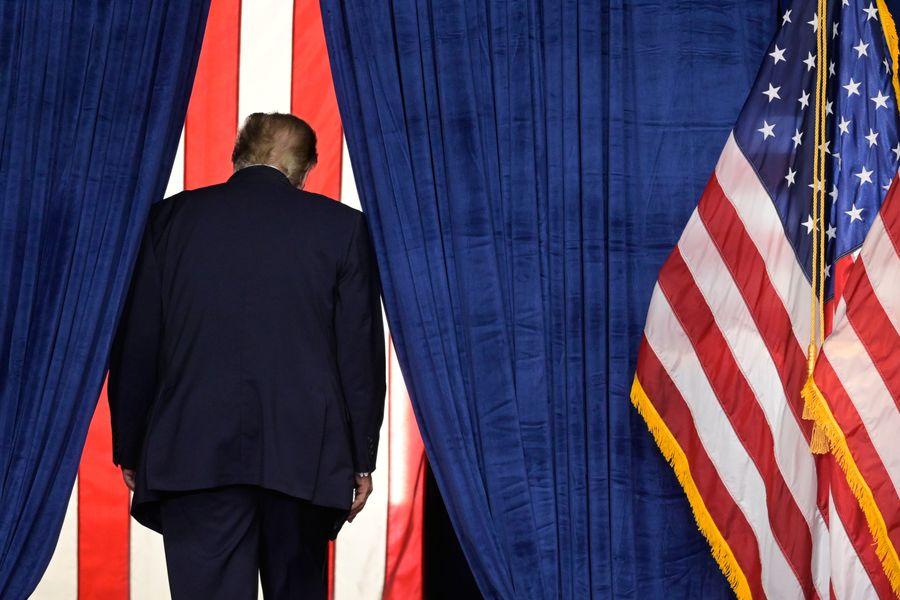
President Donald Trump convened members of his Cabinet and policy team in the East Room at the White House for an election night watch party. Earlier in the night, he was frustrated by coverage of opinion polls on Fox News and posted several times to Truth Social to call the network failing. Around 7 p.m., the posts stopped.
A White House official told several reporters, “The President has left it all out on the field and he’s done everything that was needed. Republicans are in a better spot now than they were four weeks ago.”
But the mood quickly turned from optimism to caution, literally. Former White House Press Secretary Karoline Leavitt and House Speaker Mike Johnson both said by 8:30 p.m. that they had called the president and he was feeling “cautiously optimistic.” Later in the night, White House sources were telling reporters the mood was “defiant.”
Meanwhile, Democrats were taking victory laps.
“In sweeping and decisive victories, the American people have rebuked the depravity, corruption and incompetence of a failed lame duck President Donald J. Trump,” Georgia Sen. Jon Ossoff said at his victory party.
Then the president logged back on. As it became clear that Democrats swept majorities in both the House and the Senate, Trump went on the defensive. He called Texas Gov. Greg Abbott, who had opposed him on some data center policies, a Republican in name only. Nearing midnight, he posted an image of a red MAGA hat that read “Veto” instead. And he previewed more responses to come.
“I’m going to become a political pundit, both good and bad, on the reasons these candidates won and lost!” the president posted to Truth Social.
Trump attempted a whole-of-government effort to subvert the conventional midterm tradition of the White House suffering losses. He hand-picked candidates, even ousting other Republicans. He sparked a gerrymandering war to alter congressional lines to be more favorable to the GOP. He demanded the first-ever RNC midterm convention to gin up enthusiasm and then took Air Force One barnstorming. The entire time, Trump asked voters to pretend he was on the ballot, hoping to inspire similar turnout to his successful wave in 2024.
Instead, the voters did as he asked and repudiated the first two years of his term. In Texas, Paxton fell by double digits behind Democratic state Rep. James Talarico. Darline Graham Nordone, sister of the late Sen. Lindsey Graham, lost in some of the most conservative counties in South Carolina.
“Unbelievable,” South Carolina Republican strategist Nate Leupp told RCP. “Trump wanted to be on the ballot – he got his request.
“Bloodbath” was the dominant message from Democrats throughout the night.
Voters ousted not only Republicans, but hand-picked Trump allies from Senate seats in South Carolina, Texas, and Ohio. In exit polls, a majority of Americans said they want Congress to establish more checks and balances on the White House. Around three-quarters of voters were “angry” or “dissatisfied” with the country’s trajectory. Roughly half said government corruption and the cost of living were key to their voting decisions.
But the president also changed the field. He started by selecting freshman Sen. JD Vance as his running mate in 2024, opening up a Senate seat in Ohio. Gov. Mike DeWine chose his Lt. Gov. Jon Husted to fill the role, even though Husted was known for having ambitions for the governor’s mansion, not Capitol Hill. In that vacuum, 2024 presidential hopeful Vivek Ramaswamy stepped in, losing to former health official Amy Acton.
Trump further wielded his endorsement power to hand-select Mike Collins to run for Georgia Senate, former RNC Michael Whatley for North Carolina, and Texas Attorney General Ken Paxton. For the latter two races, Trump effectively pushed incumbents Thom Tillis and John Cornyn out of their seats. Tillis opted not to run for reelection, while Cornyn lost the primary in a runoff.
Trump further hoped to thwart conventional history by changing the map itself. He urged Texas to redraw districts to favor Republicans in 2025, insisting on at least five new seats that the GOP could count on. Even that strategy fell short. Of the 16 districts expected to guarantee Republican real estate, nine remained competitive.
In the White House, the blame game has already begun. Trump posted to Truth Social around 10:30 p.m. that the losses were because his name was not physically on the ballot.
“I wasn’t on the ballot and if I was, we would have won in a landslide,” Trump said.
Other Republican operatives said it was his own policies that did the party in.
“This is the second time in my adult life that a stupid Middle East war has blown up the right’s ability to govern their own country,” Conservative Partnership Institute vice president of programs Rachel Bovard posted to X. “We live, and we learn nothing. Embroider it on a pillow.”
South Carolina was likely an unforced error, Republican operative Nate Leupp told RCP. Trump won the Palmetto State with nearly 60% of the vote in 2024. Even in that GOP stronghold, his influence backfired. After Sen. Lindsey Graham suddenly died over the summer, Trump insisted that his sister Darline Graham Nordone run in his stead, effectively preempting the primary process.
“We felt a bit of the national narrative, for sure,” Leupp said of Graham’s loss. “But we wouldn’t have felt it as strong. It certainly didn’t help the Republican cause, but it was a referendum on Trump as far as giving him the message that he should stay out of our races.”
Overall, the night proved disastrous for Trump’s strategy.
In the wake of vast defeats across the country, the GOP will be left to pick up the pieces, which could lead them away from Trump. But they’ll have to wade through two years of Democratic obstruction before they get another chance at the majority.
“My prediction is that the Democrats will overreach on what they think their mandate is, and that’s exactly what Trump did,” Advancing American Freedom president Tim Chapman told RCP. “Trump thought his mandate was to run the country from 1600 Pennsylvania Avenue to not include Congress, to adopt nationalist populist economic proposals, to adopt a foreign policy that was on again off again at the whims of Trump. The beatings will continue for both parties until one party accepts some level of humility about what they’ve actually been elected to do.”
Moving forward, Chapman suggested the midterm results will also dilute Trump’s power within his party. Many elected officials fell in line when the MAGA base voted how the president directed. If they are separating from Trump, politicians have room to do the same.
“You’re entering an environment where Republicans are going to have to scramble to rethink what they stand for as a party and rethink what their movement is all about,” Chapman said. “They’re going to have to recover some muscle memory about how to be legislative entrepreneurs themselves and how to actually propose solutions that address the problems that the American people face. And if they don’t do that, then the pain will continue.”
Support Our Mission
The Internet provides an endless stream of content. Not all of it is worth your time. That's why, every day, RealClearPolitics curates the most essential news and information—from all sides and across mediums. The links, videos, and podcasts curated here are the product of human judgment, not algorithms or AI. Please help power our mission of presenting a thoughtful, balanced public discourse through a tax-deductible donation.
Would you consider supporting us today?
Contributing to RealClear Politics through the RealClear Media Foundation supports essential initiatives that drive meaningful change.



RCP Today
Top stories on RealClearPolitics
The Takeaway
Polling intelligence and analysis delivered to your inbox
World News
Featuring the latest world news
Policy
Featuring the latest policy news
Support Our Mission
As part of RealClearPolitics, authors aim to provide balanced, non-partisan analysis by presenting top reporting and commentary from all sides of the political spectrum.
Trusted by policymakers and citizens alike since 2000