
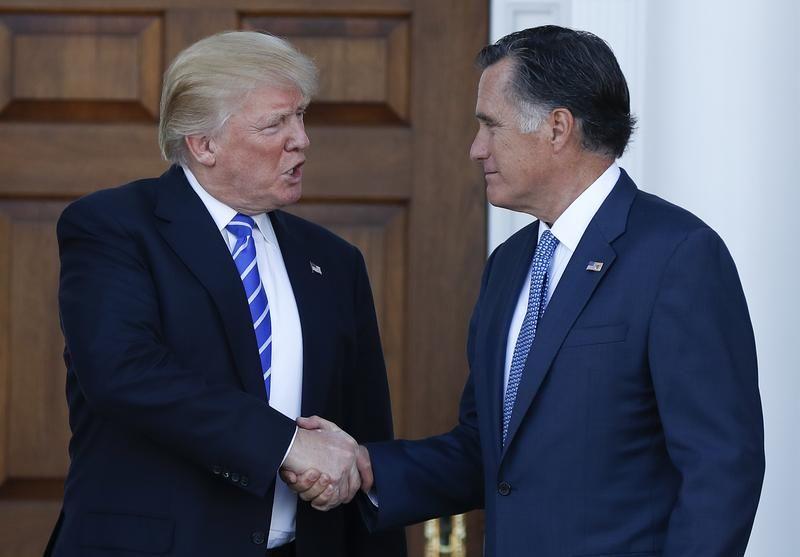
President-elect Donald Trump and Mitt Romney shake hands as Romney leaves Trump National Golf Club Bedminster in Bedminster, N.J., Saturday, Nov. 19, 2016. (AP Photo/Carolyn Kaster)
Trump Transition Hints at Wildly Unconventional White House
Published Nov. 29, 2016 • Read time: 5m
Donald Trump might be the president-elect, but not much else has changed.
Like his campaign, Trump’s transition to the White House has been lively and unpredictable — marked by Twitter rants, strategic detours, and internal disputes spilling into public view.
These hallmark quirks are now weightier in the context of the White House, however, with less than two months until the start of Trump’s presidency. If a transition process can suggest the flavor of the administration to come, many political professionals now predict a wildly unconventional White House at the highest levels, with a tinge of chaos.
This week Mitt Romney has been caught in the crossfire, as Trump’s allies have publicly, and in harsh terms, debated whether Trump should choose him as secretary of state — the sort of strategic discussion that rarely transpires in public.
However, cable news can be an effective medium for advisers to nudge Trump, who does not always keep his team in the loop but is an avid television consumer.
In an interview Sunday with CNN, Kellyanne Conway, Trump’s campaign manager, warned that some of Trump’s most loyal supporters would feel “betrayed” if the president-elect were to choose Romney as his secretary of state.
"I'm all for party unity, but I'm not sure we have to pay for that with the secretary of state position,” Conway said.
Conway later tweeted that she had expressed her opinion to Trump in private, too.
— Kellyanne Conway (@KellyannePolls) November 27, 2016I did tell him privately. And I'll respect his decision. Point is the volume & intensity of grassroots resistance to Romney is breathtaking https://t.co/bknmfGZ13a
These concerns were echoed Monday by Rep. Chris Collins, a member of the transition team’s executive committee, who panned Romney as a “self-serving egomaniac” on CNN.
Although the former Massachusetts governor and Republican nominee for president was once a vocal critic of Trump, Romney has emerged as a leading candidate for the secretary of state role, in addition to former New York Mayor Rudy Giuliani. Romney will meet Tuesday for the second time with the president-elect — and Trump’s team emphasized Monday that he, not any of his senior advisers, would be making the final call.
“The president-elect is the one person who will be making the decisions here,” spokesman Jason Miller said on a call Monday with reporters.
But the very public break among some of Trump’s advisers has shone light on internal factions, with some advisers stressing Republican Party unity as the task turns from campaigning to governing; and others, like Conway, urging Trump to remain faithful to his core supporters by elevating loyalists.
Former Sen. Scott Brown, who said he is being considered as a candidate for secretary of veterans affairs, counts himself among the former group, and told RealClearPolitics that Romney as secretary of state would be “more than qualified” and “a real asset.”
“There are times you bring people around you that you don't always agree with. It's good to have tension,” Brown said. “... The problem with this [Obama] administration right now, they don't have anyone to say, ‘Jeez, Mr. President, you're wrong.’"
It is unusual that this internal rift is playing out in partial public view. Typically, a president-elect aims to sort out such differences behind the scenes, before forging ahead publicly once a decision is reached. But not so with Trump.
“This is destructive,” Karl Rove said on Fox News. It “suggests Donald Trump is weak when his inner core, his closest advisers, are publicly telling people, ‘This is the advice I gave my chief and he isn't listening to me.’”
The transition maintains other marks of the campaign. Trump has continued to use his Twitter account as a clearinghouse for transition updates and conspiracy theories, and to settle personal scores. For technological reasons, and others, the dynamic has no precedent among commanders-in-chief.
— Donald J. Trump (@realDonaldTrump) November 27, 2016In addition to winning the Electoral College in a landslide, I won the popular vote if you deduct the millions of people who voted illegally
There has been no evidence of millions of illegal votes, or even hundreds.
Later, Trump added:
— Donald J. Trump (@realDonaldTrump) November 28, 2016Serious voter fraud in Virginia, New Hampshire and California - so why isn't the media reporting on this? Serious bias - big problem!
Asked Monday about Trump’s tweets, Miller did not cite evidence to support Trump’s claims, but dismissed Green Party candidate Jill Stein’s recount push in Wisconsin as “completely frivolous.” Lawyers for Trump’s campaign have not requested recounts or audits in any states.
Trump’s decision to raise such conspiracy theories without backing from his team or any apparent plan for action marks a stark departure from presidential morés. But holding Trump to presidential precedent at all might be fruitless, if his brief but meteoric political career thus far is any guide.
“If you try to measure Donald Trump by conventional terms,” said former White House press secretary Ari Fleischer, “you're always going to be using the wrong measuring stick."


RCP Today
Top stories on RealClearPolitics
The Takeaway
Polling intelligence and analysis delivered to your inbox
World News
Featuring the latest world news
Policy
Featuring the latest policy news
Support Our Mission
As part of RealClearPolitics, authors aim to provide balanced, non-partisan analysis by presenting top reporting and commentary from all sides of the political spectrum.
Trusted by policymakers and citizens alike since 2000