
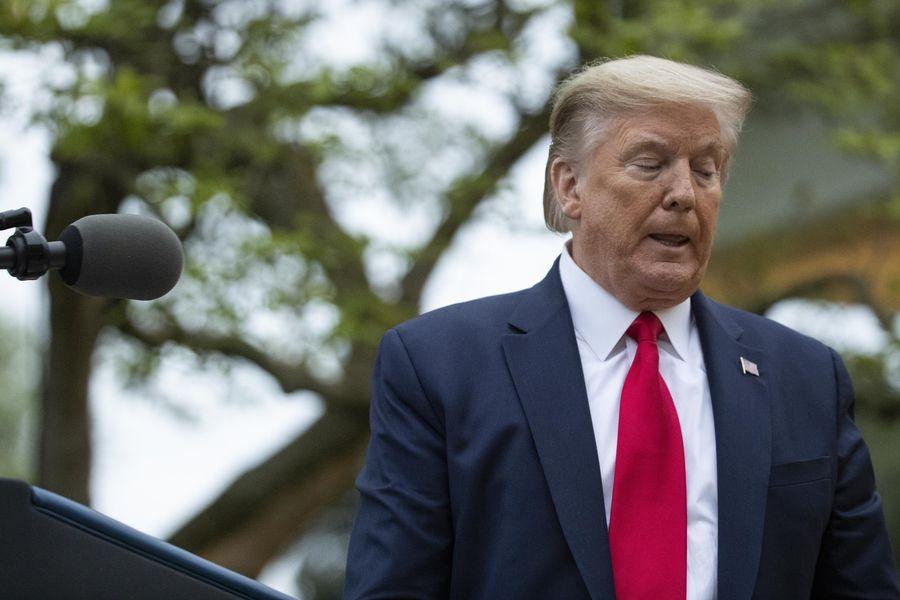
President Donald Trump turns to depart after speaking about the coronavirus in the Rose Garden of the White House, Tuesday, April 14, 2020, in Washington. (AP Photo/Alex Brandon)
The 'Trump Bump' and Its Likely Demise
Published April 16, 2020 • Read time: 5m
President Trump’s recent four-to-five percentage point bump in job approval can be viewed as a “rally round the flag” phenomenon. Surges in a president’s job approval rating have often been seen during times of national crisis or external attack, including the 1962 Cuban Missile Crisis, Iranian hostage taking in1979, the Persian Gulf War during George H.W. Bush’s presidency and the 9/11 attacks while his son was in the White House.
Such events run a predictable course: Both independents and opposing partisans warm to the commander-in-chief at times of intense national threat, with the former moving more quickly than the latter. During the Iran hostage crisis, for example, both independents and Republicans increased their support for President Carter, with GOP voters moving more slowly in that direction. Accordingly, if the Trump bump is a rally effect, then we should expect to see Democrats and independents accounting for the increases in overall job approval due to the coronavirus. We would also expect that in an era of heightened partisan feeling, “rally” effects should dissipate more quickly than they have in the past.
One reason that an increase in the current president’s popularity would have to come from Democrats and independents is that he’s already nearly maxed out with voters of his own party. Throughout the month of March, Republicans gave the president high marks across the board, and specifically with regard to his handling of the economy and the coronavirus pandemic. In early March among GOP voters, Trump had 94% approval overall, 93% approval of his handling of the economy, and 87% approval for his handling of the pandemic. As of late March, those numbers were essentially unchanged. Republicans were simply too enthusiastic about Trump at the beginning of the crisis to account for any bump in approval.
Lies, Assault and Cover-ups Don't Stop Donald Trump
Trump Stands by His Man; Obama on a Health Scourge; Hayden Interview; Reagan's Courage
Analysis: For Trump, Few Limits to Win-At-Any-Cost Approach
What If Clinton Isn't Indicted?
By contrast, both Democrats and independents increased their support of Trump on both the crisis and his overall performance. With respect to his handling of COVID-19, Democrats moved 10 points toward Trump while independents gave him a nine-point bump. On overall performance the jumps were five and six points, respectively. Among Democrats, ideology predicted whether someone would improve their views of Trump. While “very liberal” Democrats did not increase their appraisement of the president, those who described themselves as “liberal” or “moderate-to-conservative” clearly did.
Among liberal Democrats, approval of Trump rose by nine percentage points both overall and specifically regarding his response to the pandemic, while moderate-to-conservative Democrats made jumps of five and 12 points, respectively. Thus, the overall improvement in Trump’s approval rating was the result of some Democrats and independents doing what Americans traditionally do in a crisis.
Although Trump personally touted his higher approval ratings several times during his controversial and theatrical daily White House briefings, they are not necessarily useful to him now. The real question is whether they will last into the presidential campaign season.
Unfortunately for Trump, there are indications that this will not be the case. Consider the work of Richard Brody on the rally effect. Brody’s “elite opinion leader” model predicts that a lasting rally occurs only when opinion leaders refrain from critical commentary on the crisis -- that is, they lay off the president. As of late, however, the media, the opposing party, and opinion leaders generally have hardly been shy about criticizing the president’s response to the coronavirus crisis. Consequently, we should expect Trump’s approval rating resurgence to evaporate relatively quickly. Table 2 confirms this suspicion by measuring end-of-March and early April polling responses rather than the early March to late March results presented in Table 1.
Unsurprisingly, Republican approval of Trump remained relatively constant. Democratic ratings, however, declined five percentage points on COVID-19 (and one percentage point overall). Liberal and moderate-to-conservative Democrats were responsible for much of this decrease. Liberal Democrats dropped their approval by eight points on the crisis and six points on overall job performance; more moderate Democrats stayed even on their overall evaluations but dropped six percentage point on the crisis measurement. The largest drop, though, was among independents, who went from majority approval to majority disapproval of Trump in a single week, falling at least 15 points on both measures of approval.
Finally, it is interesting to note two further developments consistent with our view of rally effects. First, over the month of March, approval of the U.S. Congress rose from 17% to 26%. By the first week in April, however, it had dropped back to 21%. Second, state governors from both parties -- most of whom have generated less-negative attention from opinion elites -- are seeing increases in approval that have not yet dissipated. In recent YouGov polls, Gov. Andrew Cuomo of New York, for example, has steadily gained support, and has maintained that increased popularity through the first week of April. But there is one bit of comforting news here for the president: His fellow New Yorker (like Donald Trump, Andrew Cuomo was born in Queens) is not in line to be the Democrats’ presidential nominee in November.

The GOP Majority Should Go Out in Glory
Daniel McCarthy • RealClearPolitics
Republican Majorities Could Return Sooner Than Expected
J.T. Young • RealClearPolitics
The Danger Before the Attack
Leslie J. Sullivan • RealClearPolitics
Jon Finer’s Old and Dangerous ‘New Approach’ to Israel
Peter Berkowitz • RealClearPolitics
The President Deserves Better
John Ullyot • RealClearPolitics
Congress Doesn’t Need Another Blame Game. It Needs To Find What’s Broken
Jarrod Bernstein • RealClearPolitics
RCP Today
Top stories on RealClearPolitics
The Takeaway
Polling intelligence and analysis delivered to your inbox
World News
Featuring the latest world news
Policy
Featuring the latest policy news
Support Our Mission
As part of RealClearPolitics, authors aim to provide balanced, non-partisan analysis by presenting top reporting and commentary from all sides of the political spectrum.
Trusted by policymakers and citizens alike since 2000