
CORRECTION Pence Electoral Votes
Pence Is Right: Donald Trump IS Wrong about January 6
COMMENTARY
Published Feb. 7, 2022 • Read time: 5m
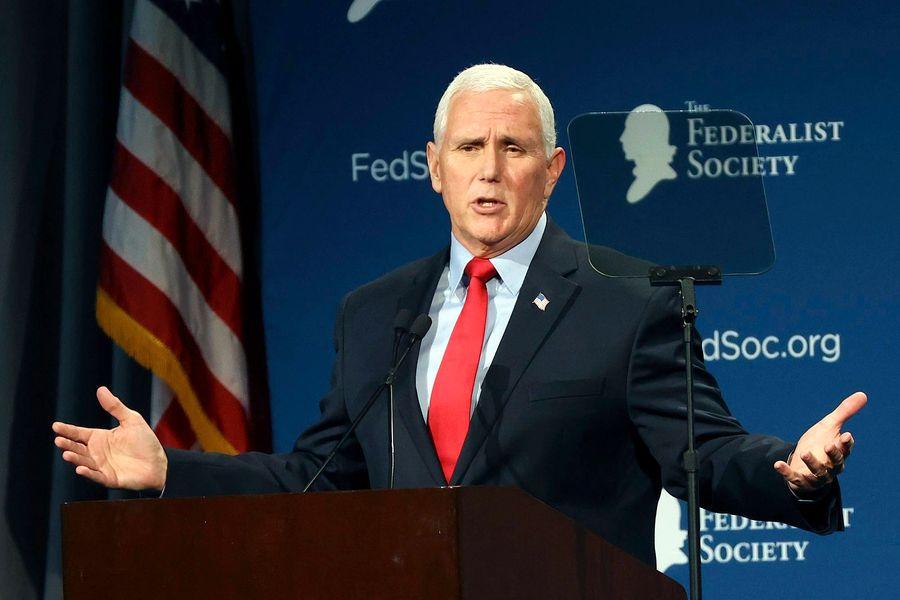
As more details emerge regarding the evidence the January 6 Special Committee is investigating, increased attention has focused on the role former Vice President Mike Pence had during the counting of electoral votes that day. Former President Trump has contended that Pence could “send back the votes for recertification or approval” and that Pence “could have overturned the Election!”
In response, Pence said four words many thought he would never say: “President Trump is wrong.” He went on to say that he “had no right to overturn the election.” Pence is right: neither the Constitution nor federal law gives the vice president (or Congress, for that matter) the authority to “send the votes back to be recertified.” It simply is not a real thing.
This war of words underscores the swift movement to eliminate post-election tomfoolery, the likes of which Trump is openly advocating.
The Eastman memo has provided greater context to Trump’s insistence that Pence had discretion to discount electoral votes. Trump lauded Eastman on January 6 and stated that if Pence “does the right thing,” he would win the election. The memo referenced John Adams and Thomas Jefferson as evidence that vice presidents have discretion to count votes, but failed to acknowledge 1) that both used their discretion to allow substance to prevail over technicalities, and 2) that both were acting prior to the passage of the 12th amendment – which has clear language detailing the vice president’s passive role in counting electoral votes during the joint session.
The 12th amendment says plainly, “The President of the Senate shall, in the presence of the Senate and House of Representatives, open all the certificates and the votes shall then be counted,” full stop. The amendment was passed to rectify a glitch in the Electoral College process by requiring electors to cast separate ballots for president and vice president in order to avoid situations like the tie between Jefferson and Burr in the 1800 election. If the Framers had any intent to give the vice president discretion to reject electoral votes or to “send them back to the states,” this would have been a good time to include it in the amendment’s language. Instead, they gave the vice president the passive role of merely opening the certificates to be counted.
Apart from the 12th amendment, it is important to examine the language of the Electoral Count Act of 1887. It is apparent that Trump wanted Pence to overtly challenge the constitutionality of the ECA by rejecting electoral votes. The ECA was originally adopted to deal with disputed electoral votes to be tabulated in the joint session of Congress on January 6. The act came about after the disputed election of 1876 and has been used a handful of times in the 130-plus years since its adoption. Although there were signposts that objections would be made after the 2020 election, I pointed out at the time that they had little chance of success due to the requirements of the ECA.
The ECA establishes a procedure that Congress must follow when two or more slates of electors are received. Primarily, electoral slates that carry the signature of a state’s governor are viewed as the certified electors of that state. If there are objections to an electoral slate, they must be made in writing and co-signed by at least one House member and one Senate member. If that occurs, each chamber meets separately to entertain the objection. For an objection to be approved, it must gain a majority of votes in both chambers.
A major bipartisan push has been made to either amend or eliminate the act in favor of some other means of governing the counting of electoral votes. Trump has seized on this movement, suggesting it means that he was right that Pence had the authority to accept, reject, or send votes back to the states. Scholars have pointed out that the ECA is clunky and uses somewhat ambiguous language that should be sharpened. In spite of this, it is impossible to see how Trump’s claims are supported in the actual language of the ECA.
The convoluted act is unwieldy and at times somewhat contradictory. Even so, nowhere does it permit the vice president or an action by the joint session to “send votes back” or to “decertify” results. Members may only accept or reject electoral votes on the basis of their being “regularly given” in accordance with state laws.
Trump’s claims suggest that any vice president who had concerns with the outcome could unilaterally reject votes simply by rejecting them. It is difficult to overstate just how improbable an argument like this has been throughout most of American history. The prospect that the Electoral Count Act would be put to a test as great as this has been virtually unthinkable for the past 130-plus years.
The belief that one person should be trusted with the discretion to accept or reject the votes of 150 million Americans is dangerous and absurd. For his part, Pence stated: “There is no idea more un-American than the notion that any one person could choose the American president.” Indeed, the Trump argument would have permitted Al Gore to reject electoral votes from Florida in 2000 based on the grounds of election irregularities which would have deservedly created a constitutional crisis of epic proportions. To this point, Pence stated that Vice President Kamala Harris would have no right to overturn election results in 2024. This is not the stuff healthy constitutional democracies typically contemplate.
In short, Pence is right and Trump is wrong – "decertifying votes” or “sending votes back to the states” are not real things. And the vice president does not have the ability to accept or reject Electoral College votes. While these things may exist in the mind of Donald Trump, they do not exist in the Constitution or in federal law. It would serve our republic well for more leaders to publicly acknowledge this.




RCP Today
Top stories on RealClearPolitics
The Takeaway
Polling intelligence and analysis delivered to your inbox
World News
Featuring the latest world news
Policy
Featuring the latest policy news
Support Our Mission
As part of RealClearPolitics, authors aim to provide balanced, non-partisan analysis by presenting top reporting and commentary from all sides of the political spectrum.
Trusted by policymakers and citizens alike since 2000