
Obama Dispenses Hugs (and Policy Analysis) in the Midwest
Published Aug. 16, 2011 • Read time: 9m
Join the Conversation
0President Obama, who has for months been wrapping his arms around energy efficient lighting and other technological wonders manufactured in the Midwest, hugged a woman Monday in Cannon Falls, Minn. This was considered a bit of news for the cerebral, wonky president, who is venturing through three states in the heartland by bus. An embrace! With an actual person!
Would the president have been moved to comfort a stranger and bring her to tears if his job approval numbers weren’t below 40 percent? Would he dispense hugs if America had any sort of confidence left in government? Would he be in Minnesota at all if Republicans who want his job had not gathered over the weekend in Iowa to condemn him? (Tim Pawlenty, now out of contention, comparing the president’s leadership to a “manure spreader in a windstorm.”)
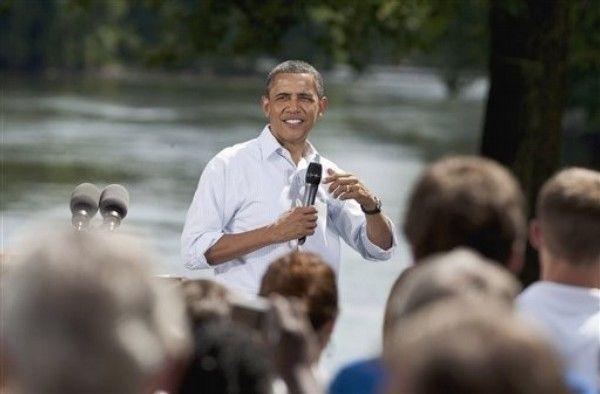
Hard to know, but there was the president, sans jacket, driving through Minnesota in a black, unmarked, specially fortified bus, talking for an hour during an outdoor town-hall session, then driving to the Old Market Deli to eat a turkey sandwich with the locals. The White House reporters traveling with the president chronicled his every public move.
Outside the Cannon Falls deli, Obama stopped to speak with a small crowd of White House-selected Minnesota residents, including a middle-aged woman who told the president that her son had recently returned from Afghanistan. “Is he okay?” Obama asked her after giving her a warm hug. Her son was fine, the woman assured the president, losing her composure briefly when he gave her a second hug. “We are so grateful,” the commander-in-chief assured her.
This is the president the Obama campaign wants America to see: the leader who sent a mother’s son to war and shares her relief that the soldier came home; the simple man humble enough to buy a taster’s choice of locally baked pies, to be enjoyed on a summer’s drive down the highway; and the president who has two young daughters and spied rambunctious school kids waving handmade signs at a local school, and then ordered his bus to brake for handshakes and photos.
The point of Obama’s bus trip is to play up his dedication to job creation and economic renewal in rural America during five town-hall sessions over three days in tiny towns in Minnesota, Iowa and Illinois. On Tuesday, for instance, the president will host an all-day economic forum in Peosta, Iowa, with invited experts and local business figures to “listen and learn,” and talk up his administration’s efforts to improve rural life for the 16 percent of the U.S. population that live beyond cities.
The Agriculture Department and the Small Business Administration will discuss new initiatives using existing federal appropriations to support private-sector lending to small businesses, which could contribute to hundreds of thousands of new jobs. USDA will also announce a health initiative to help rural hospitals recruit clinicians and upgrade technologies, plus a new effort to partner with the Labor Department to disseminate job training and employment information to rural communities using 2,800 USDA offices nationwide.
Obama is scheduled to return to Washington late Wednesday and begin a 10-day vacation with his family on Martha’s Vineyard starting Thursday. Officials with the Republican National Committee trailed the president through the Midwest to criticize his travels as campaigning on taxpayer funds. The RNC is raising contributions from GOP supporters through emails assailing Obama’s “debt-end tour,” using the image of a bus with the phrase “making it worse.” The Republican message is that Obama’s is “the most radical left-wing White House that America has ever seen.”
The debt-ceiling battles that concluded early this month in Washington are never far from conversations in the heartland this week. A testy autumn awaits Obama come September, when he and lawmakers attempt to identify an additional $1.2 trillion to $1.5 trillion in deficit reduction over the next decade.
“I want everybody to pay attention to this as the debate unfolds over the next couple of months,” the president told a crowd of about 500 people in Cannon Falls. “The key is not to try to cut more out of programs for poor folks or programs for seniors. The key right now is to get a long-term plan for fiscal stability. And in the short term, we should actually make more investments that would put people to work and get the economy moving. And if you combine those two things, we can actually solve this problem and grow the economy at the same time,” he said.
Obama tugged the topic of health care into his first, hour-long town-hall session, using Medicare as the excuse to speak about a sensitive topic that is more directly tied to the deficit debate than to America’s preoccupation with jobs. Obama discussed last year’s health reform law -- a bully pulpit rarity these days -- defending provisions of the Affordable Care Act that he said are important.
Republicans, he said, want to transform Medicare into a voucher program that would leave older Americans to fend for themselves in the health insurance marketplace. If upper-income Americans paid higher taxes, he suggested, deficit reduction would not need to lean so heavily on Medicare to provide such substantial cost savings over 10 years.
“I think there are better ways for us to manage the Medicare problem than to put a burden on seniors. And one example is, if I were paying my fair share of taxes, then we don’t have to put that kind of burden on seniors,” Obama said.
On Monday, the president fielded a handful of polite, substantive questions about health care, suggesting that in the Midwest, jobs and the economy are not the only worries. Obama was asked about the high costs of prescription drugs, the opt-out allowances for corporations, the fate of the new health care law in the courts, and the failure to enact health care coverage that covers all Americans. Obama’s replies were lengthy, wonky, at times defensive, and not always entirely clear to people not steeped in the details of the health law.
“This was a landmark piece of legislation . . . and it was entirely consistent with what I campaigned on,” Obama said of the health care law at his Monday evening event in Decorah, Iowa.
He defended the law’s mandate that everyone be insured or face potential fines, a provision of the law ruled unconstitutional last week by the 11th Circuit Court of Appeals in Atlanta. By a 2-to-1 decision, the appeals court said Congress does not have the power to require all Americans to buy health insurance. While the court struck down the insurance mandate, it agreed that the rest of the law is constitutional.
Obama blamed part of the controversy on the fact that former Massachusetts Gov. Mitt Romney, who enacted the first version of a health insurance mandate in his state, is seeking the Republican presidential nomination. As a candidate, Romney has backtracked from the health law he signed, and Obama attempted to cast his challenger as a flip-flopper.
“This should not be controversial, but it has become controversial partly because of people’s view that -- well, let me just say this,” the president explained. “You’ve got a governor who’s running for president right now who instituted the exact same thing in Massachusetts -- this used to be a Republican idea, by the way, this whole idea of the individual mandate, and suddenly some -- it’s like they got amnesia. It’s like, ‘Oh, this is terrible; this is going to take away freedom for Americans all over the world, all over the country.’ So that’s a little puzzling.”
The president arrived in the Midwest prepared with a new rejoinder to the condemnations by Republican presidential candidates and GOP lawmakers that the health law, which phases in through 2014, as “Obamacare.”
“I have no problem with folks saying ‘Obama cares,’ ” he said to applause. “I do care. If the other side wants to be the folks who don’t care, that’s fine with me.”
The president, mopping his brow in the heat, said he wants the Supreme Court to treat the health insurance mandate much like requirements that drivers buy accident insurance.
“If the Supreme Court follows existing precedent, existing law, it should be upheld without a problem,” he said. “If the Supreme Court does not follow existing law and precedent, then we’ll have to manage that when it happens.”
On a day when Obama’s hugs and sympathies may have turned heads, the president that America sees more often -- the measured, idea-driven enthusiast for government -- dominated during the question-and-answer periods. When a young woman in Cannon Falls prefaced her question by telling the president that she was recovering from lung cancer and had slept in her truck for two nights to get a chance to ask her question, Obama, the wonk, missed what was really on her mind.
He did not ask the woman about her cancer, her family or how she was feeling. The president did not try to learn her name or her hometown, or the type of truck she drove. He did not thank her for her efforts to see him or to be heard. And he did not volunteer to turn the government loose on her problem.
What did she ask the president? “I tried to get Social Security disability and they turned me down. My question to you is, can we talk about Social Security a little bit?”
And what did Obama respond? “As long as I’m president of the United States -- Social Security will not only be there for you, but it’s also going to be there for the next generation and the generation after that, because it’s one of the most important social insurance programs that we have.”
He had a lot more to say about Social Security. In fact, he spoke for another five minutes before calling on the next questioner. But the president never really heard the woman with the raspy voice, who slept in her truck so she could hear him. It was a small moment that needed a presidential embrace, and Obama missed his chance.


RCP Today
Top stories on RealClearPolitics
The Takeaway
Polling intelligence and analysis delivered to your inbox
World News
Featuring the latest world news
Policy
Featuring the latest policy news
Support Our Mission
As part of RealClearPolitics, authors aim to provide balanced, non-partisan analysis by presenting top reporting and commentary from all sides of the political spectrum.
Trusted by policymakers and citizens alike since 2000