
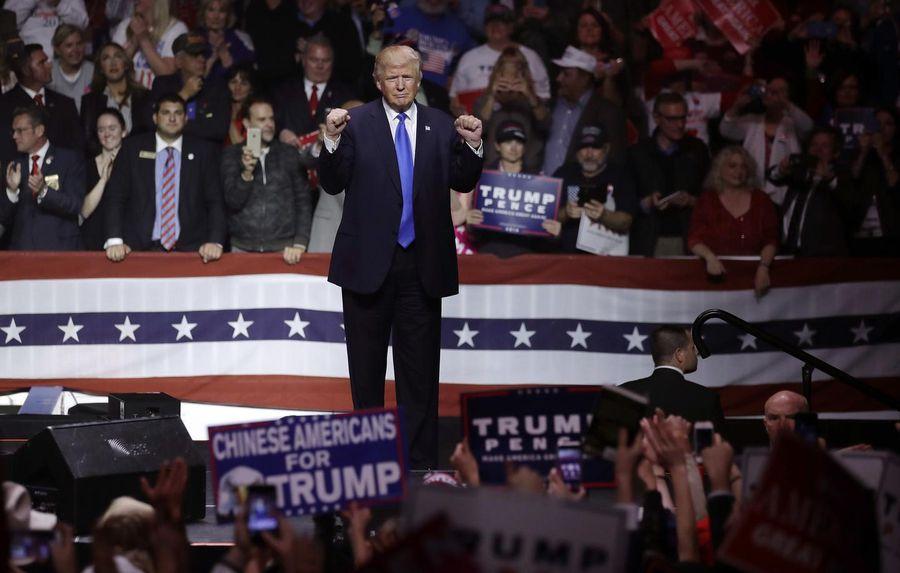
Republican presidential candidate Donald Trump acknowledges supporters as he concludes a campaign rally, Monday, Nov. 7, 2016, in Manchester, N.H. (AP Photo/Charles Krupa)
In Defense of New Hampshire
Commentary
Published April 23, 2017 • Read time: 8m
At first blush, 2016 was a disaster for the New Hampshire primary. No result in the event’s storied 100-year history challenged the foundations of its mythology quite like Donald Trump’s victory did.
It’s not a stretch to say that New Hampshire could have spared us from President Trump. Back in February of 2016, voters in the first-in-the-nation primary had a clear opportunity to ensure that the reality TV star turned reality political TV star would become the campaign footnote that most everyone had expected him to be at the outset. Instead, they kept his White House bid afloat.
Trump desperately needed a big New Hampshire triumph, having come off of a surprising defeat in the Iowa caucuses a week earlier. And that was exactly what the Granite State’s famously picky (or so the legend goes) voters gave him by handing Trump a 19-point blowout win.
It was a seminal victory that set Trump on his path to the presidency, and it resulted in plenty of heartburn among the people of New Hampshire who’re most interested in maintaining the state’s privileged status on the electoral calendar going forward.
Why? Because Trump’s win directly challenged some of the basic tenets that supposedly make New Hampshire special.
Ask any New Hampshire politico what makes the primary worthy of its station, and one of the first things they’ll inevitably mention is that it “gives the little guy a chance.” Donald Trump is a lot of things, but no one has ever accused him of being the little guy.
According to the state’s lore, New Hampshire’s voters demand face time in small venues with the candidates, over and over again. One of the favorite anecdotes that two-time primary winner John McCain loves to tell about New Hampshire goes like this: “A guy in Concord is asked, ‘What do you think about Mo Udall for president?’ And he says, ‘I don’t know, I’ve only met him twice.’”
But few people in New Hampshire had any meaningful interaction with Donald Trump once, let alone twice, during the 2016 campaign. Trump won by executing a strategy that centered on large, impersonal rallies, while dominating the national TV conversation—an approach that true believers in New Hampshire’s had long maintained is not nearly as important as good old-fashioned shoe-leather politicking.
On its face, Trump’s 2016 victory gives New Hampshire critics an opening to make their more fundamental case against the state. Those who are interested in upending the primary calendar that’s seen New Hampshire residents cast their ballots before anyone else every four years since 1920 point out correctly that the state is unrepresentative of the rest of the country, especially when it comes to its racial composition (New Hampshire is the third whitest state in the nation).
So will Trump’s 2016 New Hampshire triumph signal the death knell of what many believe to be an anachronistic institution wholly unfit to continue to begin the process of picking presidents as we approach the third decade of the 21st century?
I doubt it. New Hampshire has survived every one of the myriad challenges to its privileged status before, and it continues to have a compelling case for why it should continue to go first—even for another hundred years.
Sure, it’s an institution with plenty of flaws, but to paraphrase Winston Churchill’s assessment of democracy, the New Hampshire primary is the worst way to begin the process of picking presidents ... except for all of the other ways.
Consider the possibility of a national primary system—a proposal favored by those in other, larger states who argue for the fundamental doctrine of fairness in choosing party nominees. If Republican and Democratic voters had gone to the polls en masse, on a single day, to pick their 2016 standard-bearers, all the candidates not named Donald Trump and Hillary Clinton would have stood zero chance to make things as interesting as they did. And future insurgents in the mold of Bernie Sanders and many others before him would never have gained the kind of traction that comes from making small-scale inroads in a state like New Hampshire where the opinions of national pundits are typically cast aside gleefully.
Another frequently proposed antidote to New Hampshire’s stranglehold on the early primary calendar is a regional primary system, or one in which primary states rotate every four years, with everyone eventually getting their chance to go first. It sounds like a reasonable idea, in theory. But the kind of active voter engagement and participation that plays out in New Hampshire every four years can’t be replicated with a wave of a wand, and the state’s deeply engaged populace remains an important quality.
In 2016, 52.4 percent of eligible New Hampshire voters cast their ballots in the primary. In no other state’s primary or caucuses did a majority of voting-aged residents bother to show up. In Iowa, for the record, the caucus turnout was an abysmal 17 percent of registered adults.
New Hampshire voters like to think of themselves as especially perceptive (or “wicked smaht,” in the local parlance). But the truth of the matter is that they’re no more discerning about the qualities that make a good president than are voters in the nation’s other 49 states. But they are far more attuned to the campaign in its early stages, and they tend to take voting as seriously as residents in other states regard things like sports and religion. It’s just part of the culture there.
In the victories that they awarded to Trump and Sanders in 2016, the voters of New Hampshire were trying to send a message to the establishments of both parties: What you’re doing isn’t working, and we’ve had enough of the status quo.
In my own reporting in New Hampshire leading up to the 2016 primary, time and again I encountered people who’d never before been active participants in electoral politics but were planning to cast their ballots for Trump and Sanders (and were often trying to choose between the two in the months and weeks leading up to Primary Day).
In January of 2015, for example, I met “Ted,” a baron of the barstool at a nearly vacant sports bar nestled into the state’s blue-collar North Country outpost of Berlin (if you ever go, make sure pronounce it “BER-lin” to avoid eye-rolls from the locals).
"This f*ckin election, man,” Ted told me. “It's gonna be crazy. You watch. People are mad as f*ck."
Ted may have had a few too many Miller Lites in his system that night to expound more clearly on what he meant, but I remembered his comment over the next year and beyond, as I soon discovered that there were millions of "Teds" across the state—and the country. And they were all mad as f*ck.
Even a candidate like Trump, who spent little time having real conversations with New Hampshire voters, could pick up inklings of what was really important to people through his frequent visits to the state—a dynamic that led to him acknowledging and taking seriously the prescription drug and heroin epidemic that was ravaging the state and remains an under-covered story around the country. If we had a national primary system instead of the one that emphasizes New Hampshire, it’s difficult to imagine that Trump’s attention would have landed on an issue that wasn’t being talked about all that much on cable news sets in New York and Washington.
The future of the New Hampshire primary is uncertain. There will be powerful forces lined up against it heading into the 2020 cycle. But that in itself is nothing new, and New Hampshire has always survived every challenge that’s come its way.
Later this month, Ohio Gov. John Kasich and former Vice President Joe Biden each will both make high-profile trips to the Granite State in the time-honored tradition of stoking the flames of speculation more than 2 ½ years before the next Primary Day.
And once again, New Hampshire’s voters will begin paying attention before just about anyone else does.
I hope that the 2020 cycle brings a return to the way it typically worked in New Hampshire primary campaigns before Trump came along--a typically heartening dynamic in which the hardest workers were often rewarded and catchphrase-wielding demagogues rarely were.
But the state’s frequent penchant for rewarding the earnest underdog has never been New Hampshire’s most important role. Instead, the primary’s most important job has been to channel and distill the national mood on a local level—something it did pretty well in 2016.
In the end, New Hampshire didn’t give us Donald Trump’s presidency, as Hillary Clinton narrowly won the state in the general election. Instead, I like to think that its primary voters tried to warn the rest us that it was a real possibility, even as knowledgeable observers continued to dismiss the idea as all but inconceivable, before it was too late.

RCP Today
Top stories on RealClearPolitics
The Takeaway
Polling intelligence and analysis delivered to your inbox
World News
Featuring the latest world news
Policy
Featuring the latest policy news
Support Our Mission
As part of RealClearPolitics, authors aim to provide balanced, non-partisan analysis by presenting top reporting and commentary from all sides of the political spectrum.
Trusted by policymakers and citizens alike since 2000