
False Reports: GOP Not Losing Women in Contraception "War"
Published April 2, 2012 • Read time: 7m
Join the Conversation
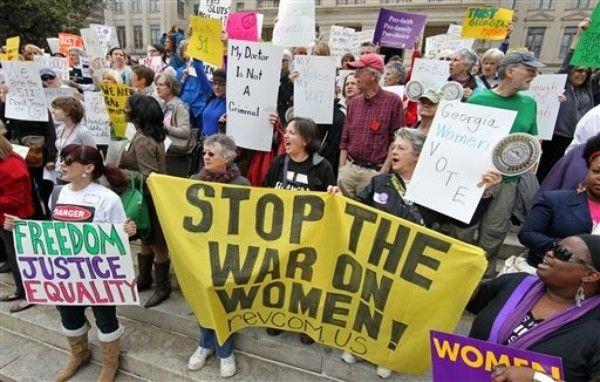
0New York Magazine's Frank Rich argued last week that there is, indeed, a "full-fledged Republican war on women." Rich asserted that this latest cultural debate is costing the likely Republican nominee, Mitt Romney, women's support. He cited a single poll to prove his point. In March, Barack Obama ran ahead of Romney among women in the NBC News/Wall Street Journal poll, 55 percent to 37 percent. That does look bad. But what share of women supported Romney before the debate over contraception coverage in the new national health care law? Essentially the same share. In mid-January, the NBC/Journal poll found that women favored Obama over Romney, 54 to 38 percent. It was a statistically insignificant shift.
Rich’s mis-analysis is hardly unique. Sans evidence, CNN reported on March 6 that “the gender gap has been widening, with the president winning more women's support since this contraception controversy has become an issue.”
Three days later, The Washington Post gave the story front-page treatment. The article began: “The fragile gains Republicans had been making among female voters have been erased, a shift that has coincided with what has become a national shouting match over reproductive issues.” Except the trends did not coincide.
The Post cited the same poll as New York magazine. Thus, it too wrongly reported that Romney had lost women’s support over the course of this debate. The Post also referenced another question in the NBC/Journal survey: Which party would you like to see control Congress? The Post reported that Democrats’ four-percentage-point advantage on the generic ballot in the summer had widened to a 15-point advantage in the most recent poll. That was one way of framing the facts. It was just not an accurate way.
Democrats’ margin with women was indeed four points in August 2011. It was 16 points in October (13 in December, seven in November). Instead of cherry-picking a date, we should consider the time span that actually coincided with the contraception row. In the most recent NBC/Journal poll, which the Post cited, Democrats on the congressional ballot actually polled 14 points ahead among women. What about before the debate began? Democrats’ had a 15-point advantage with women in the same poll, on the same question, in mid-January. The Post’s big story was wrong in every way.
The day after the Post story, The New York Times ran a piece headlined “Centrist Women Tell of Disenchantment With Republicans." The reporter, like Rich, cited a singular poll to prove Romney was losing women over the course of this debate. She noted that Romney’s female support stood at 37 percent in the mid-February CBS News/New York Times poll. But a month earlier, Romney performed only two percentage points better with women in the same poll -- a shift also within the margin of error. By mid-March, on the other side of the contraception debate, Romney’s standing with women returned to precisely where it was before the controversy, 39 percent.
The contraception firestorm concerned substantive differences over women’s health policy, feminism, religious liberty and abortion. But the heated debate over women’s issues, which began at the close of January, did not cost Republicans women’s support. Quinnipiac and Public Policy Polling (D) exhibit the same trend. Gallup found that Romney actually improved with women between mid-December and mid-February, a few weeks into the contraception debate. Obama’s job performance rating with women, in the Gallup poll, has remained steady throughout the debate, bobbing around 50 percent since the beginning of the year.
The pillars of our print media are especially prone to these mistakes on social issues. The data is misreported on subjects ranging from immigration policy to substantive, and sometimes silly, analyses of the gender gap.
The mistakes are not uniformly one-sided. Sometimes it’s conventional wisdom that endures despite the facts. “Obama risks Catholic vote with birth-control mandate,” went a Reuters headline early in the debate. There has not been a “Catholic vote” for decades in American politics. The rate of attendance at church, not what church Americans attend, strongly relates to modern voting. Religious Catholics vote more like religious Protestants than other Catholics. Yet, more often than not, poor analysis on social issues colors leftward. One reason, as MSNBC’s Joe Scarborough said at the outset of this latest bout, the media has a blind spot on cultural issues.
Republicans should be concerned. The GOP nominee cannot win with only 37 percent of the female vote. Yet early head-to-head polls are not historically predictive. George W. Bush, like Romney, earned only 37 percent of the female vote in the CBS poll in February of 2000. But Bush won 43 percent of women on Election Day.
The contraception debate could dissuade independent female voters if, in autumn, the more extreme conservative positions come to the fore in the presidential campaign. Rick Santorum’s strict social conservatism, for example, is outside the American mainstream. A slim majority of Virginia voters -- notably, more men than women -- opposed a new state law that required women seeking an abortion to undergo an ultrasound examination at least 24 hours ahead of the procedure. A far larger share, seven in 10 Virginians, disagree with the government generally making laws “aimed at convincing pregnant women who plan to have an abortion to change their minds.”
Frank Rich’s feature raised troubling questions for Republicans. But it was also littered with the broad assertions that, however unhinged from the facts, rarely raise eyebrows within the chattering class (at least, outside conservative media).
Consider this example: Republicans pick these cultural fights, he wrote, because the GOP is “particularly dependent on white men with less education and less income -- a displaced demographic that has been as threatened by the rise of the empowered modern woman as it has been by the cosmopolitan multiracial male elites symbolized by Barack Obama.”
Every assertion in that sentence is incorrect. But it sure feels right to readers on the left. Yet let’s unpack the truth. The majority of poor white males vote Republican. So do the majority of college-educated white men. Social conservatism appeals to one gender most. Hint: It’s not men.
Some oft-forgotten context: The GOP is the party of white men and white women. Democrats win women. But pundits regularly forget that Democrats have not won a majority of white women since 1964.
Rich wrote that Republicans use cultural conservatism to win poor and “threatened” white men. But more women are social conservatives than men. Fifty-seven percent of white Republican women attend church at least once a week, compared to 42 percent of white Republican men, according to Pew Research Center survey data. Blacks are the most religious racial group. But among whites, women attend services and Bible study at a significantly higher rate than men. There is no gender gap on abortion among Americans overall. But Republican women are more likely than Republican men to believe abortion should be illegal in all circumstances.
Hence in mid-February, when I detailed why Republicans could not afford to push Rick Santorum’s positions in a general election, I also noted that his positions “may inspire more support within the GOP than it turns off” because of conservative women. About a month later, some of the smartest writers on politics, like the Post’s Chris Cillizza, reported with a pang of astonishment that GOP women had not soured on Santorum. But of course not.
The mainstream media often frame women and conservatives as adversaries in the culture wars. But not only is the typical social conservative more likely to be a woman than a man, we’ve also known since the 1980 election that many issues that rally feminist groups -- abortion, for example -- do not drive the votes of most women.
Yet Mitt Romney has walked into electoral danger zones. He said he would “get rid” of government funding for Planned Parenthood. Nearly two-thirds of women, and a majority of men and independents, oppose Uncle Sam defunding Planned Parenthood, according to a Quinnipiac poll in February. So some of these stances could hurt Romney’s bid for the presidency. It’s simply false to report that they already have.





RCP Today
Top stories on RealClearPolitics
The Takeaway
Polling intelligence and analysis delivered to your inbox
World News
Featuring the latest world news
Policy
Featuring the latest policy news
Support Our Mission
As part of RealClearPolitics, authors aim to provide balanced, non-partisan analysis by presenting top reporting and commentary from all sides of the political spectrum.
Trusted by policymakers and citizens alike since 2000