
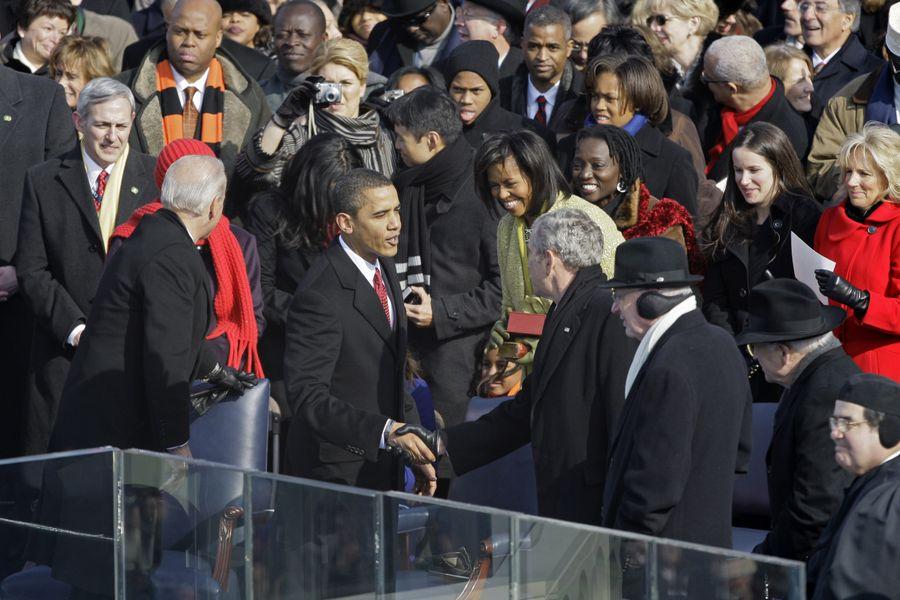
Obama Inauguration
Democratic Transitions
Published Sept. 7, 2023 • Read time: 6m
In the early 19th century, José Correia da Serra, a Portuguese polymath who’d befriended Thomas Jefferson, expressed the hope that the fledgling American government would be spared the consequences of its quarrelsome politicians’ many missteps. A priest, lawyer, diplomat, and naturalist, Abbe Correia mentioned “the special providence over the United States and little children.”
It’s an optimistic view, one cited in 1849 by prominent Pennsylvania Democrat Francis Wharton. Amplifying on this idea with another analogy, Wharton added, “That indisposition to resist or struggle, which permits a drunken man to roll down stairs unhurt, where a man in full health would be bruised and broken, is the great safety-guard of a new nation.”
Although it’s nicer to be compared to children than drunks, 21st century official Washington has neither crutch to fall back on – for the simple reason that we are no longer a new country.
So what’s our excuse today?
America is the most powerful nation on the planet, yet we continually waste our energy and credibility on counter-productive partisan quarrels. The recent fight over raising the debt limit is a classic example. It should not have been a fight at all. We have sensible legislative processes for determining federal spending; failing to meet financial obligations that we have already incurred is not one of them.
The complexity of democratic institutions encourages such antics. Our system may in the long run be better than the alternatives. But in a recklessly polarized political environment such as today’s, the costs seem high to the great mass of Americans, whose opinion of government has plummeted.
Lies, Assault and Cover-ups Don't Stop Donald Trump
Trump Stands by His Man; Obama on a Health Scourge; Hayden Interview; Reagan's Courage
Analysis: For Trump, Few Limits to Win-At-Any-Cost Approach
What If Clinton Isn't Indicted?
This is my first article as a staff columnist for RealClearPolitics, and it touches on one of the subjects I will explore in future columns: the persistent subversion of American democratic processes to score small political victories.
Rather than looking at what is wrong, however, this maiden column looks at a best-practice example of what can be done right to make democracy work. It may be reassuring to the many readers who want their government to bring order and efficiency to its operations.
I am referring here to a recently published book by the Brookings Institution. The venerable Washington, D.C., think tank was created in 1916 with precisely the idea of producing research to “strengthen democracy.” This book does that.
“Hand-Off: The Foreign Policy George W. Bush Passed to Barack Obama” is an artifact from recent White House history. The book collects 40 secret memoranda (declassified with some redactions) that were written by the National Security Council at the end of Bush 43’s second term. The memos summarized the administration’s assessment of and work on front-burner defense and diplomatic issues. Bush ordered these to be prepared in order to ease the incoming Democratic administration into the foreign policy driver’s seat.
The principal author and editor of the book is Bush’s national security advisor and director of the National Security Council Stephen J. Hadley. To make the memoranda in “Hand-Off” more useful to contemporary readers, Hadley and colleagues have written short background essays providing an update on what has happened in the nearly twelve years since Bush left office. The co-authors are Bush political appointees and distinguished career diplomats, such as Thomas Shannon, who served as undersecretary of state for political affairs in the Obama and Trump administrations.
“Hand-Off” is valuable as a primer on Bush foreign policy. The memoranda range from “Neglected Tropical Diseases,” to climate change, to terrorism, to foreign assistance. It takes nothing away from the memos that they make the best case for Bush’s policies, which Hadley argues “was not just about the war against terror but also about a democratic peace – a freedom agenda.”
The assessments and postscripts are sober and critical of the administration’s failures to meet such goals. They acknowledge, for instance, that the intervention in Iraq was based on flawed intelligence and inadequate appreciation for the need to make a long-term commitment to restoring a viable government.
The Obama administration could not have asked for a better foreign policy briefing document. But as useful as the memoranda were to the new government, the book is equally valuable as a model for presidential transitions generally. Written without fanfare, the memoranda are an object lesson in good government. “Hand-Off” should be a bible for every presidential administration.
Transition planning across the entire government has taken on greater importance over the years, and the Hadley exercise of 2007-2008 provided a model that has been built on since. In 2010 Congress mandated that the nominees for the two major political parties receive government-funded office space so they can plan for a smooth transition in the event they prevail at the polls. Five years later, another law required sitting presidents to assist with the transition planning, for instance preparing briefing memos, even if they were running for reelection themselves.
It is particularly critical that thoughtful transition planning is done in regard to foreign policy. This aspect of governance cries out for as much consistency as possible. Our allies look for reliable partners. Our enemies judge us by our resolve. Every new presidential administration has its own ideas on foreign affairs, but all need to know what has come before and build on the best of it.
Despite legislation that has sought to make them better, transitions do not always work well. It depends not only on the attitude of the departing president but also the attitude of the incoming one. Many thought the incoming Obama administration should have more quickly engaged with the departments it would soon manage. The Obama team received higher marks for preparing the transition to the Donald Trump administration, which in turn did not just drop the ball – it did not even pick the ball up.
Trump was so ill-prepared that he did not bother to write an acceptance speech in case he was elected. As journalist Michael Lewis has reported, many of his transition “landing teams” did not show up at their appointed offices for weeks. (We don’t need to refresh readers on Trump’s disorderly transition when he left office.)
As the United States enters the new race for president, we should not be satisfied with candidates scoring cheap points against the “deep state.” We need to ask how they are planning to execute the duties of the office they aspire to hold.

The GOP Majority Should Go Out in Glory
Daniel McCarthy • RealClearPolitics
Republican Majorities Could Return Sooner Than Expected
J.T. Young • RealClearPolitics
The Danger Before the Attack
Leslie J. Sullivan • RealClearPolitics
Jon Finer’s Old and Dangerous ‘New Approach’ to Israel
Peter Berkowitz • RealClearPolitics
The President Deserves Better
John Ullyot • RealClearPolitics
Congress Doesn’t Need Another Blame Game. It Needs To Find What’s Broken
Jarrod Bernstein • RealClearPolitics
RCP Today
Top stories on RealClearPolitics
The Takeaway
Polling intelligence and analysis delivered to your inbox
World News
Featuring the latest world news
Policy
Featuring the latest policy news
Support Our Mission
As part of RealClearPolitics, authors aim to provide balanced, non-partisan analysis by presenting top reporting and commentary from all sides of the political spectrum.
Trusted by policymakers and citizens alike since 2000