
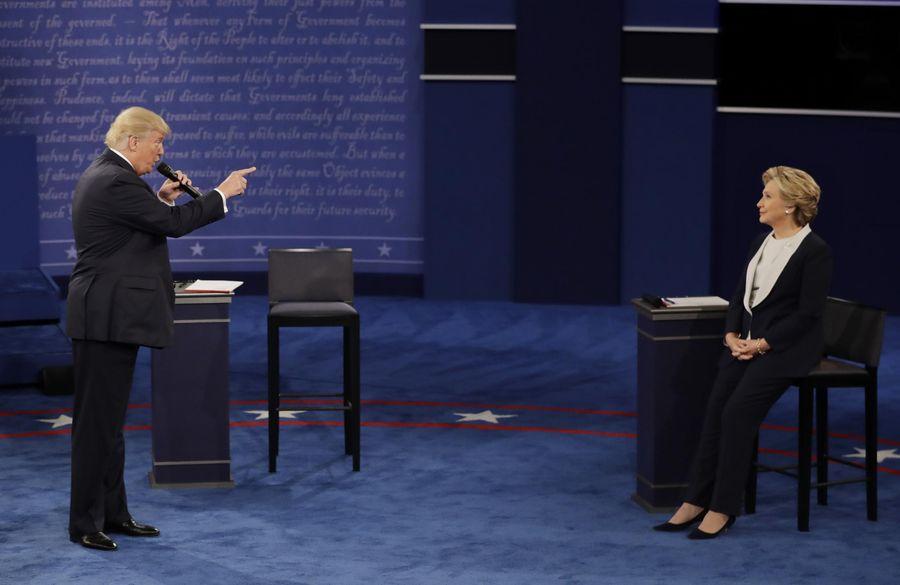
2016 AP YEAR END PHOTOS - Republican presidential nominee Donald Trump speaks to Democratic presidential nominee Hillary Clinton during the second presidential debate at Washington University in St. Louis, on Oct. 9, 2016. (AP Photo/Patrick Semansky, File)
Biden/Clinton vs. Trump: Comparing 2020/2016 Polling 'Gaps'
ANALYSIS
Published Aug. 20, 2020 • Read time: 5m
In mid-August of 2016, YouGov polling placed Hillary Clinton six percentage points ahead of Donald Trump among registered voters (41%-35%). Four years later, Joe Biden also leads Trump in mid-August YouGov polling -- only this time, the lead is about 10 points. Everyone knows what happened to Clinton’s late-summer advantage. Biden supporters naturally wonder whether their lead is any more secure.
One means of addressing this question is to examine how Biden is doing relative to Clinton with regard to four major “gaps” in American politics: the gender gap, the race gap, the age gap, and the education gap. Within each of these demographic areas, various groups differentiate between Democrats and Republicans at substantially different rates; those differences are what we refer to as “gaps.”
Table 1 shows these gaps in the 2008 to 2018 elections -- the numbers represent the percentage of each group that voted for the Democratic presidential candidate (or House candidate in midterm years). The largest of the four is the racial gap (i.e., the gap between white voters and non-white voters), which ranges from 32 points in 2018 to 42 points in 2008.
The latter came in the midst of Barack Obama’s first run for the presidency, with his candidacy turning out an extraordinary number of minority voters. The former was primarily the result of white voters favoring Democratic midterm candidates at higher rates than usual.
The second largest gap is between the youngest voters (below 30), and the oldest voters (65+), with the under-30 crowd being substantially more Democratic. That gap reached 21 points in 2008, when Obama’s campaign excited young voters.
Lies, Assault and Cover-ups Don't Stop Donald Trump
Trump Stands by His Man; Obama on a Health Scourge; Hayden Interview; Reagan's Courage
Analysis: For Trump, Few Limits to Win-At-Any-Cost Approach
What If Clinton Isn't Indicted?
The third and perhaps best-known gap is the gender gap: Women consistently vote Democratic while men more often favor the GOP. That gap runs from a high of 13 points in 2016 to a low of six in the Republican blowout of 2010. The final gap, education, is the newest. For decades, less-educated voters favored the Democratic Party at higher rates than those with a college education or better — but in recent years that trend has reversed. From 2008 through 2014 there was no education gap, but since then, college-educated voters have chosen Democratic candidates more frequently than have those without degrees.
The results for education, age and education differ somewhat among white voters, who tend to be more Republican across the board. Table 2 conveys these differences. The education gap appears to be considerably greater among white voters than it is among the voting population as a whole: 16 points in 2016 and 2018, as compared to 8/10 among the general electorate. The age gap, however, appears to be smaller, and the gender gap is largely unchanged.
Understanding these gaps helps to decode American elections. For one thing, they help explain why some better-educated suburban communities are trending toward the Democrats, and why older, rural areas favor the GOP. The size of these gaps will again be important in the 2020 election. Biden could win by increasing the gaps (getting already Democratic groups to vote for him at even higher rates) or decreasing the gaps among traditionally Republican constituencies.
Table 3 shows how mid-August 2020 Biden compares to mid-August 2016 Clinton with regard to the four gaps. The first column contains the percentage of voters who favored Clinton at this point in 2016, while the second displays Biden’s support right now. The third column highlights the difference between Biden and Clinton among each demographic group.
As the positive numbers in the third column show, Biden appears to have a significant advantage over Clinton. He is performing at least four points better among every group (with the exception of non-white voters) and has particularly substantial leads among under-30s and males. He seems to have narrowed both the gender and race gaps without losing significant support among non-white or female voters. If Biden maintains these improvements among more Republican groups, he should be well-positioned heading into the fall campaign.
Clinton’s 2016 campaign famously came up just short in Pennsylvania, Wisconsin, and Michigan -- three states that are whiter than the country as a whole. It is worth asking, then, how Biden is doing in 2020 compared to Clinton in 2016 among white voters. Table 4 shows the results. Across the board, Biden is significantly outperforming Clinton among white voters of all stripes; male or female, young or old, college-educated or otherwise, all seem more likely to support Biden than they were to favor Clinton. In every category (except 45-to-64-year-old, college-educated voters) Biden has double-digit advantage over Clinton’s mark. This lead includes a remarkable 33-point improvement among under-30 white voters.
Particularly encouraging to the Democrats is Biden’s gains among males and seniors, two blocs of white voters that overwhelmingly favored Trump in 2016. It seems that the angry older white men that Bill Clinton said cost his wife the 2016 election are not quite as angry this time around (or at least not at Biden).

The GOP Majority Should Go Out in Glory
Daniel McCarthy • RealClearPolitics
Republican Majorities Could Return Sooner Than Expected
J.T. Young • RealClearPolitics
The Danger Before the Attack
Leslie J. Sullivan • RealClearPolitics
Jon Finer’s Old and Dangerous ‘New Approach’ to Israel
Peter Berkowitz • RealClearPolitics
The President Deserves Better
John Ullyot • RealClearPolitics
Congress Doesn’t Need Another Blame Game. It Needs To Find What’s Broken
Jarrod Bernstein • RealClearPolitics
RCP Today
Top stories on RealClearPolitics
The Takeaway
Polling intelligence and analysis delivered to your inbox
World News
Featuring the latest world news
Policy
Featuring the latest policy news
Support Our Mission
As part of RealClearPolitics, authors aim to provide balanced, non-partisan analysis by presenting top reporting and commentary from all sides of the political spectrum.
Trusted by policymakers and citizens alike since 2000