
State of the Union
Biden Hopes SOTU Provides Much-Needed Reset
ANALYSIS
Published March 2, 2022 • Read time: 9m
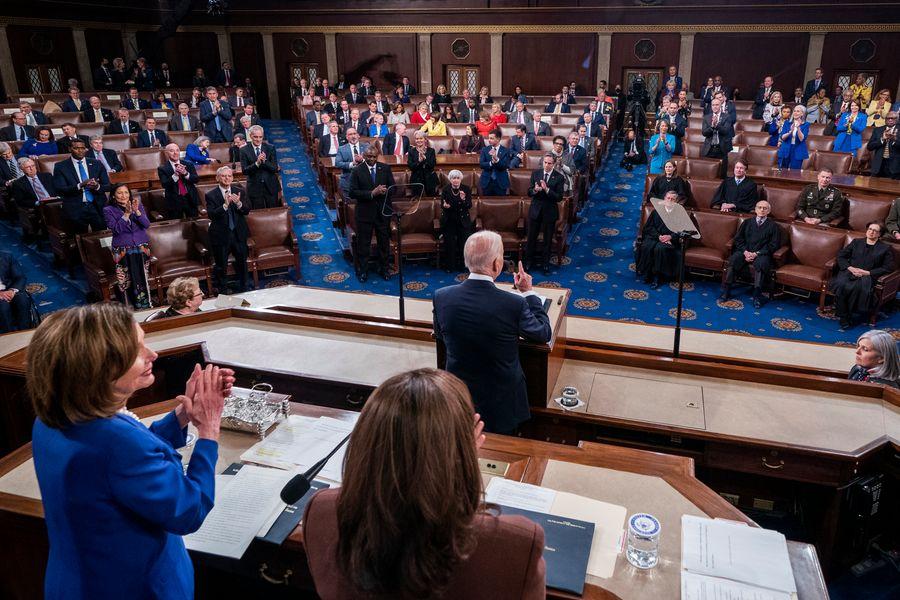
President Biden rarely stumbled during his first State of the Union address, although at times he did rush through his delivery. Ovations, some of them solidly bipartisan, were so frequent that at times he forgot to pause and ended up stepping on his own applause, plowing ahead to the next paragraph on his teleprompter before cheering lawmakers could even return to their seats – the best kind of problem for a White House beset by layered domestic and international crises.
The president began with Ukraine, bringing Republicans and Democrats to their feet early and often. Russian President Vladimir Putin “sought to shake the very foundations of the free people” and had thought “he could make it bend to his menacing ways,” Biden declared. “But he badly miscalculated.”
The West has rallied to the invaded nation instead, following the lead of the United States with diplomatic condemnations and biting sanctions aimed at Russia while vital military supplies flow to the Ukrainians. Putin would soon “pay a price,” Biden vowed, and to demonstrate American resolve he invited the joint session of Congress to stand and “send an unmistakable signal to the world” by honoring the Ukrainian ambassador to the United States sitting in the balcony. An otherwise bitterly divided Congress obliged, united in support of the ambassador sitting solemnly next to first lady Jill Biden and waiving a miniature blue-and-white flag that matched the outfits of many in the Congress below.
The State of the Union came as America watches a land war erupt in Europe for the first time since the administration of Franklin D. Roosevelt, a commander in chief whom Biden would very much like to emulate. And while congressional Republicans stall his domestic legislative agenda, as the GOP did in FDR’s time, Biden rallied them in condemnation of Putin, pledging to close U.S. airspace to Russian flights for the first time, vowing to seize the yachts and private jets of Moscow’s oligarchs, and promising that “freedom will always triumph over tyranny.”
Lies, Assault and Cover-ups Don't Stop Donald Trump
Trump Stands by His Man; Obama on a Health Scourge; Hayden Interview; Reagan's Courage
Analysis: For Trump, Few Limits to Win-At-Any-Cost Approach
What If Clinton Isn't Indicted?
The response on Capitol Hill was so positive it was easy to forget that Russian battalions were less than 20 miles outside Kyiv. On the domestic front, lines were similarly blurred. Democrats cheered Biden for reversals or rejections of policies many of them had held sacrosanct just months, if not weeks ago. The speech that lasted just over an hour was a pivot in prime time.
Absent Tuesday night was the divisive (and scientifically dubious) talk about a pandemic “of the unvaccinated.” Biden instead walked into the lower chamber, eight months after saying the rule was “vax-or-mask,” and pointed to new guidelines from the Centers for Disease Control which mean that “most Americans in most of the country can now be mask free.”
Kids need to be in schools. Workers, out of sweatpants and in the office. A “reset” was needed, he said, hours after the White House lifted its own mask mandate and as more liberal cities such as Washington, D.C. and New York City have been lifting their requirements for schools and indoor settings. “Stop looking at COVID as a partisan dividing line,” Biden said in words that sounded like a self-help mantra as well as advice to his countrymen. “See it for what it is: a God-awful disease. Let’s stop seeing each other as enemies. Let’s start seeing each other for who we are: fellow Americans.”
Republicans clapped.
Rejected explicitly was the “defund the police” mantra held dearly by many on the left. So that no one could conflate his views with those of progressives in his party, Biden again declared, “We should all agree that the answer is not to defund the police.” He was so emphatic about this point, he punctuated it with the phrase “Fund them!” three times, to ensure he could be heard over the roaring chamber.
“The answer is to fund the police with the resources and training they need to protect our communities,” he continued, noting how his American Rescue Plan had appropriated $350 billion to state and local governments to do just that. “So, let’s not abandon our streets, or choose between safety and equal justice. “Let’s come together to protect our communities, restore trust, and hold law enforcement accountable.”
More Republicans whooped.
Also missing from his repertoire last night was any of the previous talk about “surging to the border” asylum seekers, and in its place a call to shore up security on the southern boundary with Mexico. “We need to secure the border and fix the immigration system,” Biden said. “It’s not only the right thing to do – it’s the economically smart thing to do.” After the flow of migrants reached a decades-high level during his first year in office, Biden called on lawmakers to join him in getting security and citizenship reforms “done once and for all.”
Even more Republicans cheered.
Biden may have left some in the Grand Old Party disoriented. Ted Cruz nodded at times in agreement with the president, and the Texas senator did admit afterward that Biden “briefly acknowledged some of the challenges facing this country” such as immigration and energy, but complained that the president’s speech had been delivered through “rose-colored glasses.”
Tasked with giving the official Republican response immediately after the president wrapped, Iowa Gov. Kim Reynolds blasted Democrats for a porous border, hypocrisy over mask mandates, and their “defund the police” rhetoric. Only toward the end of her address did Reynolds, in a likely preview of Republican midterm arguments, meet the president on the footing he just laid out, charging that Biden had “tried to paint a different picture tonight, but his actions over the last 12 months don't match the rhetoric.”
Even before the president’s speech began, Mitch McConnell told reporters that his party was roughly aligned with Biden on Ukraine: “I think there’s broad support for the president in what he’s doing now.” The issue had been, the Senate minority leader qualified, “What took him so long?”
Biden likely relished all that applause as his motorcade returned to the White House. But what his party needs desperately, if Democrats are to avoid a shellacking in November, is a presidential polling bump. When he addressed Congress in April, Biden enjoyed a 53% approval rating according to the RealClearPolitics Average, a number that plummeted to 40% ahead of his first State of the Union.
Early polling after Tuesday’s address gave White House staffers, unmasked for the first time since last July, something to smile about in the selfies they posted online. A CBS News/YouGov poll taken after the remarks reported that while 22% disapproved of the president’s speech, a whopping 78% approved.
A single speech will not erase all the challenges the country now faces, least of all inflation, which has reached a 40-year high. Biden promised that getting prices under control was “my top priority.” He again blamed kinks in the supply chain and called on Congress to pass his stalled Build Back Better legislation, which he seemed to rename “Building a Better America,” while promising again that the repackaged proposal would “ease long-term inflationary pressures.”
Some of the blame for high energy prices belonged to Putin, Biden said, while making the point that his administration’s harsh economic sanctions against Russia were meant to target the Russian economy, not the American consumer. Toward that end, and as pain at the pump worsens, he announced that the United States, in cooperation with 30 other countries, would release 60 million barrels of oil from reserves worldwide, steps meant to “blunt gas prices here at home.”
Biden urged Americans to look past that pain and pointed to the 6.5 million new jobs created during his tenure as evidence of a vibrant economy – “more jobs created in one year than ever before in the history of America.” What was needed, he insisted, was a rejection of fiscal conservatism, specifically the Reagan-era “trickle-down theory,” which he argued led to a weaker economy and greater inequality. In its place, the president proposed a “new economic vision for America,” illustrated by the proposed $250 billion Innovation Act. Pass it, he told lawmakers, and the CEO of Intel who was sitting in the balcony as a guest of the first lady would boost the company’s planned domestic investment from $20 billion to $100 billion, thus trickling down to create thousands of jobs.
To further aid in the recovery, Biden also unveiled for the first time a new “test-to-treat" strategy. After aggressively backing vaccine mandates, the president’s new program will allow people who test positive for COVID to receive antiviral pills “on the spot” at their pharmacy “at no cost.”
Biden spoke for 64 minutes, returning to the White House well before midnight and leaving behind the National Guard who manned the fencing surrounding Capitol Hill. Notably, he never mentioned the reason for the extra security measures: the Jan. 6 riot. He also glossed over his party’s doomed voting rights reforms. Much else was absent, too, especially on foreign policy.
Other than accidentally referring to the Ukrainian people as “Iranians,” Biden didn’t mention Iran or the nuclear deal his administration is pursuing with that hostile country. He didn’t mention North Korea either. China was name-checked twice, but only briefly. The Afghanistan war, which ended in a chaotic withdrawal and precipitated his drop in the polls beginning last September, was a blip on the radar.
Biden received plenty of applause, though, for what he did highlight, and his allies are now left to hope that the State of the Union address will both reset his term and revive his popularity. The speech didn’t seem to change one critical mind, though. Sen. Joe Manchin, a Democratic swing vote who sat with Republicans last night, seemed to shrug his shoulders when asked about the president’s attempt to refurbish his legislative agenda.
“They just can’t help themselves,” Manchin joked when reporters asked about the attempted revival. “I don’t know where that came from,” he quipped of the rebranding, before concluding that, at least on his end, “Nothing’s changed.” Despite their applause, little has likely changed in Republican minds either.

The GOP Majority Should Go Out in Glory
Daniel McCarthy • RealClearPolitics
Republican Majorities Could Return Sooner Than Expected
J.T. Young • RealClearPolitics
The Danger Before the Attack
Leslie J. Sullivan • RealClearPolitics
Jon Finer’s Old and Dangerous ‘New Approach’ to Israel
Peter Berkowitz • RealClearPolitics
The President Deserves Better
John Ullyot • RealClearPolitics
Congress Doesn’t Need Another Blame Game. It Needs To Find What’s Broken
Jarrod Bernstein • RealClearPolitics
RCP Today
Top stories on RealClearPolitics
The Takeaway
Polling intelligence and analysis delivered to your inbox
World News
Featuring the latest world news
Policy
Featuring the latest policy news
Support Our Mission
As part of RealClearPolitics, authors aim to provide balanced, non-partisan analysis by presenting top reporting and commentary from all sides of the political spectrum.
Trusted by policymakers and citizens alike since 2000