
Israel Politics
Restoring Conditions in Israel That Make Compromise Viable
COMMENTARY
Published Sept. 3, 2023 • Read time: 8m
Join the Conversation
0TEL AVIV—The security, stability, and prosperity of a pluralistic, rights-protecting democracy depend on citizens’ disposition to compromise. A nation’s success in securing outcomes that may satisfy no camp entirely but with which all can live represents a substantial political achievement. It stems in significant measure from the people’s commitment to widely held norms and principles and their shared sense of participating in a common enterprise that transcends the interests of this group or that tribe.
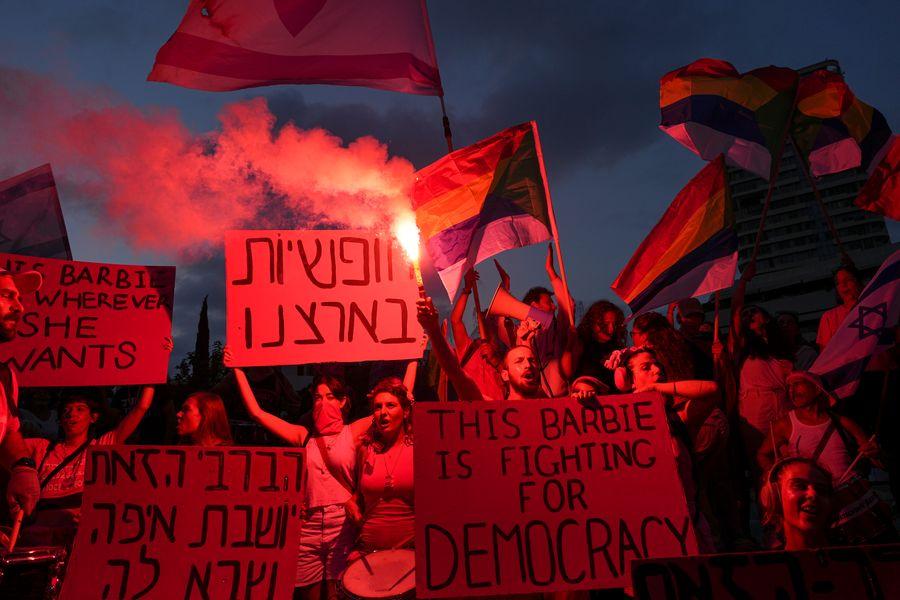
These tried-and-true maxims apply to the rights-protecting and democratic nation-state of the Jewish people. Yet since early January, when Israeli Prime Minister Benjamin Netanyahu’s coalition government proposed sweeping judicial reforms – prompting tens of thousands to take to the streets every Saturday night for almost eight months and counting – prominent voices on both sides have disparaged compromise as ignominious defeat. The retreat to the extremes presents a serious internal threat to Israel’s security, stability, and prosperity.
Many supporters of Netanyahu’s governing coalition reject further compromise in reining in what many – and not only conservatives – regard as Israel’s hyper-activist supreme court. In the judgment of Netanyahu’s allies, the compromises that have already been forced upon their camp amount to surrender to arrogant elites unwilling to accept their inability to win elections and mark a betrayal of the democratic principle of majority rule. Plenty of Netanyahu’s supporters are determined to remember the indignity and, when political circumstances allow, to exact revenge.
Nuclear Jihad: The Threats Are Inside Our Tent
Israel's "Sorrow of the Left"
Signs of Progress Against Extremists in Syria
The World Is Getting Worse, But This Time America Won't Save It
Meanwhile, many opponents of the governing coalition’s judicial overhaul remain adamant that further compromise in preventing what they call regime change is out of the question. That’s because, they believe, the Netanyahu government seeks not merely to extinguish the high court’s independence. The larger goal, opponents contend, is to prevent the court from interfering with two policies that, according to the opposition, imperil Israel’s free and democratic character: application of Israeli sovereignty to Judea and Samaria, which would incorporate 2.5 to 3 million West Bank Palestinians into the Jewish state, and entrenchment of exemptions from the normal obligations of Israeli citizenship, including military service and gainful employment, for the rapidly growing ultra-Orthodox community.
Mutual contempt is consuming the nation’s common ground. Many on both sides advance compelling arguments for their positions while denying legitimacy to the other’s concerns. Many on both sides express anger and resentment at how their communities have been disrespected while turning a deaf ear to the other’s wounds and grievances. Many on both sides have resolved to mount a last stand in defense of the nation they love while denouncing opponents as intransigent foes who pose an existential menace to the country.
In “Israel’s Elites Revolt Against Democracy,” my friend Gadi Taub – a bestselling author in Israel as well as a historian, journalist, and podcast and radio talk-show host – forcefully states the governing coalition’s case. “The protest movement that arose to defend the court’s power (and its backers among the country’s economic and military elite) are together attempting to block the redemocratization of Israeli politics, as the reforms intended to do,” he maintains. The protesters’ real goal, according to Taub, is to oust Netanyahu. Reservists declining to report to duty and warnings by retired commanders, including former chiefs of staff and heads of the Mossad and Shabak (Israel’s internal security service), about declining morale constitute an unfolding “military coup,” in Taub’s judgment. Opposition to the recently passed curtailment of the court’s ability to invalidate ministerial actions and appointments as unreasonable “is not about saving Israel from a future theocratic right-wing dictatorship,” he writes. “It is about releasing Israel’s democracy from the already existing juristocratic rule.”
Taub anticipates a protracted struggle. “The road to freeing Israeli democracy from the tyranny of the country’s Supreme Court and its auxiliaries is going to be long and difficult,” he asserts. “This is not only because the court is not going to give up any of its powers voluntarily. It is also because Israel’s progressive elite rules through the court, and it is now thrashing wildly, threatening to burn the house down, tear the army apart, weaponize the law, and bring economic ruin in the country, if the plebs dare to challenge the patricians’ juristocracy.”
Taub’s condemnation of Israel’s high court and censure of the opposition reflect important issues of judicial overreach and opposition zeal. Yet only some – probably a small minority but including well-known figures – among the protesters fit his withering description of progressive authoritarians. The bigger problem is that treating Israel as a pure democracy despite its founding as a rights-protecting democracy skews Taub’s analysis.
First, Taub gives the impression that Netanyahu’s governing coalition secured an unambiguous mandate to undertake far-reaching judicial reform, yet the democratic legitimacy of the coalition’s ambitions to substantially alter the relation between government branches is dubious. Notwithstanding opposition leaders’ fears, Netanyahu scarcely mentioned judicial reform during last autumn’s campaign. Nor did he make an issue of the judiciary in the previous four elections Israel has held since the beginning of 2019 or, for that matter, as prime minister from 2009 to 2019. Netanyahu’s coalition, moreover, lacks a mandate for sweeping change of any sort. Last November, his bloc won the opportunity to form a coalition thanks to a mere 30,000-vote margin, garnering 49.57% of the total votes (some 300,000 ballots cast for the left-wing party Meretz and the Arab party Balad were wasted because they received too few to qualify for representation in the Knesset). And for several months the polls have indicated that a majority opposes the coalition’s reforms and supports the opposition.
Second, Taub neglects the paucity of the Israeli political system’s checks and balances. Israel not only lacks a written constitution; it is also bereft of a meaningful separation between the legislative branch and the executive branch: In practice, the prime minister heads both. In “The Federalist, No. 47,” James Madison, following “the celebrated Montesquieu,” argued that when any two of the three principal powers of government are placed in a single department “the fundamental principles of a free constitution are subverted.” While thoughtful opposition observers agree with the right that reform of Israel’s highly assertive judiciary is imperative, Israel particularly needs a strong and independent high court to check abuse of power because its executive and legislative branches largely function as a unit.
Third, Taub overlooks the teaching as old as Aristotle and adapted for modern rights-protecting democracies by “The Federalist Papers” that the worthy democratic principle of majority rule must be tempered by combining it with other worthy political claims. One general limitation on majority will is the protection of individual rights. A specific implication in the Israeli context of the imperative to harmonize the competing interests and principles in the nation is that regarding major reform of basic governmental institutions, the concerns of the country’s tech sector and entrepreneurial class, which have become vital to Israeli prosperity, and of its people’s army, which is indispensable to Israel’s security, must be taken into account rather than derided.
Fourth, while facing a generally progressive permanent bureaucracy, media establishment, and system of higher education, the right in Israel cannot persuasively portray itself as a victim incapable of translating election victories into political achievements because of an imperial court and its bureaucratic, media, and academic enablers. One need look no further than Netanyahu’s authoritative assessment. Last year, in “Bibi: My Story,” Israel’s longest-serving prime minister celebrated, and rightly so, his fostering of a prosperous economy, which sustains a powerful military that has buttressed the nation’s diplomacy. Furthermore, Netanyahu’s current coalition partners have effectively pursued their long-term political aims with his Likud party’s assistance. Ultra-nationalist members of Finance Minister Bezalel Smotrich’s Religious Zionist party and of National Security Minister Itamar Ben-Gvir’s Otzma Yehudit party have seen Jewish settlement in Judea and Samaria steadily expand. Meanwhile, the ultra-Orthodox have won increased state subsidies for their community’s separatist way of life while maintaining control over the Chief Rabbinate, which exercises jurisdiction over Jewish marriage and divorce, Jewish burial and conversion, Jewish immigrants, and more.
In “Israel is in danger from a radicalized Center,” Yedidia Stern acknowledges his side’s extremism. An opponent of the coalition’s judicial reforms – and Jewish People Policy Institute president and Bar-Ilan University law professor – Stern warns that notwithstanding his sympathy for their anguish, volunteer reservists refusing to report for duty, doctors planning to emigrate, and those calling for the cantonization of Israel destabilize the nation and undercut the Zionist commitment to provide a home for all Jews in a free and democratic Israel. One could add to Stern’s list of dangers those who encourage intimidation of lawmakers and ministers through threats of, or actual, violence.
The coalition and opposition are on track for a head-on collision on Sept. 12 when all 15 supreme court judges hear appeals of the new restrictions on the court’s use of the reasonableness doctrine. To avoid a genuine constitutional crisis, the court must find ways to both uphold the rule of law and to author restraints on its own excesses. And Netanyahu must honor his post-election promise to “set up a national government that will look after all the citizens of Israel, without exception, because the state is all of ours” by concentrating his formidable intelligence and political talents on restoring conditions in Israel that make compromise viable.

The GOP Majority Should Go Out in Glory
Daniel McCarthy • RealClearPolitics
Republican Majorities Could Return Sooner Than Expected
J.T. Young • RealClearPolitics
The Danger Before the Attack
Leslie J. Sullivan • RealClearPolitics
Jon Finer’s Old and Dangerous ‘New Approach’ to Israel
Peter Berkowitz • RealClearPolitics
The President Deserves Better
John Ullyot • RealClearPolitics
Congress Doesn’t Need Another Blame Game. It Needs To Find What’s Broken
Jarrod Bernstein • RealClearPolitics
RCP Today
Top stories on RealClearPolitics
The Takeaway
Polling intelligence and analysis delivered to your inbox
World News
Featuring the latest world news
Policy
Featuring the latest policy news
Support Our Mission
As part of RealClearPolitics, authors aim to provide balanced, non-partisan analysis by presenting top reporting and commentary from all sides of the political spectrum.
Trusted by policymakers and citizens alike since 2000