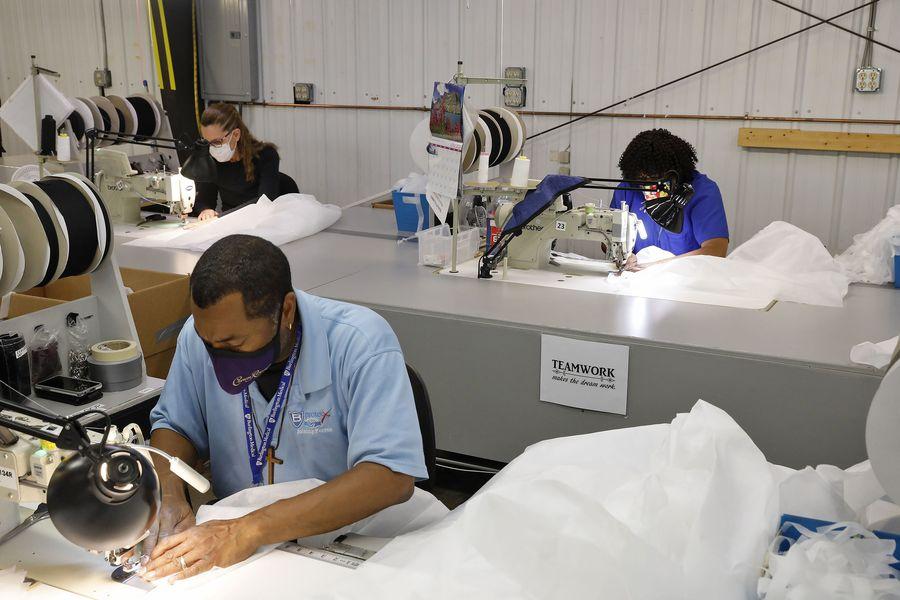
Employees at Burlington Medical in Newport News sew disposable gowns Wednesday, May 6, 2020. The manufacturing business recently shifted from producing radiation protection gear for medical facilities to in-demand personal protective equipment such as masks, gowns and plastic face shields. (Jonathon Gruenke/The Virginian-Pilot via AP)
COVID-19 and the Defense Industrial Base
COMMENTARY
Published May 13, 2020 • Read time: 4m
A number of apt analogies have been made between the current COVID-19 crisis and 9/11, including our appreciation and admiration for those on the front lines to keep the rest of us safe. Like 9/11, this threat seemed to come at us suddenly, and we were not as ready as we could have been. I observed a tabletop exercise in the aftermath of 9/11 which revolved around terrorists spreading a livestock disease that brought much of the nation’s economy to a standstill. We have known that the spread of a pathogen, whether intentional or not, could inflict significant damage on the country. But still, we are playing catch up. What about the next time?
In some ways, a more appropriate historical comparison for our current situation may be World War II. That was the last time the entire nation was so deeply affected by emergency measures deemed necessary to fight a threat to our country. The civilian economy faced rationing, price and wage controls, and factories were converted to manufacture war weapons and materiel.
According to Arthur Herman’s Freedom Forge, those responsible for war production knew that the key to winning was “America’s free enterprise system. That meant keeping the drive for war production as voluntary as possible, so that the right incentives – which included the profit motive – found the right people to do the job.” It took a while to make the transition, but once they did, American industry produced “two-thirds of all Allied military equipment used in World War II.”
Manufacturing Our Way to an American Comeback
Why Do Democrats Hate American Manufacturers?
To Government, Every Penny Is Sacred
Obama's Manufacturing Speech in Asheville
COVID-19 demonstrates one kind of threat to American national security and our people. But we expect the government to have the country as prepared as possible against all of the different kinds of national security threats, including those we do not see coming. As in the past, being ready for future threats requires having a healthy, agile industrial base that can ensure those on the front lines have what they need to defend and protect us. That includes traditional defense suppliers, but it must extend to non-traditional companies, as well. Protecting the country is no longer just a question of tanks, ships, and planes, as we have seen.
To have a healthy defense industrial base demands at least three things. One is to pay attention and know what the state of the industrial base is. Congress has previously required several reports on this topic, but we all probably underestimate the fragility of the supplier-and-subcontractor layer, which is largely small and medium-sized businesses. We need to keep our finger on the pulse of those we must count on in time of need and follow the readiness of our industrial base as closely as we follow the readiness of our military units.
Secondly, we need stable, reliable funding. The recent history of defense spending being used as a political football is well-known. Without predictable, on-time funding, no industry can keep the necessary expertise on the payroll or make the needed investments upon which we rely in an emergency.
Thirdly, with the transparency and appropriate oversight that must accompany such funding, we need more flexibility and less prescriptive regulation than we have now. Just as world events and the evolution of threats move quickly, we must be able to move faster in making funding adjustments to meet needs and opportunities.
Plus, many of the companies upon which we depend to meet national security threats also compete in the commercial market. The burden imposed by congressional restrictions and Department of Defense regulations too often makes them choose between government and commercial markets. We cannot protect our people if many of our most capable people and companies are on the sidelines.
Congress has made a number of changes to DOD’s acquisition system in recent years, and program managers at DOD have been more willing to utilize those authorities with some impressive successes. I have some additional proposals to offer this year. But this effort must be continual. The world does not wait for us to catch up, and DOD is still a long way from moving at the speed with which the threats are coming at us.
With COVID-19, the healthier an individual is going in, the better the chance of the surviving the disease. The healthier our defense industrial base, the better our country can weather and respond to the inevitable national security shocks to come. The time to prepare is now.

Newsom Defies Voters, Juries and Lawmakers To Spare Murderers While Defending Abortion
Curtis Hill • RealClearPolitics
The Algorithmic Tilt
Frank Filingeri • RealClearPolitics
A RealClear Thanksgiving: Investing in a Better Future
David DesRosiers • RealClearPolitics
Trump’s Newsom Problem: Antagonist-in-Chief
Carolina Lumetta • RealClearPolitics
America’s Free Spirit
John Maxwell Hamilton • RealClearPolitics
The GOP Majority Should Go Out in Glory
Daniel McCarthy • RealClearPolitics
RCP Today
Top stories on RealClearPolitics
The Takeaway
Polling intelligence and analysis delivered to your inbox
World News
Featuring the latest world news
Policy
Featuring the latest policy news
Support Our Mission
As part of RealClearPolitics, authors aim to provide balanced, non-partisan analysis by presenting top reporting and commentary from all sides of the political spectrum.
Trusted by policymakers and citizens alike since 2000