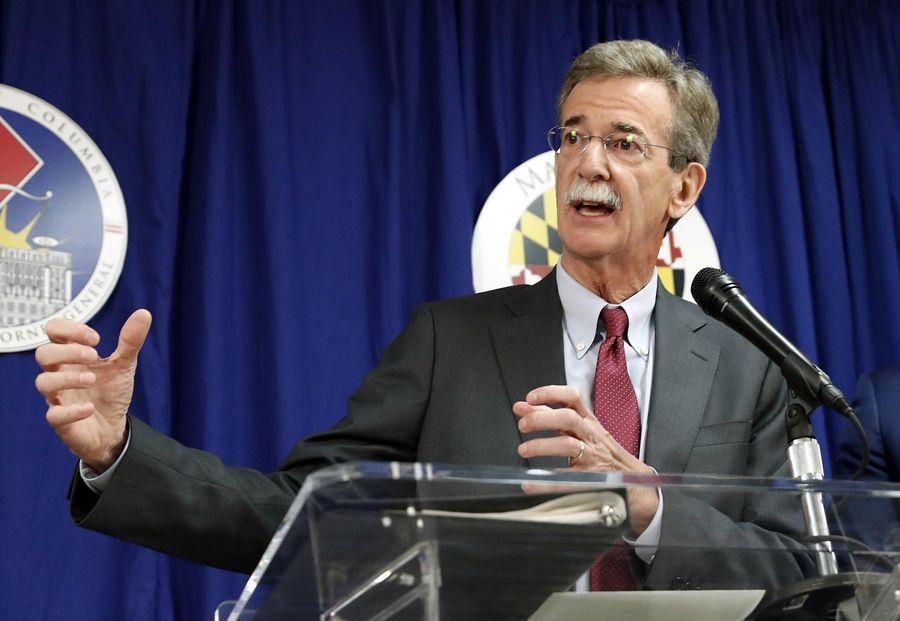
FILE - In this June 12, 2017 file photo, Maryland Attorney General Brian Frosh speaks during a news conference in Washington. A spokeswoman for Frosh says the state is suing the U.S. Environmental Protection Agency for failing to act on a petition requiring power plants in five upwind states to reduce pollution. (AP Photo/Alex Brandon, File)
To Fix Our Democracy, First End Gerrymandering
COMMENTARY
Published Jan. 23, 2019 • Read time: 4m
I have known Brian Frosh for many years, long before he became Maryland’s attorney general. He is smart, kind and humble, and even though we do not share every political opinion or belong to the same political party, I have financially supported several of his campaigns. I now fear that, due to his role in Maryland’s gerrymandering case to be heard by the Supreme Court, my friend Brian may go down in the history books as a villain.
Americans are deeply frustrated and disenfranchised by our current political system. According to a recent Pew Poll, six out of 10 Americans believe that we need sweeping changes in our government, while American faith in our government remains at historical lows. Gerrymandering, the pervasive practice of drawing congressional districts for political purposes, owns a great deal of responsibility for the dysfunction of our government and the loss of trust among Americans in their government.
In Maryland, for example, congressional districts have been drawn to blatantly benefit the Democratic Party, and have resulted in much more extreme representation. If our state’s eight House seats were divided proportionally – that is to say, if they represented the entire spectrum of Maryland voters -- our congressional delegation would consist of: one far-left Democrat, four moderate Democrats, one independent, two moderate Republicans, and one far-right Republican. Instead, after the districts were redrawn under Democratic Gov. Martin O’Malley, who admitted doing so to most effectively elect party members, the state is represented by six far-left Democrats, one moderate Democrat, and one far-right Republican. In other words, instead of the five seats they should hold, Democrats control seven. Worse yet, instead of six moderates and two extremists, we have one moderate and seven extremists. Similar dynamics exist in most states, with predictable results: poisonous partisanship on Capitol Hill.
Gavin Newsom's Misguided Redistricting Initiative
A Warning Against the Overuse of Sanctions
Open The Books on the California State Checkbook
Senate Passes Bill Addressing Heroin, Opioid Crisis
How does this happen? It starts with Congressional District 1, which was drawn by Democrats to put as many Republican voters as possible into one jurisdiction, resulting in the election of Andy Harris, an arch-conservative member of the Freedom Caucus. Six of the other seven districts were drawn to be safely Democrat, which means that the most liberal Democrat usually wins the primary and coasts through the general election. The only somewhat contested district is the 6th.
Today, the fight to end gerrymandering is moving to the forefront of the national debate about how to save our democracy. Last week, the U.S. Supreme Court announced that it would take up cases on the gerrymandered congressional districts in Maryland as well as in North Carolina, which together may lead to consequential decisions on the constitutionality of gerrymandering. In Maryland, Brian Frosh is appealing the verdict of federal judges who determined that the current congressional map was improperly drawn by the Democrats in 2010 with the intent to break up a Republican-leaning seat.
While the state attorney fights to maintain the status quo, 71 percent of Americans want to end gerrymandering. Organizations such as FairVote and Represent.Us have built enthusiastic networks of political reformers eager to change the system for the better. Apparently, because Frosh feels that Republicans are guilty of skewing elections in places like Texas and Wisconsin, he believes he must do the same in Maryland to serve his party’s interests. While he is correct that Republicans do the same thing elsewhere, he should choose to fight gerrymandering nationally rather than to preserve partisan advantage in Maryland.
With the Supreme Court preparing to hear arguments, Frosh should instead propose standards for how elected officials in charge of redrawing congressional districts must perform their duties. The court should strike down redistricting done for partisan advantage, including upholding the ruling in Maryland, and should suggest independent commissions or computer algorithms to draw districts. If the Supreme Court chooses not to set such a standard, Congress should use the legislative process to reform our elections. Under the Constitution’s Elections Clause, Congress has the authority to set rules on redistricting, such as the CLEAN Act in 2017, which required states use of an independent, nonpartisan commission when redrawing districts. Whether by a court ruling or by legislative action, the elimination of gerrymandering would be a victory for our nation -- not for any one political party -- and would have a profound impact in the fight to fix our democracy.

Newsom Defies Voters, Juries and Lawmakers To Spare Murderers While Defending Abortion
Curtis Hill • RealClearPolitics
The Algorithmic Tilt
Frank Filingeri • RealClearPolitics
A RealClear Thanksgiving: Investing in a Better Future
David DesRosiers • RealClearPolitics
Trump’s Newsom Problem: Antagonist-in-Chief
Carolina Lumetta • RealClearPolitics
America’s Free Spirit
John Maxwell Hamilton • RealClearPolitics
The GOP Majority Should Go Out in Glory
Daniel McCarthy • RealClearPolitics
RCP Today
Top stories on RealClearPolitics
The Takeaway
Polling intelligence and analysis delivered to your inbox
World News
Featuring the latest world news
Policy
Featuring the latest policy news
Support Our Mission
As part of RealClearPolitics, authors aim to provide balanced, non-partisan analysis by presenting top reporting and commentary from all sides of the political spectrum.
Trusted by policymakers and citizens alike since 2000