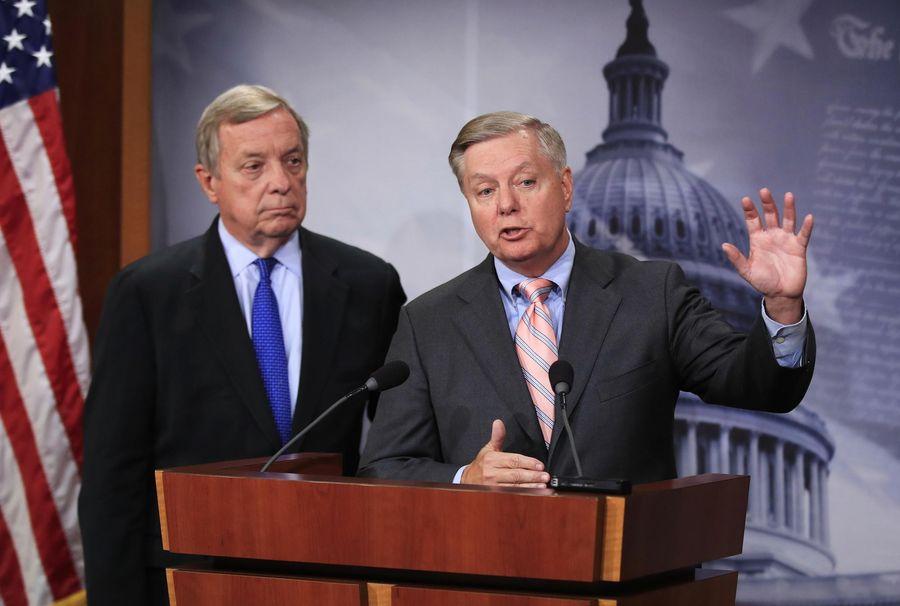
Sen. Lindsey Graham, R-S.C., right, with Sen. Dick Durbin, D-Ill., speaks during a news conference on Capitol Hill in Washington, Tuesday, Sept. 5, 2017, to discuss their bipartisan Dream Act, which would allow young immigrants who grew up in the United States to earn lawful permanent residence and eventually American citizenship. (AP Photo/Manuel Balce Ceneta)
Storms and Crises Trigger a Breakout of Bipartisanship
Commentary
Published Sept. 8, 2017 • Read time: 6m
It came suddenly, like the high winds and water, but cooperation between Republicans and Democrats has burst forth unexpectedly, and after spending much of his seven-plus months in office playing divisively to his base, even President Trump has joined in the fun.
A nation heartbroken by the devastation and loss wrought by historic storms, and frustrated by a dysfunctional Congress and chaotic executive branch, is -- at least for the moment -- seeing relief and results. Disaster funding is being dispatched by the government with more to come, committed members of both parties are working on a way to repair Obamacare and stabilize the fragile exchanges after Senate Republicans failed to repeal and replace the law, there is bipartisan consensus behind passing a bill to legalize the status of “Dreamers,” and Republicans and Democrats have joined to urge the Supreme Court to eliminate gerrymandering when the court rules on a case in October.
The American people “want to see a coming together,” the president said this week, shortly after agreeing to a Democratic spending plan to cover hurricane relief, government operations and the debt ceiling for another three months, and indicating his support for a plan Senate Minority Leader Chuck Schumer proposed to end the debt ceiling altogether. Trump’s embrace of the “losers” and “obstructionists” in Congress came just one day after his administration ended the Deferred Action for Childhood Arrivals program started under President Obama. The bipartisan backlash, including from titans of the business community, was swift and fierce, and Trump retreated with a tweet just hours after his own attorney general had deemed the program unconstitutional, pledging he would “revisit” the issue if Congress failed to act.
Gavin Newsom's Misguided Redistricting Initiative
A Warning Against the Overuse of Sanctions
Open The Books on the California State Checkbook
Senate Passes Bill Addressing Heroin, Opioid Crisis
On Wednesday Trump stunned both Republican and Democratic congressional leaders in an Oval Office meeting by taking the first offer Democrats made on a funding bill, and he assured leaders of his intent to sign legislation legalizing status for DACA recipients. And while Trump’s new bipartisanship is unorthodox and a bit unfriendly, given that it involves kicking his own party in the stomach, it is still -- albeit in Trumpian fashion -- technically a reach across the aisle.
Thursday morning Trump woke up with bipartisan fever and called Schumer and House Minority Leader Nancy Pelosi to gush over the positive reviews the deal he gave them was getting on cable news shows. Pelosi expressed concern about DACA again, asking Trump if he could assure the Dreamers that they are free from deportation while the Congress mulls a solution. Soon Trump tweeted out such a statement, though it isn’t entirely factual since Dreamers can lose their protected status if they don’t apply for renewals by Oct. 5, but he wrote that their status is safe for six months: “You have nothing to worry about - No action !”
Pelosi seemed stunned that her appeal had worked. “This is what I asked the president to do and, boom boom boom, the tweet appeared,” she said. Trump, reportedly conflicted over the DACA dilemma, had tried to slice it in half, appealing to his voters who wanted the repeal he promised during the campaign while falling short of actually deporting the more than 800,000 people who had been brought here as children -- more than half before they were 6 years old -- to countries they had never known.
After Attorney General Jeff Sessions called the program “unilateral executive amnesty,” Trump told reporters, “I have a love for these people and now Congress will hopefully be able to help them and do it properly, and I can tell you, speaking to members of Congress, they want to be able to do something and do it right.” Sure enough, members of both parties rushed to the cameras to promise legislation that would stop deportation of the Dreamers. Republican Sen. Lindsey Graham and Democratic Sen. Dick Durbin have their DREAM Act, which Republican Sen. Cory Gardner and his Colorado Democratic colleague Sen. Michael Bennet jumped on board. In addition, GOP Rep. Carlos Curbelo has authored the Recognizing America’s Children Act, Democratic Rep. Luis Gutierrez has the American Hope Act and Republican Rep. Mike Coffman offered up the BRIDGE Act (Bar Removals of Individuals Who Dream and Grow Our Economy).
While Senate Majority Leader Mitch McConnell hasn’t indicated he wants to bring up a bill in the Senate, he is about the only high-profile Republican dodging the issue. House Speaker Paul Ryan has said the Congress should act, business leaders are begging for a fix, and a bipartisan group of former education secretaries said in a letter that failure to reverse Trump’s action would “undermine faith in our country’s immigration system, and make it harder to enforce our laws. It would create a gaping hole in our economy, disrupt our communities, and make it infinitely harder to strengthen our immigration system and protect our country.”
As GOP Sen. Lamar Alexander and Democratic Sen. Patty Murray lead an effort in the Health, Education, Labor and Pensions Committee to reform the Affordable Care Act, incorporating consensus provisions drafted by the Problems Solvers Caucus in the House, off-the-record coffees are being held for members before hearings to foster further conversation across the aisle. A bipartisan group of governors, led by Ohio’s John Kasich and Colorado’s John Hickenlooper, is weighing in to support plans to provide permanent cost-sharing subsidies, a reinsurance program with state and federal burden sharing, and flexibility for states.
Governors and former governors have also collected support from current and former members of Congress -- from the Freedom Caucus to the Progressive Caucus -- to fight gerrymandering.
Former California Gov. Arnold Schwarzenegger is collecting heavyweight support for the amicus brief he is filing with the Supreme Court in the Gill v. Whitford case it will hear in October that could end gerrymandering. Kasich signed on, tweeting: “gerrymandering restricts voters’ ability to hold our leaders in check.” Sen. John McCain filed a separate brief, joined by Democratic Sen. Sheldon Whitehouse. In it they wrote that voters are increasingly concerned the political system is rigged by gerrymandering. “They see its mischief, and absent a legal remedy, their sense of powerlessness and discouragement has increased, deepening the crisis of confidence in our democracy. We share this perspective.”
Elected officials are stepping back from the partisan breach, working together to mitigate crises, solve problems and restore trust in public service. As rapidly as this new comity surfaced it could race right back out the door -- boom, boom, boom. But while it’s here it should be lauded and rewarded.

Newsom Defies Voters, Juries and Lawmakers To Spare Murderers While Defending Abortion
Curtis Hill • RealClearPolitics
The Algorithmic Tilt
Frank Filingeri • RealClearPolitics
A RealClear Thanksgiving: Investing in a Better Future
David DesRosiers • RealClearPolitics
Trump’s Newsom Problem: Antagonist-in-Chief
Carolina Lumetta • RealClearPolitics
America’s Free Spirit
John Maxwell Hamilton • RealClearPolitics
The GOP Majority Should Go Out in Glory
Daniel McCarthy • RealClearPolitics
RCP Today
Top stories on RealClearPolitics
The Takeaway
Polling intelligence and analysis delivered to your inbox
World News
Featuring the latest world news
Policy
Featuring the latest policy news
Support Our Mission
As part of RealClearPolitics, authors aim to provide balanced, non-partisan analysis by presenting top reporting and commentary from all sides of the political spectrum.
Trusted by policymakers and citizens alike since 2000